

Most lifters eventually learn that a sore muscle is not automatically a bad sign. A first session back after time away, a new split squat, a longer range of motion, or a harder eccentric phase can leave a familiar stiffness the next day. That pattern is usually called delayed onset muscle soreness, or DOMS.
But “I am sore” is not a diagnosis, and it should not become a reason to dismiss every symptom after training. Normal soreness has a context, a pattern and a direction. It follows a recognizable training stress, feels like a broad muscular response rather than a sudden incident, and gradually allows normal movement to return. When pain, function or whole-body symptoms stop fitting that pattern, it is time to stop treating the problem as ordinary recovery.
This article is a general safety guide, not medical assessment. It cannot tell you what a specific symptom means. If you are unsure, or if symptoms are severe or concerning, stop activity and seek appropriate medical care.
- What an ordinary soreness pattern can look like
- Why context matters more than toughness
- Changes that should stop a training session
- Urgent warning signs that need medical care
- How to return to useful training decisions
Normal soreness has a recognizable story
DOMS commonly follows unfamiliar or unusually demanding exercise, especially work with a strong eccentric component. It often develops after the session rather than at one precise moment during a repetition. Stiffness, tenderness and a temporary reduction in comfortable range can make stairs or a warm-up feel different for a day or two.
A 2019 review of DOMS mechanisms and diagnostics describes symptoms as typically delayed, with soreness often peaking around 48 to 72 hours after exercise. That is a general pattern, not a timetable that proves a symptom is harmless. People, exercises and training doses vary. The useful question is whether the response makes sense in relation to what you did and whether it is gradually moving back toward normal function.
For example, tender quadriceps after the first hard split-squat session in months can fit an ordinary training response. The same soreness that becomes sharply worse, stays intensely localized, or makes normal movement less possible is a different situation. You do not need to decide the cause yourself to decide not to push another hard session through it.
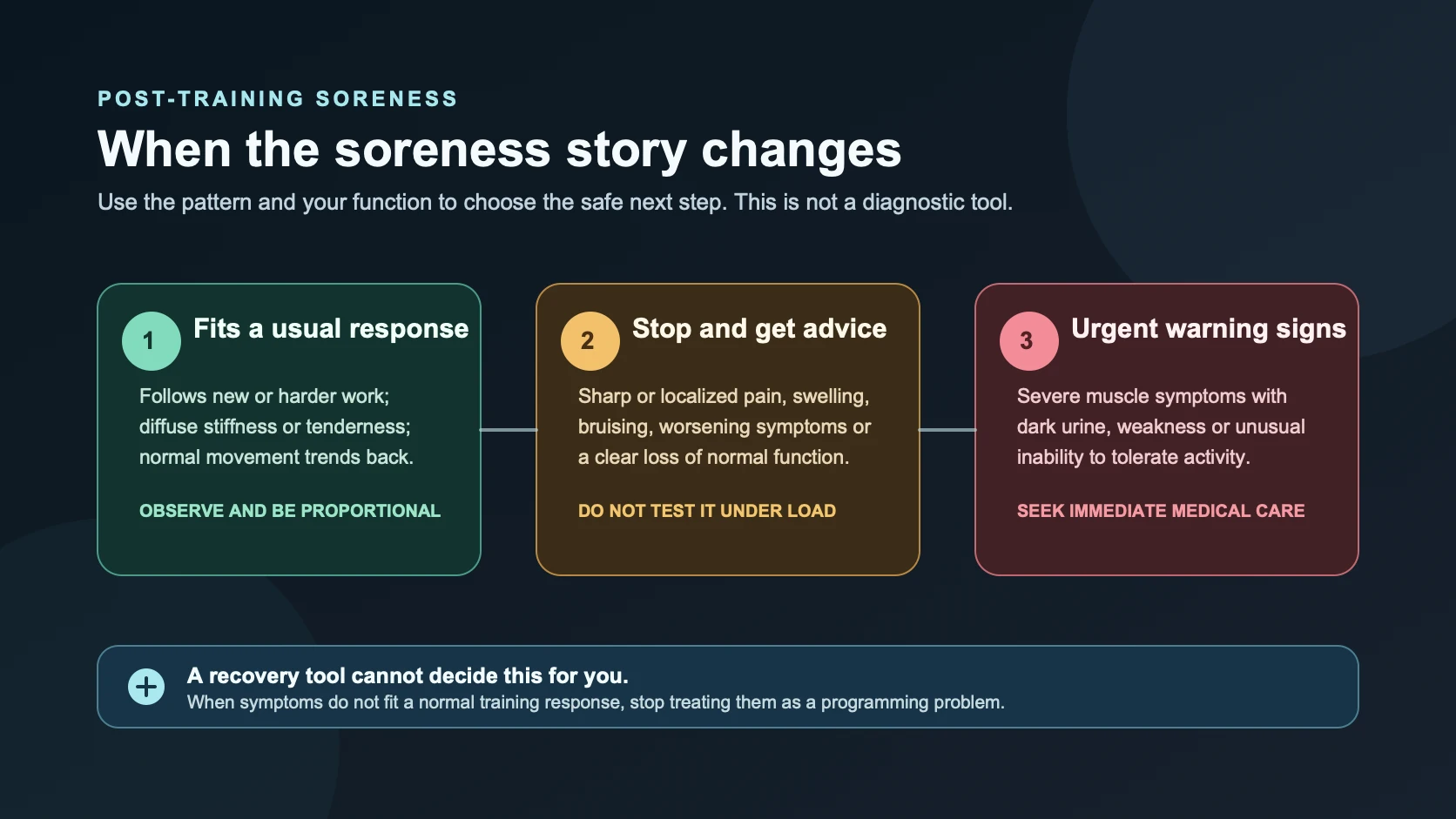
Context matters more than how tough you feel
Before calling something DOMS, look at the context without trying to win an argument with your body. Was there a new exercise, a larger-than-usual dose, a return after a break, more downhill running, a new class, heat or a session that felt very different from your normal training? A recognizable change makes ordinary soreness more plausible, but it does not give you permission to ignore every later symptom.
Then look at what the symptom is doing. Is it diffuse tenderness in the trained area, or a pinpoint pain? Does a gentle warm-up make movement feel more normal, or does the problem become sharper, more unstable or more restrictive? Are you gradually able to do ordinary tasks, or is your normal function clearly declining? A training log can record these observations, but it cannot replace an exam or a clinician’s judgment.
The key distinction is not “mild versus hard-core.” It is whether the response remains compatible with safe, normal movement and a sensible recovery direction. The guide Soreness Is Feedback — Not a Scorecard explains why soreness never proves a session was productive. This article adds the safety boundary: it also never proves that a problem can be trained through.
Stop treating it as ordinary soreness when function changes
Pain that starts suddenly during a movement, feels sharp or highly localized, comes with visible swelling or bruising, produces numbness or marked weakness, or changes how you can use the area does not fit the simple “I worked hard yesterday” story. The same applies when symptoms are worsening rather than settling, or when you cannot return to normal daily movement without compensating.
Do not try to solve those signs by changing rep ranges, adding a recovery device or testing the movement again under load. Stop the exercise and seek appropriate individual clinical or qualified sports-medicine advice. The safe decision does not require you to label the problem as a strain, tear, tendon issue or anything else. It only requires you to recognize that the usual training response is no longer a safe assumption.
This also applies when a symptom appears in a place or manner that the workout does not explain. Chest pain, fainting, severe shortness of breath, new neurological symptoms, or severe dizziness are not soreness questions. Stop activity and obtain urgent medical guidance.
Know the urgent warning signs
Severe post-exercise symptoms can occasionally overlap with conditions that require prompt medical assessment. The U.S. Centers for Disease Control and Prevention lists muscle pain more severe than expected, dark tea- or cola-colored urine, and weakness or unusual inability to complete previously manageable activity among symptoms of rhabdomyolysis. The CDC advises seeking medical attention immediately if these symptoms occur. Read its rhabdomyolysis signs and symptoms guidance for the full information.
That does not mean a workout or ordinary DOMS lets you diagnose rhabdomyolysis at home. The CDC explicitly notes that symptoms can overlap with other conditions and that assessment requires a healthcare provider and blood testing. The action is simpler than the diagnosis: if severe muscle symptoms, dark urine, weakness or unusual exercise intolerance appear, seek immediate medical care rather than waiting for a foam roller, more water or another training day to answer the question.
Heat, prolonged exertion and a sudden jump in workload are good reasons to be more cautious, but they are not the only context in which concerning symptoms deserve attention. When in doubt, err toward evaluation. A missed workout is cheaper than turning an unresolved problem into a longer absence.
Do not chase recovery tricks before you choose the right response
When soreness is ordinary, simple behavior is usually enough: normal meals, sleep, gentle movement if it feels comfortable, and a proportional next session. You do not need a complicated protocol to prove that you are taking recovery seriously. The 2025 umbrella review of physical therapies for DOMS found a large but mostly low-quality review literature across many treatments. That uncertainty is a reason to avoid treating any modality as a solution to every painful response.
When symptoms do not look ordinary, recovery gadgets are even less relevant. Do not use massage, heat, cold, stretching or medication as a reason to continue loading a concerning area. Get the right level of guidance first.
For the programming side, When Your Program Is Asking for a Deload helps distinguish a recoverable training adjustment from a medical issue. A deload may be useful for accumulated training cost. It is not a substitute for assessment when symptoms are severe, unusual or getting worse.
Return to training decisions, not bravado
Once a normal soreness response settles and comfortable movement returns, the lesson is usually not to avoid the exercise forever. It is to make the next exposure more measured: keep a familiar movement in the program, raise volume or intensity in smaller steps, and leave enough room to see how you respond. Repeated, sensible exposure is more useful than alternating between avoiding all discomfort and trying to earn a badge through it.
If a concerning symptom was evaluated, follow the guidance you received rather than applying a generic return-to-training plan from the internet. Your best next step is individualized when the reason for the symptom is individualized.
Conclusion
Normal muscle soreness has a plausible cause and a general direction back toward normal movement. It is not a prize, but it can be a routine background part of training. The moment symptoms become severe, sharply localized, worsening, function-limiting or systemic, they no longer belong in the same mental box.
Stop the activity. Do not self-diagnose. Seek appropriate advice, and seek immediate medical care for urgent warning signs. Good recovery is not about being able to explain away every symptom. It is about knowing when not to.
FAQ
How long can normal post-training soreness last?
DOMS often peaks around one to three days after unfamiliar or hard exercise, but there is no fixed timeline that can confirm a symptom is safe. The trend in function and the overall symptom pattern matter more than counting days.
Should I train through severe soreness?
Do not treat severe, worsening, sharply localized or function-limiting symptoms as a normal training challenge. Stop the activity and seek appropriate individual guidance.
Is dark urine after exercise normal?
Dark tea- or cola-colored urine with muscle pain, weakness or unusual exercise intolerance is an urgent warning sign described by the CDC. Seek immediate medical care rather than assuming it is ordinary soreness or dehydration.
Continue with a related guide
For the training meaning of ordinary soreness, read Soreness Is Feedback — Not a Scorecard. For a proportional recovery adjustment when there are no warning signs, continue with When Your Program Is Asking for a Deload.