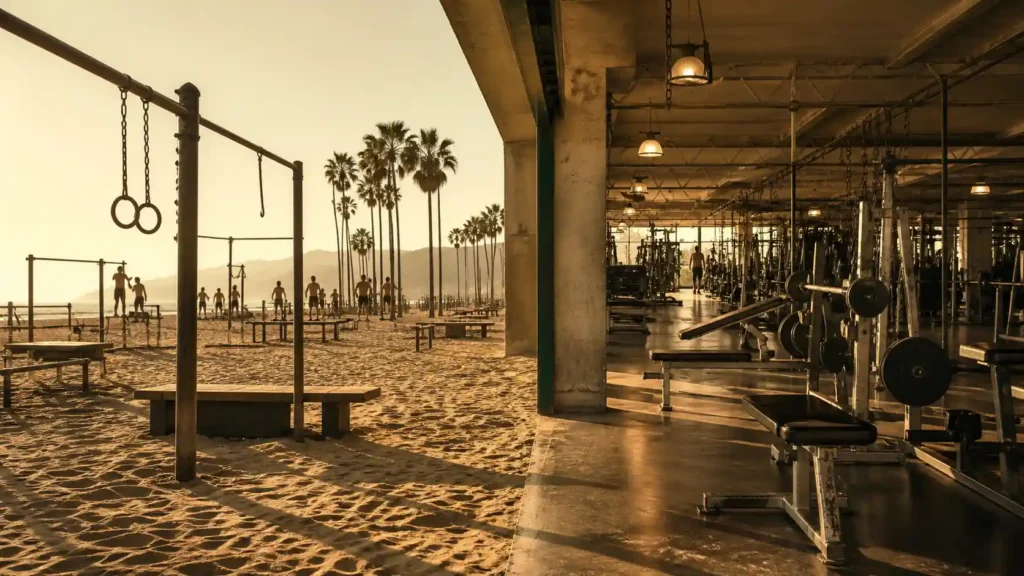
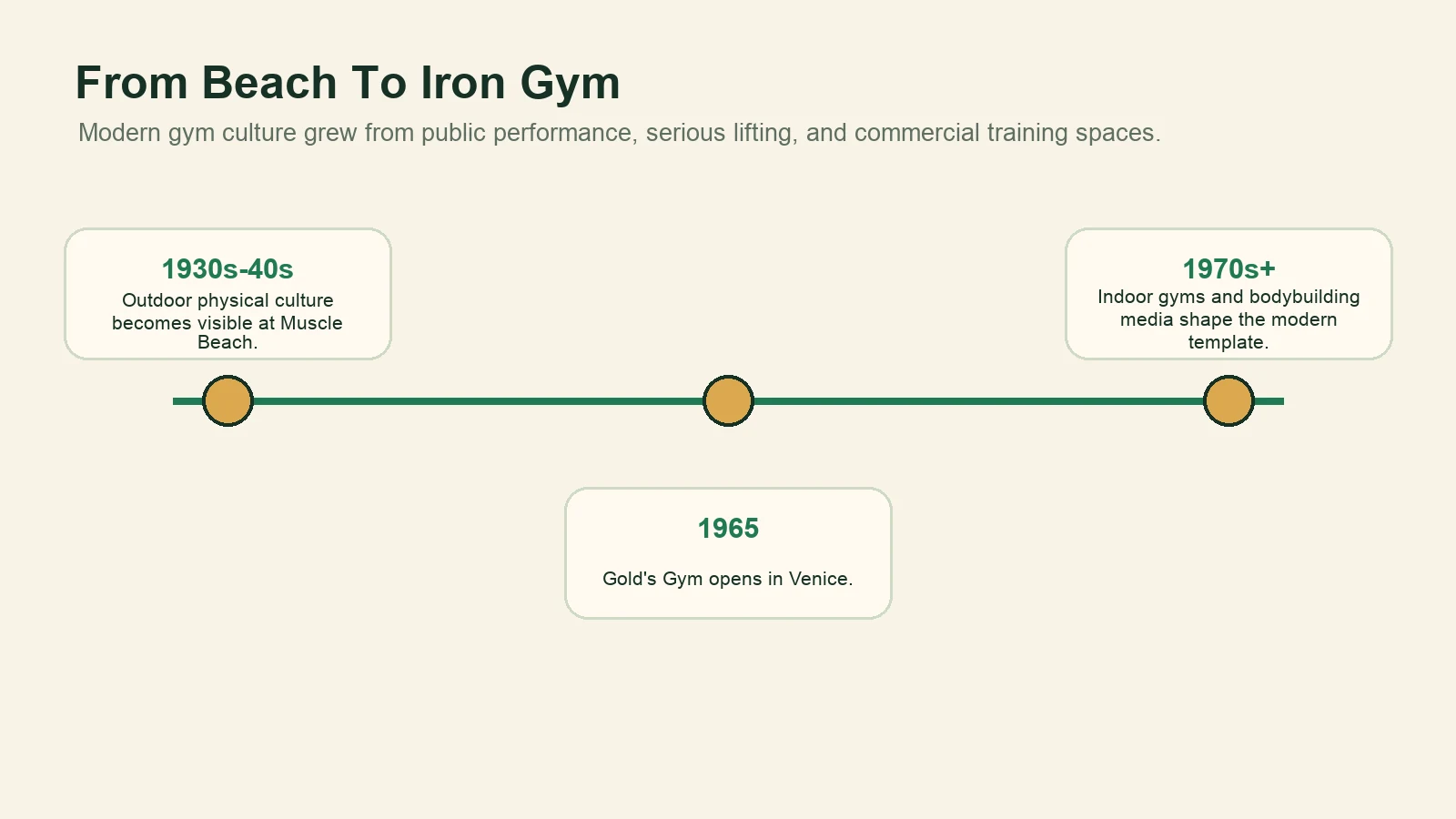
Modern gym culture did not appear fully formed. It grew from places where physical practice became visible. Before the familiar image of racks, benches, mirrors, and rows of dumbbells, there was outdoor physical culture: bodies moving in public, strength and skill performed where people could watch.
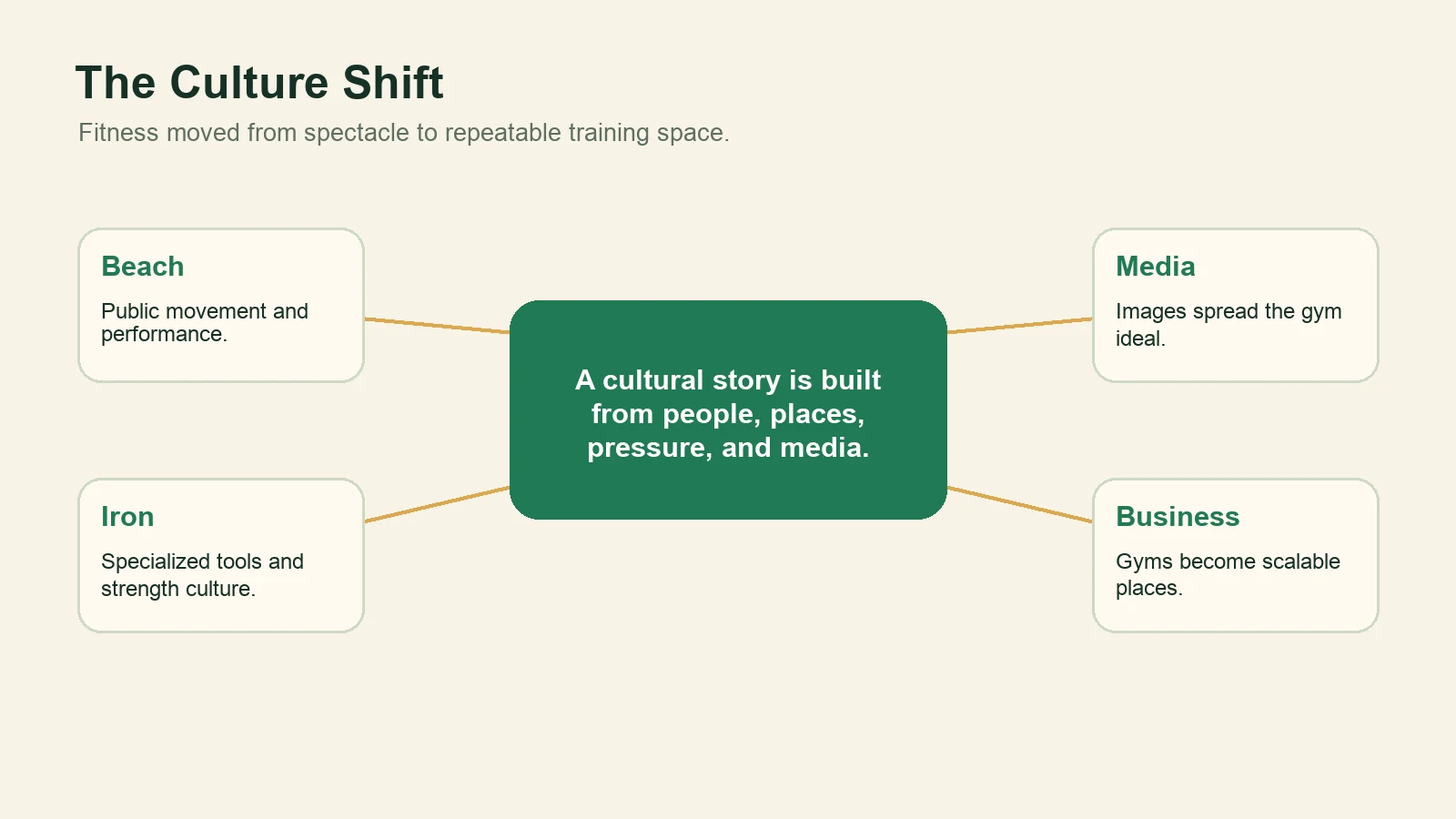
The path from Muscle Beach to Gold’s Gym shows that fitness history is also place history. The beach made movement visible. The iron gym made serious training repeatable. Media made the culture travel. Business made the model scalable.
This article is a cultural map, not a complete history of every athlete, gym, or contest. The point is to understand how modern gym culture took shape through spaces.
- Why Muscle Beach mattered
- Why indoor iron gyms changed the work
- How media spread the image
- What modern lifters can learn from place
Muscle Beach made fitness public
The City of Santa Monica identifies Original Muscle Beach among the recreational destinations along Santa Monica State Beach. That matters because the place represents a public version of physical culture: acrobatics, strength, physique, skill, and spectatorship.
Outdoor training changed the social meaning of fitness. Movement was not hidden. Bodies were not only private projects. Strength, coordination, and showmanship became part of a shared public scene.
That public quality helped shape the imagination around fitness. People could see what practice produced. They could watch, compare, admire, question, and eventually join. A culture becomes stronger when it has a visible place to gather.
Gold’s Gym made serious lifting repeatable
Outdoor culture had visibility. Indoor iron gyms added specialization. A serious gym could provide equipment, weather protection, heavier loading, and a daily environment where physique and strength work became more systematic.
The Gold’s Gym Venice page still uses Venice as a core part of its identity. The symbolism is not accidental. Venice became linked with the idea that serious lifting had a home.
That matters because tools shape behavior. Rings and bars at the beach encourage one kind of practice. Barbells, benches, dumbbells, cables, and mirrors encourage another. The modern gym grew from the combination: public energy plus specialized tools.
Media turned places into symbols
A training place becomes cultural when people who are not there can still picture it. Film, photography, magazines, and later the internet helped turn certain gyms and beaches into symbols.
The Letterboxd page for Pumping Iron is useful because the film sits at the intersection of bodybuilding, gym space, and pop culture. It gave viewers images of the training world and helped the indoor gym become part of the story people told about modern fitness.
The place did not need to be copied exactly to influence people. Most gyms are not Venice. Most lifters are not elite bodybuilders. But once the image existed, people could imagine the gym as a serious environment for transformation and craft.
Business made the gym model travel
Modern gym culture also needed business structure. A legendary room can inspire people, but a scalable gym model lets more people access equipment and training space.
The World Gym about page shows another branch of the serious-gym lineage connected to Joe Gold’s later legacy. Together with the continuing Gold’s Gym presence, it shows how one local training culture helped influence a wider commercial fitness landscape.
Commercial growth has trade-offs. It can make training more accessible, but it can also dilute culture into branding. The best version keeps the useful core: equipment that serves real training, a room that invites effort, and standards that help beginners learn without intimidation.
What modern lifters can learn
First, place matters. Your environment changes what feels normal. If the room supports training, consistency becomes easier.
Second, tools matter. You do not need everything, but you need tools that match the work: progressive resistance, safe setup, and enough simplicity to repeat.
Third, stories matter. People join fitness cultures partly because they can picture themselves inside them. A good gym helps people imagine not just a better body, but a more capable version of daily life.
Why this history still affects today’s gyms
Today’s gyms still carry pieces of this older shift. The open training floor, the mirror wall, the free-weight area, the public performance of effort, the idea of a "serious" room, and the dream of transformation all have roots in earlier physical culture.
That legacy is useful when it creates access and aspiration. It becomes limiting when one image of gym culture makes everyone else feel like a guest. Modern fitness is healthier when it keeps the best parts of the lineage—practice, community, visible effort—while making room for more bodies, ages, goals, and training styles.
The future of gym culture does not have to reject the past. It has to widen the invitation.
The useful tension: spectacle and practice
Muscle Beach reminds us that fitness has always had a public side. People watch bodies move, admire skill, compare strength, and tell stories about what they see. Gold’s Gym reminds us that progress also needs private repetition: sets, logs, technique, recovery, and ordinary days.
Modern fitness works best when it respects both sides. Spectacle can inspire someone to begin. Practice is what helps them continue. A gym culture that only performs can become shallow. A gym culture that never invites anyone in can become closed and intimidating.
The healthiest version keeps the door open while protecting the seriousness of the work.
Continue with a related guide
For the next practical step, read Joe Gold: The Man Who Built the Gym That Became a Fitness Mecca. For a second perspective from the same topic cluster, continue with Larry Scott and the Birth of Mr. Olympia.
Conclusion
From Muscle Beach to Gold’s Gym, modern gym culture took shape through visibility, tools, media, and community. The beach made physical culture public. The iron gym made serious training repeatable. Film and business helped the image travel.
For everyday lifters, the lesson is practical: choose or build places that make the right work easier. Culture is not decoration. It is the set of signals that tells people what kind of effort belongs here.