
Chris Bumstead’s place in modern bodybuilding history has a simple factual center: he won the Classic Physique Olympia six years in a row, from 2019 through 2024. The official Olympia winners archive records the sequence plainly. What the sequence came to represent is more interpretive. For many fans, it became a return to an idea of bodybuilding that put proportion, posing, and a recognizable silhouette beside sheer size.
That does not mean there is one objectively correct physique or that a contest winner provides a template for ordinary training. It means Bumstead became the most visible reference point for a division whose rules and presentation deliberately differ from open bodybuilding.
This is a historical profile, not a guide to copying professional contest preparation. Elite bodybuilding involves resources, risks, and contest-specific choices that do not transfer cleanly to a normal gym week.
- The six-title record
- What Classic Physique is designed to reward
- Why the word classic stuck
- What a long championship run can and cannot teach
The record is the starting point
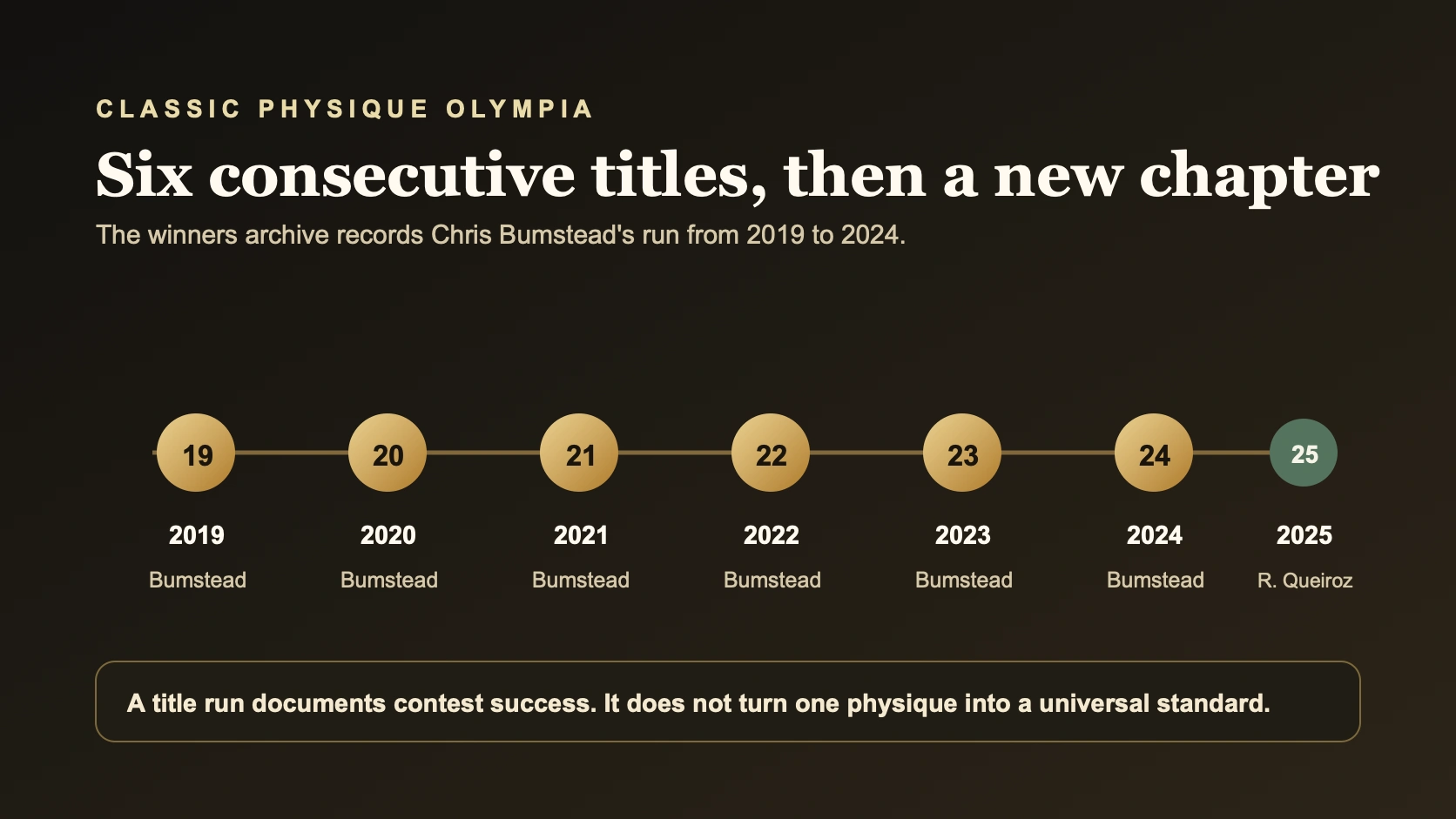
The Classic Physique Olympia winners archive lists Bumstead as champion in 2019, 2020, 2021, 2022, 2023, and 2024. The same archive records Ramon Rocha Queiroz as the 2025 winner. That makes the shape of the story unusually clear: six consecutive wins, then a change of champion.
A title is one result. Six annual wins are something different. They show that an athlete stayed at the center of the same judged contest across changing lineups and repeated preparations. They do not prove that every observer preferred the same look, but they explain why the athlete became synonymous with an era of the division.
A category with a different brief
Classic Physique is not simply open bodybuilding with smaller athletes. The 2024 IFBB Classic Physique rules set height-based weight limits and specify mandatory comparisons and poses. Those constraints give the category a distinct visual brief: size matters, but it is judged alongside lines, proportion, presentation, and the overall silhouette.
That framing helps explain the language around Bumstead’s run. “Classic” is not a scientific measurement, and it should not be confused with a health label. It is a cultural shorthand for a look that fans connect with earlier bodybuilding imagery: a visible waist, balanced development, intentional posing, and a physique that reads as a whole rather than a collection of isolated body parts.
The division’s rules do not declare one person the perfect embodiment of that idea. Judging remains contextual and competitive. But a six-year winning sequence gave one public example enough repetition to become a common reference point.
Why the word classic returned to the conversation
Bodybuilding has always contained more than one visual argument. The sport can value maximum mass, conditioning, symmetry, presence, or the way a physique appears during a pose. Different divisions make different tradeoffs visible.
That is why the comparison to older figures should be handled carefully. Frank Zane’s different kind of dominance belongs to another competitive era with its own standards and opponents. The connection is not that Bumstead recreated Zane, or that either man settled the question of what bodybuilding should look like. The connection is that both became useful reference points in conversations about proportion and presentation.
Bumstead’s run arrived when those conversations had an established division of their own. The modern category gave the audience a repeatable stage for that preference, and the repeated wins gave the preference a recognizable champion. That is the reasonable meaning behind “the return of the classic physique ideal”: not a literal return to a past body, but a renewed place for a particular visual language in contemporary bodybuilding.
A record does not become a training prescription
It is tempting to turn a celebrated athlete into a complete answer. Watch the poses, buy the program, copy the exercise list, and assume the result follows. That is a poor reading of any elite record.
Professional contest preparation is shaped by genetics, coaching, years of training, schedule, diet, stage requirements, and choices that are not visible in a highlights reel. A title run tells us that an athlete repeatedly succeeded within a specific contest. It does not tell an everyday lifter what bodyweight to chase, how lean to become, or what program will fit their life.
The more useful lesson is narrower. Build a training goal around qualities you can actually observe and repeat: stronger technique, a sensible amount of work, better movement control, or a schedule that lets you return next week. Progressive overload is more than adding weight because the quality of the work and the ability to repeat it matter too.
The closing chapter makes the run easier to read
In his own 2024 retirement speech, Bumstead marked the end of his Olympia competition chapter after the sixth title. The 2025 winners archive then shows the division moving to a new champion. That transition matters because it keeps the story from becoming mythology. The division existed before one athlete, and it continues after him.
What remains is a well-documented sequence and the influence that sequence had on how people talked about the category. Bumstead did not bring back a single universal ideal. He became the defining champion of a division that made proportion, posing, and presentation central again for a large modern audience.
Continue with a related story
For another long modern Olympia chapter, read Phil Heath: The Rise of The Gift. Then compare a different generation of stage culture in Pumping Iron: The Film That Took Bodybuilding Out of the Gym and Into Pop Culture.