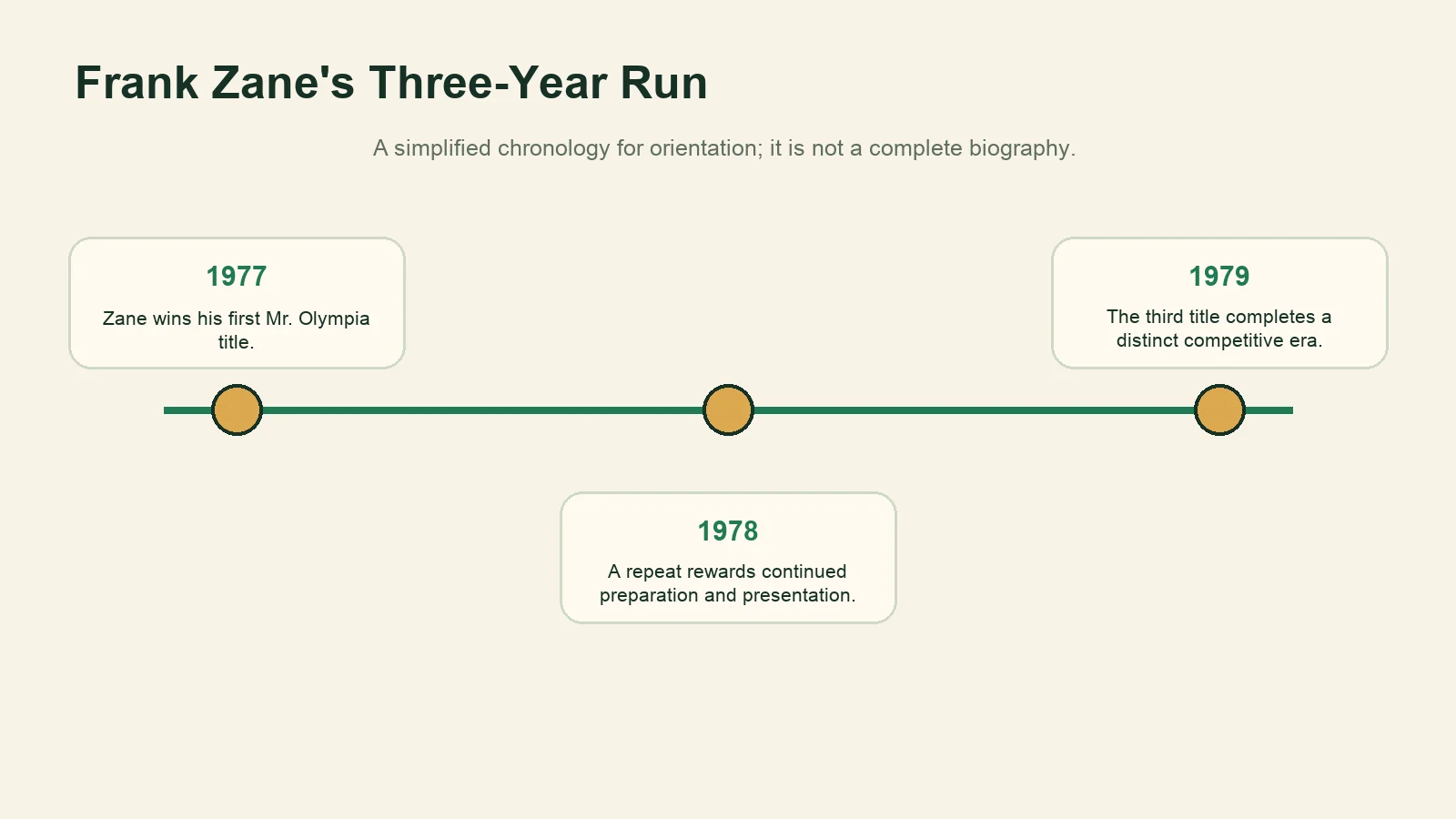
Frank Zane’s place in bodybuilding history is often described with one word: aesthetics. That word can be useful, but it is also vague. It can become a shortcut for taste, nostalgia, or arguments about who had the "best" physique. The record is clearer. Zane won Mr. Olympia in 1977, 1978, and 1979. Three consecutive titles made his approach an era, not just an alternative look.
The better question is not whether aesthetics beat size. Physique sport does not reduce cleanly to one dimension, and every era judges through its own standards. Zane’s story matters because it demonstrates that dominance can be built through preparation, proportion, presentation, and repeatable competitive execution. That is a different lesson from chasing a single visual extreme.
- The factual record
- Why presentation is part of the sport
- How three wins created an era
- What lifters should not copy
The factual record
Frank Zane’s official biography records his Mr. Olympia wins in 1977, 1978, and 1979, after years of training and earlier competition. Together with his own account of preparing for the era’s contests, it provides the factual frame for this article: a champion who repeated the result over three seasons.
Zane’s own account of training for the 1975-79 Olympias is especially useful because it does not read like a magic routine. It describes planning, practice, photographs, posing, changing training circumstances, and the mental effort of preparing for a specific event. A first-person historical account is not universal advice, but it is direct evidence of how one competitor thought about a competitive block.
That context prevents a common mistake. A title photograph looks like an end state. The preparation behind it includes many decisions that a still image cannot show: schedule, exercise selection, recovery, posing, feedback, and the pressure of public comparison.
Aesthetics is not a shortcut
In bodybuilding, presentation is part of the competitive task. Proportion, posing, condition, stage control, and comparison with the field all shape how a physique is received. Calling that "aesthetics" should not imply that the work is superficial. It is a particular kind of craft, with its own demands and its own limits.
Zane’s legacy is often used to stage a false choice between artistic presentation and serious training. The record does not support that framing. A three-year run requires enough reliable preparation to arrive ready more than once. It also requires the ability to make that preparation readable under stage lights, in a lineup, and in front of judges.
For a general fitness reader, however, this is where boundaries matter. Professional physique sport can be interesting without becoming a health or body-image blueprint. A person can appreciate symmetry, posing, and disciplined practice while choosing completely different goals: strength, mobility, sport performance, stress relief, or simply a more consistent routine.
Why the run still resonates
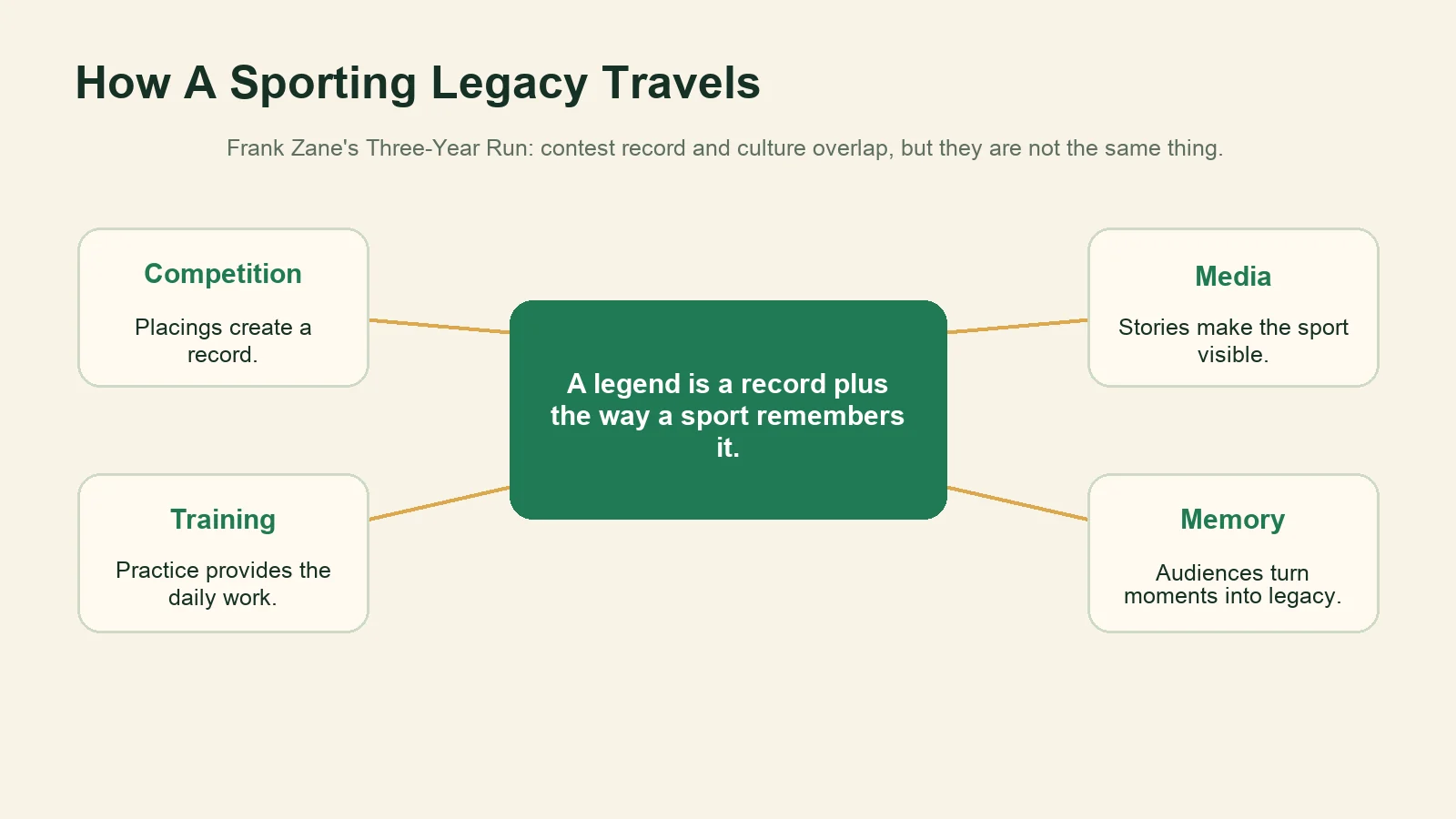
The 1977-1979 sequence is remembered because it made a distinct visual and competitive language visible at the top of the sport. A single title can be explained away as timing. A repeated title asks people to take the pattern seriously. Zane’s three victories became a reference point for conversations about proportion and presentation precisely because they occurred on a recurring, high-profile stage.
That cultural memory has a downside. It encourages readers to compare bodies across decades as if the judging, photography, expectations, and competition fields never changed. A more honest view is that each champion is both an athlete and a product of a specific sporting moment. The history is richer when we leave that complexity intact.
The practical reading for lifters
First, evaluate training by the demands of your actual goal. Zane prepared for a judged physique contest. A powerlifter, runner, parent training twice a week, or beginner learning movement should not borrow the same scoreboard. Clear goals make exercise choices more rational.
Second, use feedback deliberately. Zane’s training account describes regular photographs as part of his preparation. For most people, feedback can be less intense: a training log, a technique video, a monthly check-in, or a note about sleep and energy. The point is not constant self-surveillance. It is making adjustment possible.
Third, resist the urge to make one body the final answer. Fitness culture loves definitive images. They are easy to sell and easy to share. A more durable practice is to judge progress against personal capability, consistency, and wellbeing rather than an old contest photograph.
There is a broader cultural reason the Zane era remains easy to discuss. It gives people a vocabulary for contrast. Readers can point to a competitive record and then talk about presentation, posing, and visual balance rather than pretending the sport has only one winning dimension. That is useful history, provided it does not become a new rule that one aesthetic is inherently better or more virtuous than another. The result belonged to a specific judged contest, a specific field, and three specific years.
For modern trainees, that restraint is important. Bodies respond differently, and fitness goals do not need public approval to be legitimate. A beginner who learns to train twice a week consistently may be making a more meaningful change than someone repeatedly chasing an image that does not fit their life. Historical champions can broaden a reader’s idea of what the sport has valued; they should not narrow a reader’s idea of what progress is allowed to look like.
That perspective keeps the word dominance in proportion. In a contest it describes a result. Outside the contest, it should never become a demand to dominate one’s body, time, or identity. Sustainable training is allowed to be quiet, ordinary, and still deeply valuable.
Continue with a related guide
For the next practical step, read From Muscle Beach to Gold’s Gym: Where Modern Gym Culture Took Shape. For a second perspective from the same topic cluster, continue with Joe Gold: The Man Who Built the Gym That Became a Fitness Mecca.
Conclusion
Frank Zane made aesthetics a different kind of dominance because his 1977, 1978, and 1979 wins turned a way of presenting bodybuilding into a repeated competitive result. The lesson is not that every lifter should pursue the same look. It is that serious preparation can be judged by more than the loudest or simplest measure.
Read the title run as history, respect the craft behind it, and choose a standard that fits your own life.