

Greek yogurt is one of the rare foods that actually deserves some of its gym reputation. It is convenient, high in protein, easy to combine with other foods, and useful in both sweet and savory meals. But when lifters only talk about protein, they miss part of why Greek yogurt works so well.
Plain Greek yogurt can also contribute calcium, vitamin B12, iodine, and potassium. Those nutrients do not make it a magic recovery food, but they do make it more than a macro trick. For busy lifters, that matters because a good staple should help cover several nutritional jobs at once.
This article is for healthy adults who tolerate dairy and want practical food guidance. The short version is this: Greek yogurt is a strong protein base, but its best use is inside a meal that also includes carbohydrates, fiber, flavor, and enough variety across the day.
- Why Greek yogurt is useful for lifters
- What a plain nonfat reference serving gives you
- Why calcium and B12 matter
- Where iodine and potassium fit
- How to build better Greek yogurt meals
Why Greek yogurt is useful for lifters
The main advantage is density. Greek yogurt is strained, so it usually contains more protein per serving than regular yogurt. That makes it easy to add a protein-forward food without cooking, meal prep, or a shaker bottle.
The ISSN position stand on protein and exercise recommends that most exercising individuals aim for daily protein around 1.4-2.0 g per kilogram of body weight, with meal-level doses often around 20-40 g. Greek yogurt can help a meal move toward that range, especially when the serving is large enough or paired with another protein source.
It is also flexible. Greek yogurt can become breakfast with fruit and oats, a snack with berries and nuts, a sauce for rice bowls, a replacement for some sour cream, or a base for a higher-protein dip. That flexibility is not glamorous, but it is exactly what makes a food repeatable.
What a plain nonfat reference serving gives you
Using USDA FoodData Central reference data for plain nonfat Greek yogurt, a 100 g portion is roughly around:
- 10 g protein
- 110 mg calcium
- 0.75 mcg vitamin B12
- 141 mg potassium
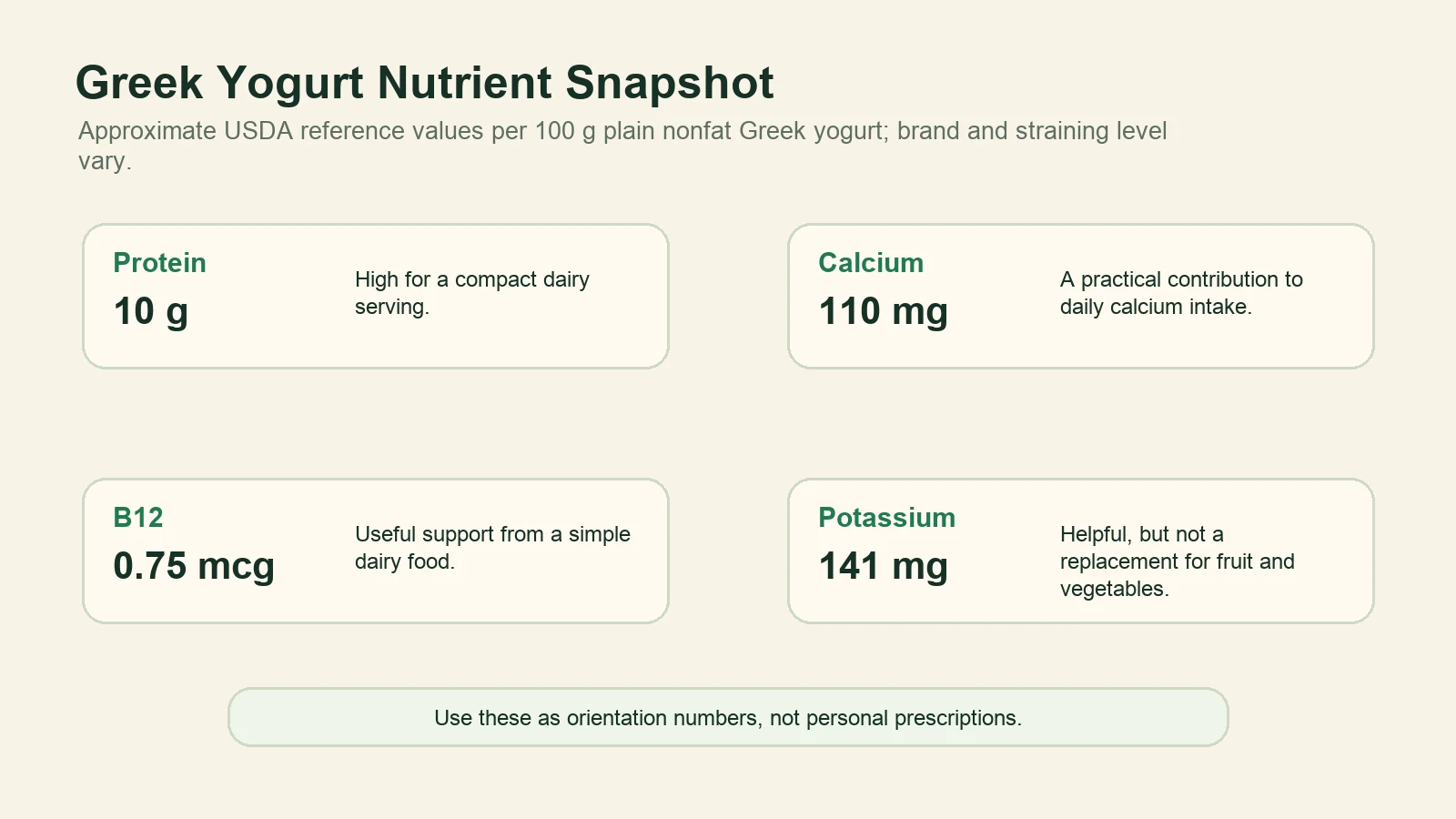
A real bowl is often bigger than 100 g. Many people eat 170-250 g, which means the protein and micronutrients scale up. That is why Greek yogurt can feel more substantial than the small reference number suggests.
The label still matters. Full-fat, low-fat, and nonfat versions differ in calories and fat. Flavored versions can add a lot of sugar. Some products are thicker, some are strained more heavily, and some are closer to regular yogurt in protein. The best default for a lifter is usually plain Greek yogurt, then add your own fruit, oats, honey, nuts, or savory ingredients based on the meal.
Why calcium and B12 matter
Calcium is easy to associate only with bones, but the NIH calcium fact sheet also notes roles in muscle movement, nerve signaling, blood vessel function, and hormone release. Lifters do not need to turn calcium into a performance supplement, but they should not ignore it either.
Greek yogurt can help cover calcium in a way that is simple and repeatable. That is especially useful for people who do not drink much milk or who struggle to build calcium-rich foods into their day. It is not the only route, but it is a convenient one.
Vitamin B12 is another useful part of the package. The NIH vitamin B12 fact sheet describes B12 as needed for healthy blood and nerve cells and DNA synthesis. Dairy foods can contribute B12, though someone with low intake, absorption issues, or a mostly plant-based diet may need a more deliberate strategy than yogurt alone.
For lifters, the practical point is simple: Greek yogurt supports more than muscle protein. It helps the normal body systems that let training continue.
Where iodine and potassium fit
Iodine is a quieter reason dairy can matter. The NIH iodine fact sheet explains that iodine is an essential component of thyroid hormones, which regulate important biochemical reactions including protein synthesis and enzymatic activity. Dairy can contribute iodine, although the amount varies by farming, feed, sanitation practices, and brand.
That variability is why iodine should be mentioned carefully. Greek yogurt may help, but it should not be treated as a guaranteed iodine dose unless the product has reliable data. People with thyroid disease or medical advice about iodine should follow their clinician’s guidance.
Potassium is more straightforward. The NIH potassium fact sheet describes potassium as an essential mineral and electrolyte. Greek yogurt contributes some, but the bigger move is pairing it with potassium-rich foods like banana, berries, potatoes, beans, or other produce across the day.
How to build better Greek yogurt meals
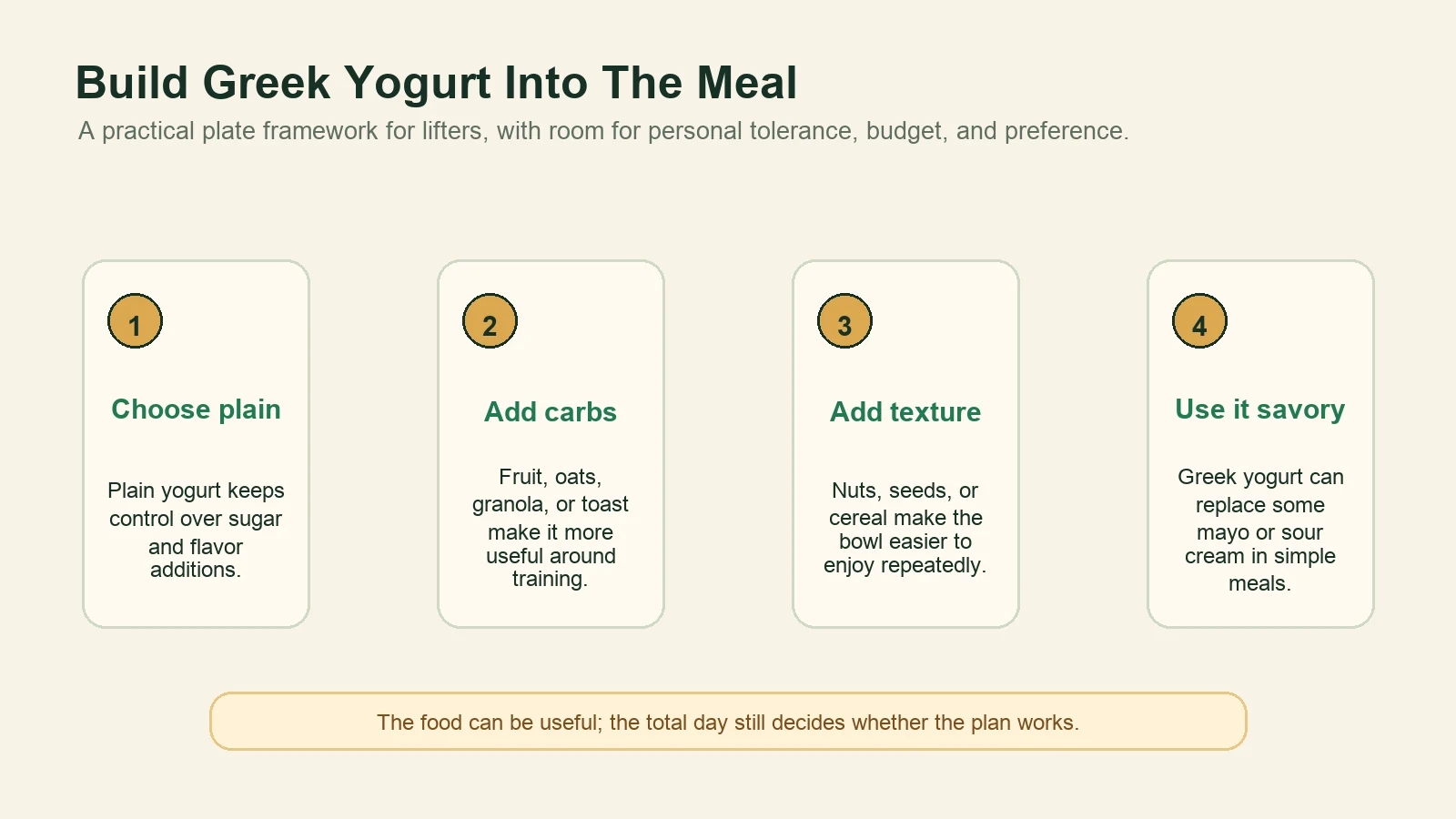
Start with plain yogurt. That gives you control. You can make it sweet, savory, higher-carb, lower-carb, higher-fat, or lighter without being locked into a flavored product.
For a training-friendly bowl, add carbohydrates. Fruit, oats, cereal, granola, toast, or honey can make the yogurt more useful before or after training. If the goal is a lighter snack, berries and a smaller portion of oats may be enough. If the goal is a meal, the bowl needs more structure.
Add texture too. Nuts, seeds, cereal, or chopped fruit make Greek yogurt less monotonous. This matters because consistency is easier when food is pleasant enough to repeat.
Greek yogurt also works savory. Mix it with lemon, garlic, herbs, salt, pepper, or mustard and it becomes a sauce for potatoes, rice bowls, wraps, meat, eggs, or vegetables. That can help lifters use it outside breakfast.
If you have a milk allergy, lactose intolerance, kidney disease, thyroid disease, or medical advice about calcium, potassium, iodine, or dairy intake, individual guidance matters more than general fitness content.
What Greek yogurt does not do
Greek yogurt does not replace an entire protein plan. A small spoonful is not a high-protein meal. It also does not make vegetables, whole grains, legumes, seafood, meat, eggs, or other foods unnecessary.
It is not automatically healthy in every version. Some flavored yogurts are closer to dessert than a plain protein base. That may still fit sometimes, but it should not be confused with the plain version.
It is also not mandatory. People who avoid dairy can use soy yogurt, tofu, fortified plant milks, legumes, and other protein foods, though they may need to pay closer attention to calcium, B12, iodine, and protein quality depending on the pattern.
A practical label note
The label is where Greek yogurt becomes either simple or confusing. Look first at protein per serving, then serving size. Some cups look similar but contain very different amounts because one is 100 g, another is 150 g, and another is 170 g. That can make a snack seem more protein-rich than it really is.
Next, check added sugar if the yogurt is flavored. Sweetened yogurt can still fit, but it should be chosen intentionally. A plain tub plus fruit, honey, jam, or cereal often gives you more control. Finally, check whether the product is truly Greek-style and strained, because some products use thickening ingredients and may not have the same protein density.
Continue with a related guide
For the next practical step, read Lean Beef vs Chicken: Which Makes More Sense for a Strength Athlete?. For a second perspective from the same topic cluster, continue with Milk for Muscle and Strength: What’s Actually Inside a Glass?.
Conclusion
Greek yogurt is useful for lifters because it is convenient, protein-forward, and flexible. Its real value is broader than protein: it can also contribute calcium, vitamin B12, iodine, and potassium in a food that can become breakfast, snack, sauce, or part of a larger meal.
The best version is simple. Choose plain yogurt most of the time, build it with carbohydrates and produce when training demands it, use labels to avoid surprises, and treat it as one useful staple inside a varied diet.
FAQ
Is Greek yogurt enough protein for a meal?
It depends on the serving. A small cup may be a snack. A larger bowl, especially with another protein source or a high-protein brand, can move closer to the 20-40 g range often used in sports nutrition.
Should lifters choose nonfat or full-fat Greek yogurt?
Either can fit. Nonfat is easier when you want more protein with fewer calories. Full-fat can be more satisfying and useful when calories are higher. The better choice depends on the rest of the day.