
A missed rep can feel larger than it is. You planned five repetitions, got four, and leave the gym thinking the program failed, the day was wasted, or you are not disciplined enough. The same thing happens after an interrupted week: a work deadline, travel, poor sleep or a missed session becomes proof that the routine is over.
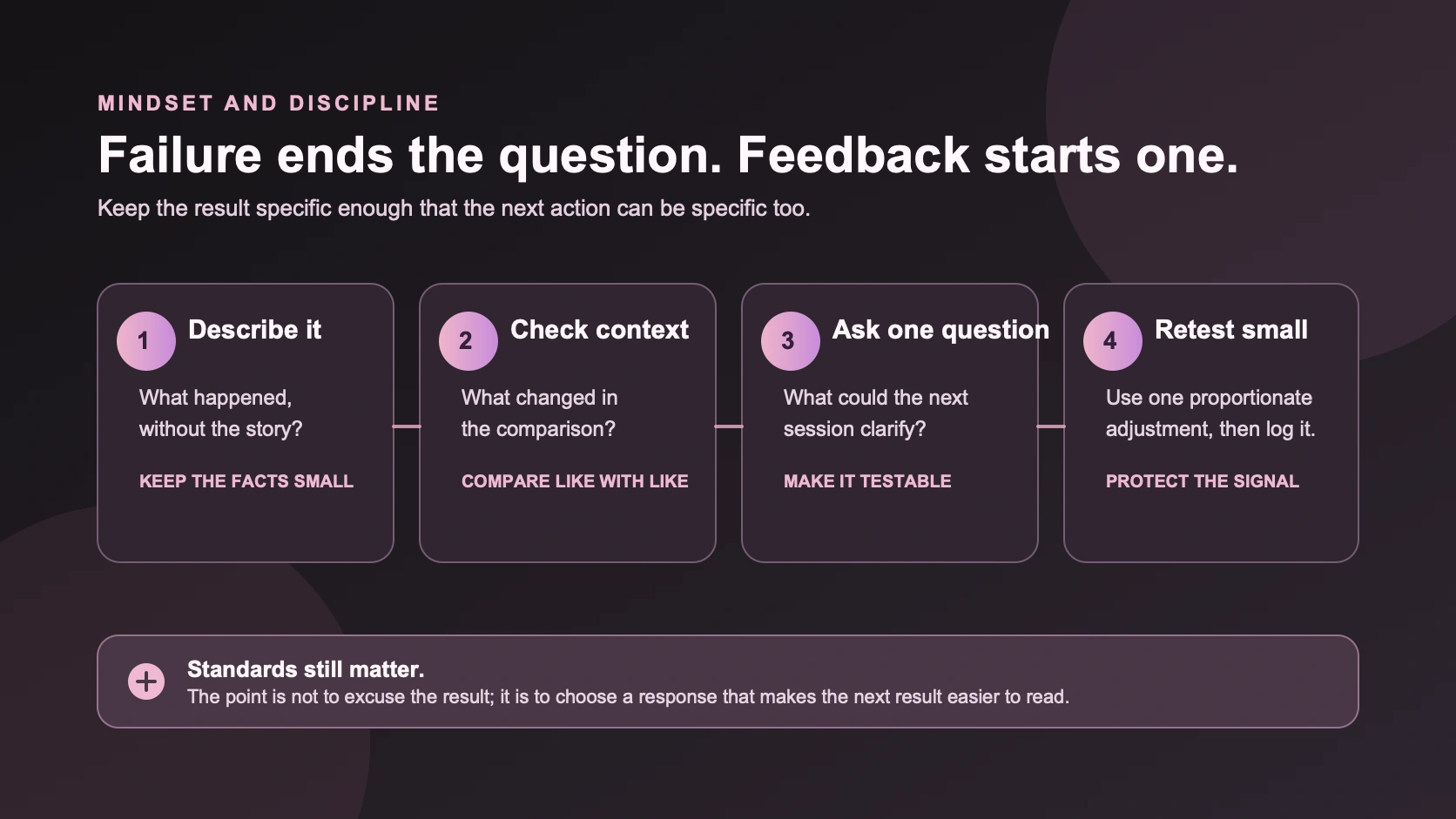
That interpretation is understandable, but it is not very useful. A training result is first an event. It becomes feedback when you describe what happened, check what changed and decide whether there is a small question worth testing. It becomes “failure” when one event is turned into a final judgment about the plan or the person doing it.
This is not an argument for lowering standards or explaining away every bad result. A repeated problem deserves a response. The difference is that feedback keeps the response specific enough to improve the next decision.
- Why a result is not a verdict
- How to describe the event honestly
- What context changes the meaning
- How to choose one next test
- When feedback becomes a real programming question
A result is a fact before it becomes a story
Start with the shortest honest description. “Missed the fifth rep at 90 kilograms.” “Skipped Tuesday because I worked late.” “The planned run felt much harder than usual.” These are facts. They may be disappointing, but they are still limited pieces of information.
The story starts when extra conclusions arrive: “I am weak.” “The program is useless.” “I always quit.” Those claims are much larger than the event that triggered them. They combine a moment of training with an identity or a permanent prediction, which makes a practical adjustment harder to see.
This is why a basic log is valuable. Record the exercise, load, repetitions, effort target and one relevant note. The note might be “rushed warm-up,” “new bar,” “poor sleep,” or “no unusual context.” You are not writing a defense brief. You are keeping enough detail to avoid inventing a more dramatic story later.
Feedback needs context, not excuses
Context changes what a result can mean. A missed rep after a late-night flight, shortened warm-up and unfamiliar equipment does not answer the same question as a missed rep in the fifth comparable week of the same program. Both results belong in the log. They simply carry different weight.
Useful context is concrete: the movement variation, range of motion, warm-up, rest period, time pressure, recent training load and whether the technique matched your normal standard. You do not need a perfect laboratory. You need to know whether you are comparing like with like before you rewrite the program around one emotional session.
The same rule applies to an interrupted week. Missing two sessions because life became unusually busy is not the same as quietly abandoning a routine for months. Treat the difference honestly. The first may call for a smaller version of the plan next week; the second may call for rebuilding the schedule from the ground up. Neither becomes easier to solve by calling yourself a failure.
The NIDDK guide to changing habits recommends tracking progress, planning for setbacks and returning to the plan rather than treating a setback as failure. It is general behavior guidance, not a strength program. Its narrow value here is practical: a record lets you see the obstacle and choose a next action instead of relying on a mood after a bad day.
Ask one question that can change the next session
Feedback becomes useful only when it leads to a question you can answer. “Why am I bad at training?” is too large. “Was the load jump too large for this rep target?” is answerable. So is “Did the rushed warm-up change my setup?” or “Can I protect two shorter sessions during a busy week?”
Choose one question. If you change the exercise, add volume, reduce rest, switch the training split and test a maximum all at once, the next result will be just as difficult to interpret. A small adjustment is not timid. It is how you find out whether your explanation had any value.
For a main lift, the next test might be to repeat the planned load with the same setup, keep the load steady and improve one repetition, or use a slightly lighter load while restoring the intended technique. For an attendance problem, the next test might be a fixed 35-minute version of the session rather than a promise to “be more motivated.” The answer should fit the problem you actually recorded.
The Difference Between Training Hard and Making Every Session a Test explains why a working set and a test set serve different jobs. A missed target in a normal work session is not automatically evidence that you need an unplanned test. It may simply tell you to finish the planned work, record the context and return to the progression rule.
Feedback should be proportionate
The response should match the pattern. One unusual session can deserve a note and no change. Several comparable sessions that miss the same target may deserve a programming review. A repeated inability to recover from the week may require less training cost, a different schedule or a clearer priority.
The 2024 systematic review and meta-analysis of feedback in self-monitoring interventions included 19 studies and 3,261 participants. In the subset that could be pooled, feedback provision improved physical-activity intervention outcomes compared with no feedback, while the authors also found substantial variation and limits in the studies. That is not proof that a training log will solve every lifting problem. It supports the modest idea that recorded information can be more useful than a vague memory when you are trying to stay engaged with a behavior.
That distinction protects both standards and patience. Feedback is not “everything is fine.” It is “what exactly happened, and what is the smallest useful response?” If the answer remains unclear after several comparable exposures, the uncertainty itself is feedback: get a coach’s eye on technique, simplify the plan, or review the inputs you have been taking for granted.
Do not turn a tool into a verdict machine
Numbers can clarify training, but they can also feed an unhelpful story. A wearable score, bar-speed reading, bodyweight change or missed set is a measurement with conditions. It does not rank your value, discipline or future potential. Use the number to decide whether the next session should repeat, adjust or pause. Do not use it to turn a normal fluctuation into a character test.
This matters especially when progress is slow. Why Slow Progress Is Still Progress shows why trends need several comparable sessions before they earn a large conclusion. The same patience applies after a poor result. A week can be messy without invalidating a month of useful work.
If pain, dizziness, illness or a health concern is changing what you can do, do not use a mindset article to decide what is safe. Stop the activity and seek appropriate individual guidance. Feedback is a training tool, not medical assessment.
Conclusion
Failure says the conversation is over. Feedback says the result needs a better question. In training, that difference is practical. A missed rep, a disrupted week or a slow month can become useful when you describe it clearly, keep the context visible and make one proportionate adjustment.
Keep standards. Keep the log. But leave room for the possibility that one disappointing event is not the whole story. The next useful action is usually smaller and more specific than the judgment you first wanted to make.
FAQ
Is a missed rep a failure?
It is a result. It may show that a target was too ambitious, that the conditions changed or that a pattern needs review. One missed repetition is not enough information for a global verdict.
What should I write after a bad session?
Record the facts: exercise, load, repetitions, technique standard and one relevant context note. Then choose one question to revisit instead of changing the entire program immediately.
When should I change the program?
Change it when a problem repeats across comparable sessions or when the current plan no longer fits recovery, schedule or the stated goal. Make one proportionate change so the next result remains readable.
Continue with a related guide
For a practical way to read uneven progress across a training block, read Why Slow Progress Is Still Progress. For the discipline of keeping training and testing separate, continue with The Difference Between Training Hard and Making Every Session a Test.