

Slow progress can feel suspicious. You are showing up, completing the work, and trying to make sensible choices, yet the changes are too small to deliver the satisfying proof you expected. The temptation is to call the plan broken, add more work, or replace everything with something more exciting.
Often, that reaction arrives too early. Training does not improve in a straight line, and one session is a poor judge of a longer process. A slightly cleaner rep, one more repeatable workout, or a load that feels more controlled than it did a month ago may not look impressive in isolation. It can still be evidence that the plan is moving.
This is not an argument for waiting forever. Slow progress is useful only when there is something concrete to observe and a time to review it. The goal is to stop treating every ordinary week as failure while keeping a clear standard for when a program needs an adjustment.
- Why one session is not a verdict
- What counts as progress besides a personal record
- How to make the comparison fair
- When slow becomes a question worth investigating
- How to adjust without starting over
One session is a signal, not a verdict
Training days are affected by sleep, stress, time pressure, equipment, how familiar the movement is, and plain day-to-day variation. That is not an excuse to ignore the log. It is a reason to avoid reading a single hard session as a complete diagnosis of your program.
Consider two lifters who both miss a planned repetition. One has completed the same work for six weeks, improved technique, and has been sleeping badly for two nights. The other has missed the target for several comparable sessions, has added unplanned volume, and cannot recover well enough to repeat the work. The same missed repetition means different things because the pattern around it is different.
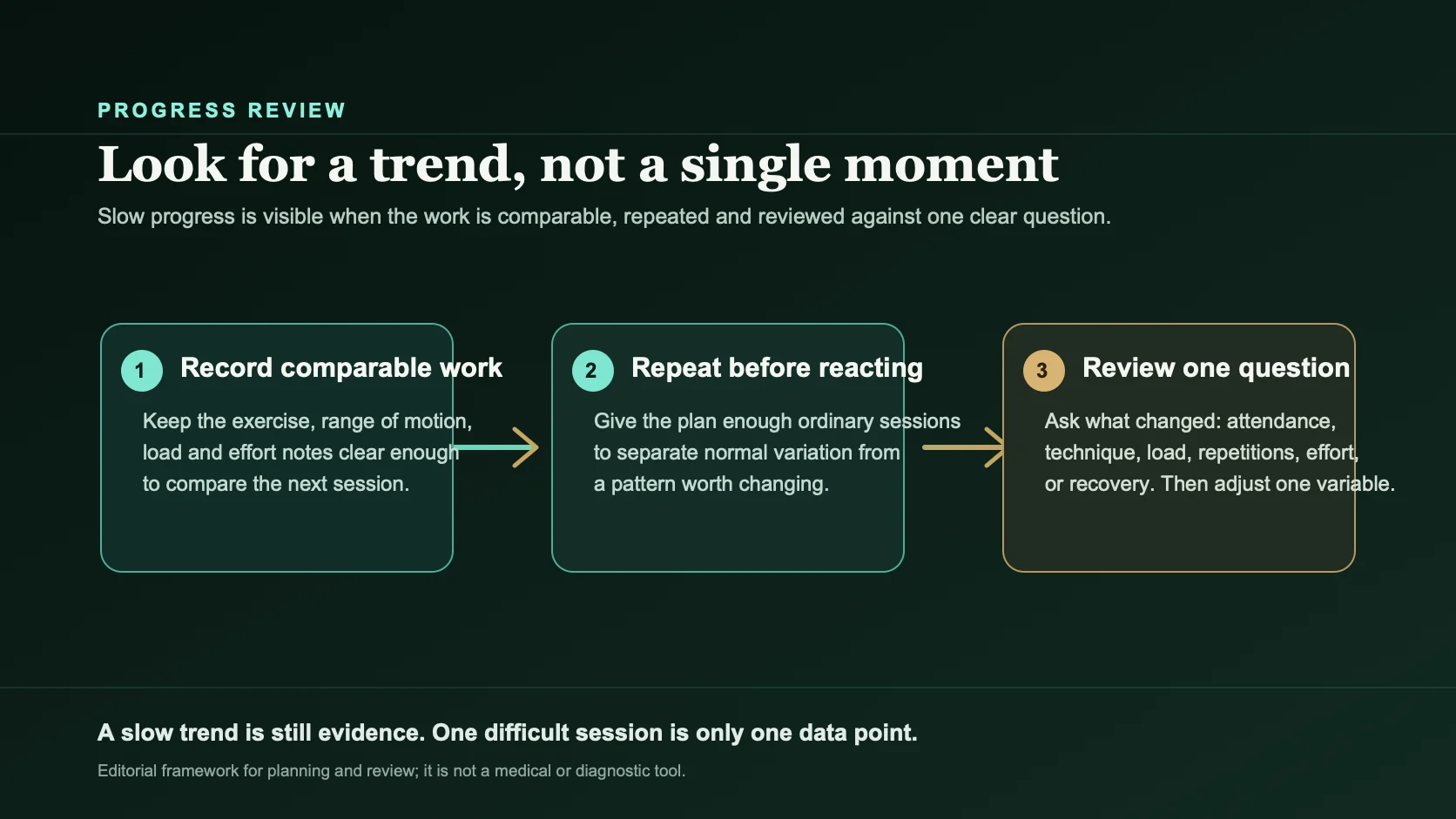
Start with a small set of measures you can actually compare: the exercise variation, range of motion, load, repetitions, effort target, and a short note about anything unusual. You need enough detail to avoid rewriting the story from memory after a disappointing day.
Progress has more than one visible form
Adding weight is one form of progress, but it is not the only one. You may complete the same load with steadier technique, add a repetition within the planned range, use a more consistent setup, or complete your sessions without turning the rest of the week into a recovery problem. For a beginner, simply making attendance routine can be the result that allows everything else to follow.
The important question is whether the change matches the job of the block. If the plan is teaching you to squat with consistent depth, a more reliable set can matter before a bigger number does. If the plan is building a repetition range, the next useful step may be one additional controlled repetition rather than a rushed load jump.
Progressive Overload Is More Than Adding Weight to the Bar explains this more broadly: load is only one way to make work more demanding. Treating it as the sole scoreboard can make legitimate progress invisible.
Make the comparison fair before you judge it
You cannot tell much by comparing unlike sessions. A set after a long workday, a new barbell, a rushed warm-up, or a changed exercise variation is not a clean match for a set performed under different conditions. This does not make the session useless. It just makes the conclusion smaller.
Use a simple rule: compare like with like before you make a big decision. Keep a main movement in the plan long enough to learn it. Record the same basic standard. Review several exposures rather than reaching for a verdict after the most emotional one.
The same principle applies to goals. “Get stronger” is too broad to review on a Friday night. “Complete three sessions this week, keep the squat sets inside the planned repetition range, and note whether the final set stays controlled” gives you something observable. The NIDDK guidance on building health habits similarly emphasizes small, specific goals, tracking progress, and returning after setbacks rather than treating a slip as failure.
That source is general health guidance, not a strength-training program. Its practical value here is narrow: clear actions and a record of what happened make it easier to respond to a setback without inventing a global judgment about yourself.
Slow becomes a real question when the pattern is clear
Patience should not become a slogan that prevents adjustment. If comparable sessions repeatedly stall, technique is deteriorating, attendance has become unreliable, or recovery is consistently worse, the plan is giving you a question worth answering. The answer is not automatically “do more.”
First, check the basic inputs. Are you completing the work as written? Has the movement changed? Did you add sets or exercises that were not part of the plan? Is the target load moving too quickly for the repetition range? Are life demands making the current schedule unrealistic? These questions are more useful than a blanket verdict that you lack discipline.
The evidence around adherence also deserves restraint. A 2023 systematic review of behavior-change strategies found low-certainty evidence that self-monitoring and feedback could improve physical-activity adherence in adults with metabolic syndrome. That population and those interventions do not prove that a training log will solve every lifter’s problem. They do support a modest practice: feedback is more useful when it is based on what you actually did, not on what you vaguely remember intending to do.
If pain, dizziness, illness, or a health concern is changing your training, do not use a progress review to decide what is safe. Individual guidance is more appropriate than a generic article.
Change one variable, then watch what happens
Once you have a clear pattern, make the smallest adjustment that matches it. If the sessions are too long, redistribute some work. If a progression jump repeatedly breaks technique, use a smaller step or build more repetitions first. If attendance is the weak point, reduce the plan to a schedule you can actually keep before adding exercises.
Avoid changing the split, exercise selection, volume, loading scheme, and training days all at once. That may feel decisive, but it removes the information you need. When everything changes, you cannot tell which decision helped or hurt.
The Difference Between Training Hard and Making Every Session a Test is useful when slow progress has tempted you to chase a record during an ordinary workout. A planned session can be demanding without becoming a daily referendum on whether the program works.
Choose a point to review the block before you begin it. Until then, collect comparable sessions. At the review, make one change only if the evidence points to a clear problem or opportunity.
Do not let a quiet week erase a useful trend
Slow progress is frustrating partly because it is easy to forget. A difficult workout has emotional weight; the three weeks of completed work before it can disappear from memory in minutes. Your log protects the wider picture.
Look back for changes that would have been hard to predict from one session: fewer skipped workouts, more stable technique, less guesswork around loading, or the ability to repeat demanding work without needing to rescue the next day. These are not consolation prizes. They are the conditions that make a later performance result more likely and more useful.
The habit is not to celebrate every tiny fluctuation. It is to give ordinary work the chance to accumulate before deciding what it means. Slow progress remains progress when it is part of a trend you can see, explain, and continue.
FAQ
How long should I wait before changing a training plan?
There is no single number of weeks that fits every plan. Review after enough comparable sessions to see a pattern, and sooner if pain, illness, unsafe technique, or a clear mismatch with your schedule appears. Decide the review point before the block where possible.
What should I track if I am not adding weight yet?
Track the work that matches the goal: repetitions in a planned range, technique notes, effort target, session completion, and whether the workload is repeatable. These measures make a later load change easier to judge.
Is slow progress a sign that I should train harder?
Not by itself. First check whether the work is comparable, the plan has been repeated long enough, and recovery and attendance support the current workload. A clear pattern can justify an adjustment, but “more” is only one possible change.
Continue with a related guide
For the wider principle behind measured progression, read Progressive Overload Is More Than Adding Weight to the Bar. To keep slow weeks from turning into unplanned max-effort sessions, continue with The Difference Between Training Hard and Making Every Session a Test.