The first pull-up is a clear goal because the result is easy to recognize: you begin from your chosen start position, pull yourself upward, and finish at a consistent point relative to the bar. The path there is less neat. It involves grip, upper-body pulling strength, trunk control, practice with your bodyweight, and a setup you can use safely.
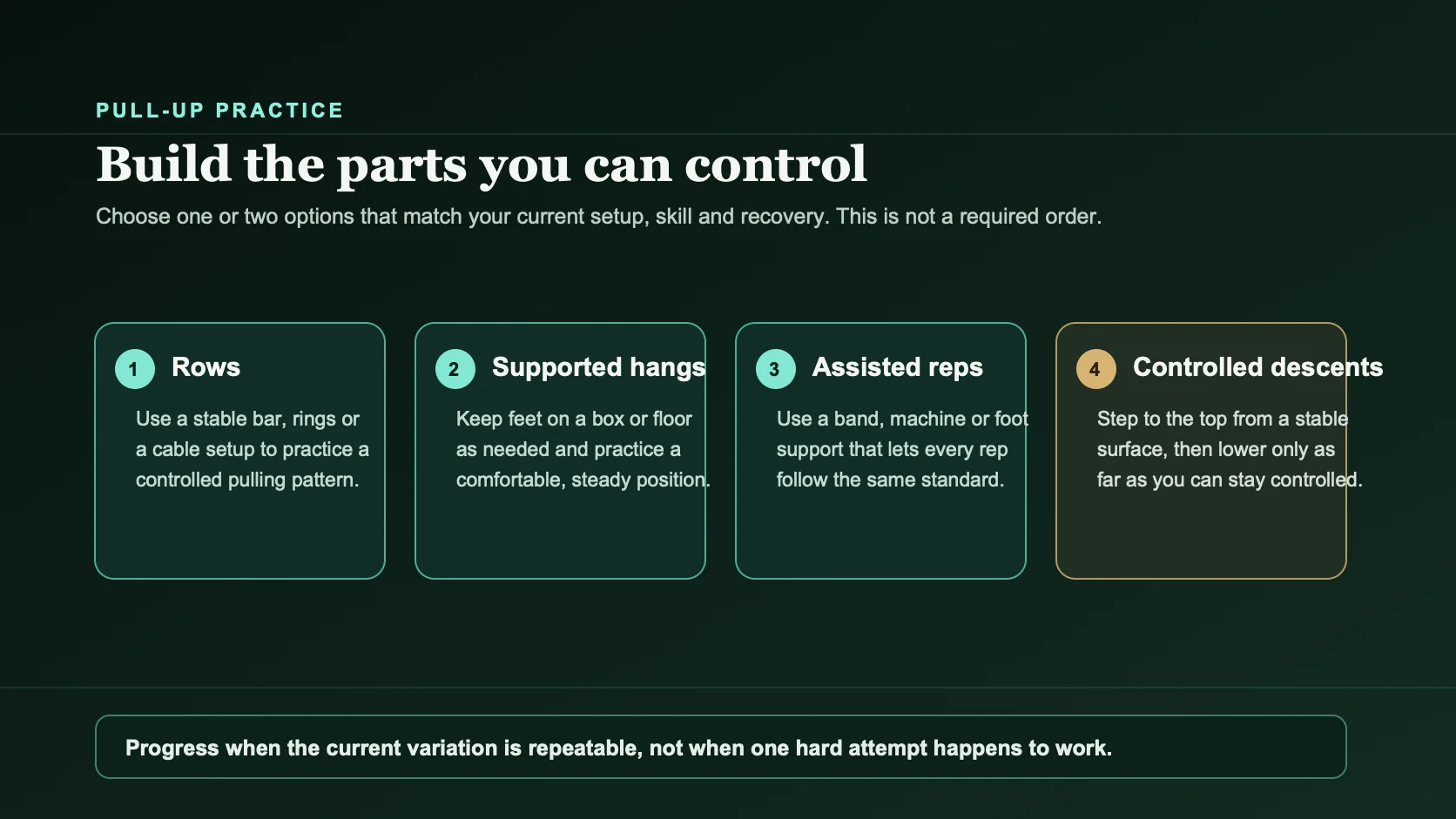
That is why a first pull-up is rarely helped by one heroic attempt at the end of every workout. It is better built from smaller pulling tasks that are repeatable: rows, supported hangs, assisted repetitions, and controlled descents. Each option gives you a way to practice part of the job without pretending that one exercise works for every person or every training space.
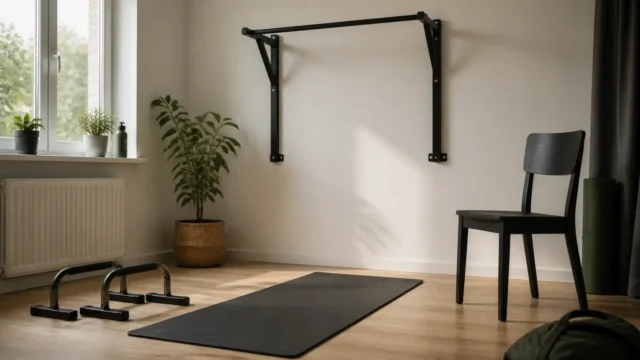
This guide is for beginners who can use a secure pull-up station, rings, a stable low bar, or another appropriate pulling setup. Do not improvise with a doorframe, loose furniture, or a bar you have not confirmed is designed to support your bodyweight. If you have acute shoulder or elbow pain, a recent injury or surgery, dizziness, numbness, or a health condition that changes how you should exercise, get individual guidance before building a progression around it.
- Set a standard for the first rep
- Build pulling practice before testing
- Choose assistance you can measure
- Use descents with control
- Know when to try the unassisted rep
Decide what counts as your first pull-up
Before you chase a first rep, choose a simple standard you can repeat. A common option is an overhand or neutral grip, a controlled start with arms extended as your shoulder comfort allows, and a finish where your chin is clearly above the bar. The exact grip and range may differ with the equipment and your tolerance. What matters is that you do not change the standard every time the attempt gets hard.
You do not need to swing, kip, or turn the first rep into a different movement to make it count. Those methods have their own contexts, but they make it harder to compare one attempt with the next. A calm, repeatable standard gives you better feedback and makes the eventual rep more meaningful.
The ACSM position stand on resistance-training progression is not a pull-up tutorial, but its basic principle applies: choose a manageable level of resistance, practice it consistently, and progress the variables deliberately. A pull-up progression is still resistance training even when the resistance is mostly your bodyweight.
Build the pull before you test it
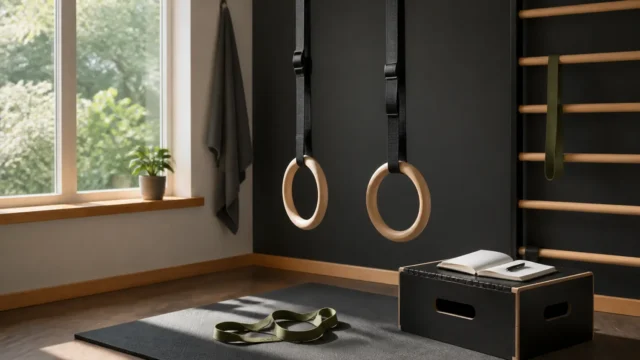
A pull-up asks you to move your whole body, so the first useful question is not “Can I do one today?” It is “What pulling work can I repeat with control this week?” Rows are often the most accessible answer. A body row on a stable low bar, ring row, or cable row lets you practice a similar upper-body pulling pattern while changing the difficulty by changing body angle or load.
Rows do not need to copy a pull-up exactly to be useful. They give you a way to train the back and arm muscles involved in pulling while you learn how to keep your torso organized. Use an angle or load that allows deliberate repetitions rather than a version that forces you to jerk upward or lose position early.
Supported hangs can also help you get familiar with the bar. Keep some weight through the feet on a box or the floor if needed. The aim is not to prove grip endurance by hanging until your hands give out. It is to learn a comfortable, stable position and to notice whether the setup or your shoulders object to the movement.
For the surrounding bodyweight routine, start with Calisthenics for Beginners: Where to Start. A first pull-up develops more smoothly inside a week that also includes pushing, leg work, trunk training, rest, and a realistic schedule.
Choose assistance you can make smaller over time
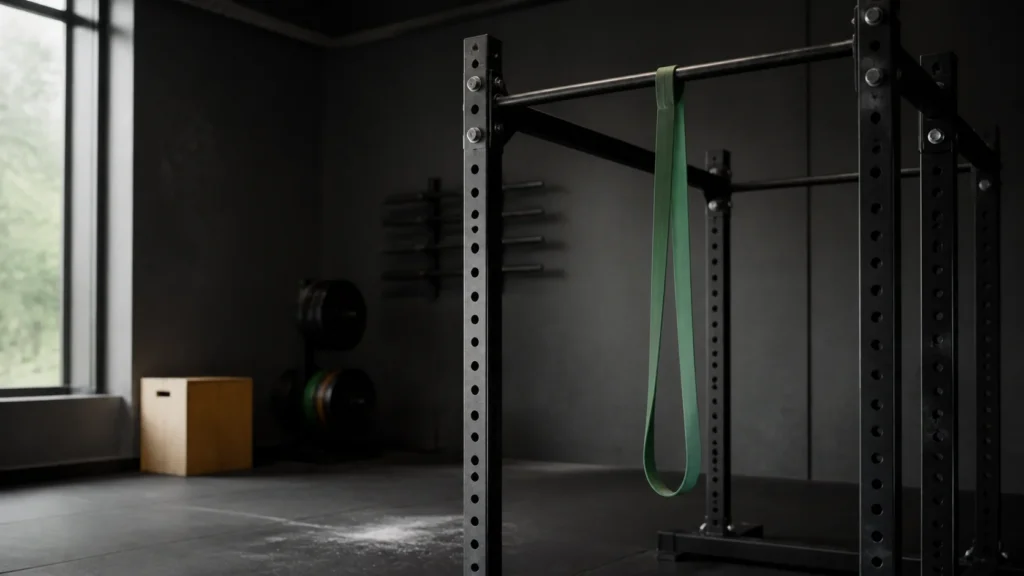
Assisted pull-ups are useful when the help is consistent enough to compare. A resistance band, assisted machine, or foot-supported setup can all work. The practical test is simple: can you use the same assistance, grip, range, and pace for the planned repetitions?
With a band, choose enough assistance that you can move without kicking or rushing the bottom of the rep. With a foot-supported setup, use only as much leg drive as the current variation requires and keep the support arrangement the same from session to session. With an assisted machine, record the assistance setting just as you would record a load.
Assistance is not a shortcut around the movement. It is the adjustable part of the movement. When the same number of controlled reps becomes more repeatable, reduce the assistance slightly or add a repetition within a planned range. Do not reduce assistance, add more sets, and introduce slow descents all in the same week. One change at a time gives you a better chance to understand what happened.
Progressive Overload Is More Than Adding Weight to the Bar explains why this counts as progression. In bodyweight training, a smaller band, less foot support, a cleaner range, or one additional controlled rep can all make the work more demanding.
Use controlled descents as practice, not punishment
A controlled descent, sometimes called an eccentric, begins near the top position and lowers toward the start. Use a stable box or step to reach the top rather than jumping to the bar. Lower only as far and as slowly as you can maintain control; a sudden drop is not a productive target.
Descents can be demanding, so begin with a small number of high-quality repetitions and leave enough rest to repeat the position. If the next repetition requires you to scramble back to the top or your elbows and shoulders feel increasingly irritated, end the set or choose a less demanding option next time. The goal is practice, not a dramatic burn.
There is no requirement to use descents at all. Some people progress well with rows and assisted reps until an unassisted attempt becomes realistic. Others use brief descents because they have access to a stable step and can recover from them. Choose the route that provides clear, safe repetitions in your actual environment.
Practice often enough to learn, not to prove yourself
Two or three pulling exposures a week are enough for many beginners. One session might emphasize rows and assisted reps; another may include supported hangs and a few controlled descents. The exact split matters less than keeping the total work manageable and the setup stable.
The World Health Organization recommends muscle-strengthening activity on two or more days per week for adults. Read the WHO physical-activity guidelines as a broad public-health framework, not as a promise that any person will get a pull-up on a fixed schedule. Your starting strength, body size, equipment, skill, recovery, and training consistency all affect the timeline.
Write down the variation, assistance, sets, repetitions, and one short note about control. That record makes slow changes visible. It also stops a random hard session from becoming evidence that you should abandon the plan or attempt a maximal pull-up every visit.
Try the first unassisted rep when the work points to it
There is no perfect checklist, but a reasonable time to try an unassisted rep is when you can consistently perform the current assisted work with a stable start, a repeatable path, and a controlled finish. Make the attempt after a normal warm-up, when the station is free and you have not exhausted your grip with unrelated work.
Treat the attempt as information. If you reach partway, note where control changed and return to the planned work. If you complete the rep, record the standard you used, then avoid turning the rest of the session into repeated max attempts. One clean rep is a milestone; it is also the beginning of a new progression problem.
Use a bar, rack, rings or machine that is designed and secured for bodyweight loading. A better progression cannot compensate for an unstable setup.
The first rep is a result of repeatable practice
The first pull-up is not proof that you suddenly became a different kind of trainee. It is the visible result of many less visible sessions: rows that became more controlled, assistance that became smaller, and a standard that stayed consistent long enough to measure.
Do not let the goal turn every session into a test. Build the pulling work you can do now, record the variation honestly, and reduce help only when the current version is repeatable. That approach may look slower than a daily challenge, but it gives you a plan you can keep using after the first rep arrives.
FAQ
How often should I train for my first pull-up?
For many beginners, two or three pulling exposures per week are enough. Keep the setup and total work manageable, and include rest and the other major movement patterns in the week.
Are assisted pull-ups worth doing?
Yes, when the assistance is consistent and lets you practice a controlled range. Record the band, machine setting, or foot-supported arrangement so you can make a fair comparison over time.
Should I do negatives every day?
Not automatically. Controlled descents can be demanding. Use a small number only if you can set them up safely, recover from them, and keep the descent controlled. Rows and assisted repetitions are valid alternatives.
Continue with a related guide
Build the full bodyweight foundation in Calisthenics for Beginners: Where to Start. For the same progression logic applied to pushing, continue with Push-Ups: The Exercise Most People Stop Progressing Too Soon.