
Stretching after training is one of the most familiar gym rituals. You finish the last set, find a quiet corner, pull a hamstring into a long hold, and leave with the feeling that you have done the responsible thing. That feeling can be valuable. It is not the same as proof that the stretch has restored your muscles, removed tomorrow’s soreness, or repaired a hard session.
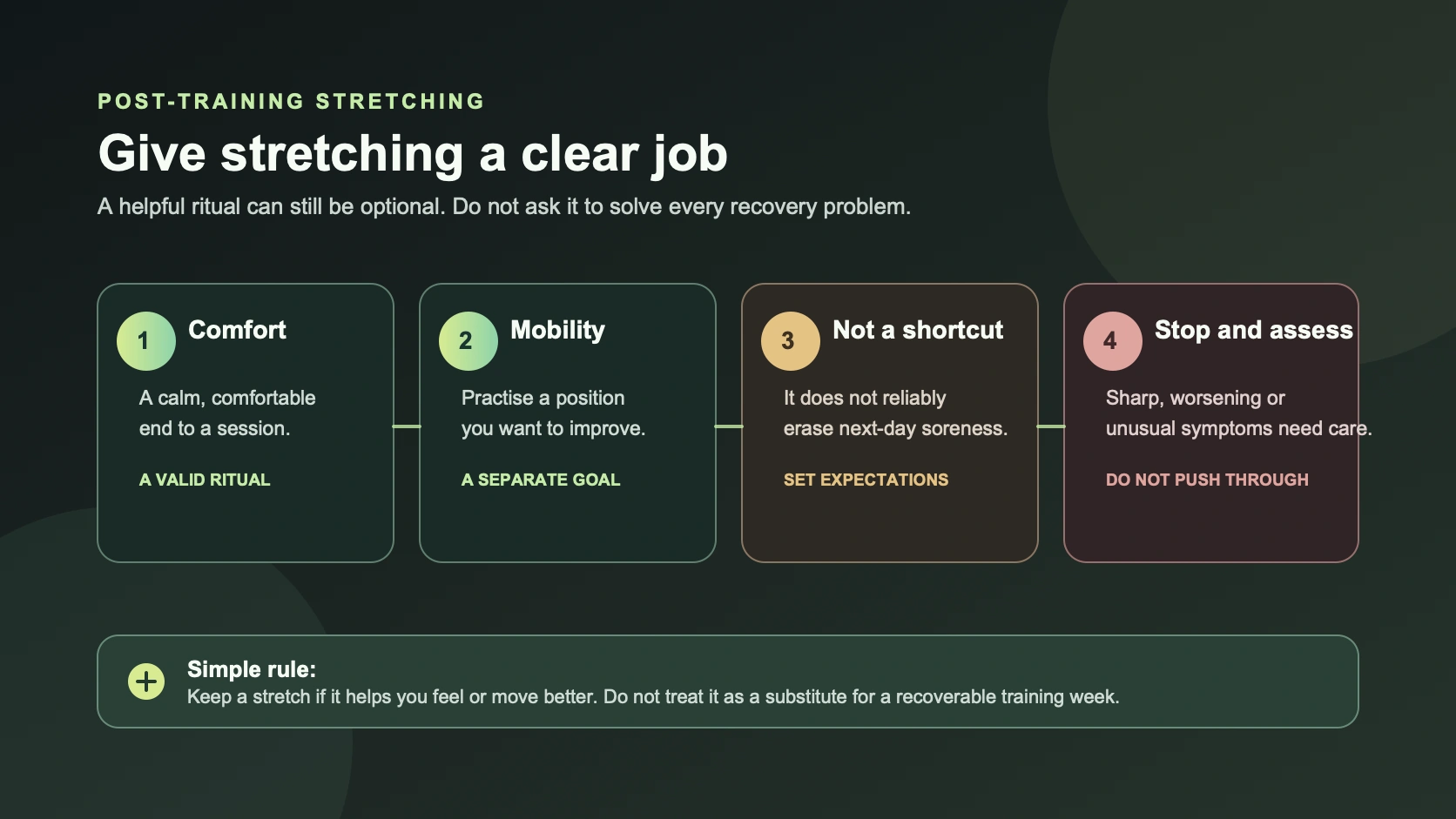
The useful answer is less dramatic. Post-training stretching can be a pleasant way to slow down, notice how you feel, or spend a little time on a range of motion you care about. It is not a reliable recovery shortcut. If you enjoy it and it stays comfortable, it can belong in your routine. If you are doing it only because you think it will erase the cost of training, the evidence does not support that expectation.
That distinction frees you from two bad extremes: treating stretching as mandatory, or dismissing it because it is not magic. A ritual can still have a job. The job just needs an honest name.
- What post-training stretching can and cannot promise
- Why soreness is not the right test
- Mobility practice and recovery are different goals
- How to keep a stretching routine useful
- When a stretch is not the right response
Start with the claim you are making
People use the word recovery to describe several different things: feeling calmer after a session, reducing stiffness after sitting, restoring strength for the next workout, improving a movement position, or preventing delayed-onset muscle soreness. A few easy stretches may help one person transition out of a session or feel more comfortable. That does not mean they have the same effect on every other outcome.
The strongest claim is the one stretching cannot reliably carry. A 2021 systematic review and meta-analysis of post-exercise stretching compared stretching with passive recovery and found no clear benefit for strength recovery or soreness at 24, 48 or 72 hours. The authors also noted that the evidence base was small, mixed and generally low confidence. That does not prove stretching has no subjective value. It does mean you should not build a recovery plan around the promise that it will make hard training disappear.
The earlier Cochrane review reached a similar practical conclusion: stretching before or after exercise did not create clinically important reductions in delayed-onset muscle soreness for healthy adults. Read the Cochrane review of stretching and muscle soreness for the full evidence summary. The takeaway for a normal lifter is simple: being sore tomorrow is not evidence that you forgot to stretch today.
Soreness is a feeling, not a stretching score
Soreness can follow a new exercise, a higher-than-usual dose, a long session, a return after time away, or a movement your body has not recently practised. It can also vary for reasons that have little to do with one cooldown. Sleep, total training load, food, stress, novelty and individual response all affect how a session feels afterward.
That is why the post-workout test is misleading. A stretch may feel satisfying immediately because it changes sensation or gives you a calm end point. You can enjoy that without assuming it has changed the recovery timeline. If your program repeatedly produces soreness that makes the next planned session unworkable, the more useful question is usually whether the training dose, exercise selection, progression or schedule fits the week.
Recovery Is Part of the Program makes the wider point: recovery is created by the structure of the week, not by a collection of things done after the fact. A five-minute routine can be a nice addition. It cannot consistently compensate for sessions that are too large, too frequent or poorly placed.
Mobility work has a different job
Stretching may be part of mobility practice when you have a movement or position you want to make more comfortable and can train it gradually. That is a separate goal from recovering from today’s workout. You might work on ankle range to make a squat position easier, shoulder comfort for an overhead movement, or hip motion that a particular sport requires. The best approach depends on the goal, the movement and the person.
This is also why a generic full-body stretch routine is not always necessary. If there is no mobility goal and you do not enjoy stretching, you do not need to add it as a compulsory tax after every session. If a short routine helps you settle down or supports a movement you are practising, keep it simple and specific.
Context matters before training too. A 2016 systematic review of acute stretching effects found that long static or PNF holds immediately before performance could produce small-to-moderate changes in some measures, while dynamic activity within a broader warm-up had a different role. That is not an argument against post-training stretching. It is a reminder not to treat every type, timing and goal as the same intervention.
A ritual can be useful without being a protocol
There is room for a low-pressure post-training ritual. A few comfortable positions, a slow walk out of the gym, putting equipment away without rushing, or a few minutes of quiet breathing can mark the end of the session. That transition may make training feel more sustainable even if it does not change a laboratory recovery marker.
Use a small routine if it gives you a clear benefit you can actually name: it feels pleasant, it helps you maintain a position you are actively working on, or it makes it easier to leave the gym without immediately jumping into the next task. Keep the intensity low enough that you are not trying to prove flexibility. The sensation should be tolerable, controllable and easy to stop.
Avoid turning the ritual into another scoreboard. You do not need to collect a precise number of minutes, add more positions every week, or force a stretch because a training app says it is mandatory. The goal is not to build the longest cooldown. It is to use the smallest version that fits your life.
For a broader rest-day decision, What a Good Rest Day Actually Looks Like keeps the focus on reducing demands rather than filling every free minute with recovery chores. A recovery practice should lower friction around the next workout, not become another task you fail to complete.
When stretching is not the right response
Do not use stretching to push through sharp, worsening or localized pain, a new loss of strength, numbness, significant swelling, or a movement pattern that suddenly feels different. Stop the activity and seek appropriate individual guidance when those apply. A general guide cannot tell whether a specific symptom is ordinary training discomfort, an injury, or something unrelated to training.
The same caution applies to a pattern of fatigue or soreness that does not match the work you are doing. More stretching may feel like a harmless answer, but it can delay the more important step: looking at training load, sleep, food, illness, stress or the need for professional assessment. Active Recovery vs Doing Absolutely Nothing offers a useful next decision once you know the issue is ordinary training fatigue rather than a warning sign.
Conclusion
Stretching after training is best understood as optional. It can be a useful comfort practice, a calm end to a session, or one part of a mobility goal. It is not a dependable way to restore strength or prevent meaningful next-day soreness.
Keep it if it makes your training experience better. Skip it if it feels like an obligation. Put the bigger recovery decisions where they belong: in a training dose you can recover from, adequate rest, and a week that leaves room for ordinary life.
FAQ
Should I stretch after every workout?
Only if it has a clear purpose for you, such as comfort, a mobility goal or an enjoyable transition out of training. It is not mandatory for recovery, and missing it does not mean you have compromised the session.
Does stretching after training prevent soreness tomorrow?
Current systematic reviews do not show a meaningful reduction in delayed-onset muscle soreness from stretching after exercise compared with passive recovery. Soreness is better managed by making the overall training dose repeatable.
Continue with a related guide
For a practical approach to rest days, read What a Good Rest Day Actually Looks Like. For a separate decision about easy movement after training, continue with Active Recovery vs Doing Absolutely Nothing.