

Active recovery sounds like a better answer than rest. It sounds intentional, while doing nothing can feel lazy when you are used to following a plan. But a recovery day is not improved just because it contains more activity. The useful choice is the one that leaves you more ready for the next session that matters.
For some people, that means a relaxed walk, an easy spin on a bike, or normal errands. For others, it means an unstructured day away from training. Both can be sensible. The problem starts when an easy activity quietly becomes a second workout, or when rest becomes a rule you follow even though light movement would help you return to your routine feeling better.
This guide is for everyday lifters, not athletes trying to recover between multiple events on the same day. It does not diagnose persistent fatigue, illness, pain, or a training problem. If movement causes sharp pain, unusual shortness of breath, dizziness, new weakness, or symptoms that are getting worse, stop and seek appropriate medical advice.
- What active recovery actually means
- Why rest is not a failure of discipline
- How to keep easy activity easy
- A practical way to choose between them
- When neither option should be self-managed
Active recovery is low-cost movement, not bonus training
Active recovery is simply light activity performed after hard work or on a day without structured training. In practice, it may be a walk, an easy cycle, gentle mobility that you already tolerate well, or the ordinary movement of a normal day. The label describes the role of the activity, not a magic method.
The missing word in many recovery conversations is easy. If the pace rises because you are chasing steps, sweat, calories, a segment, or a new conditioning goal, the activity may no longer be recovery. It may still be worthwhile exercise, but it belongs in the training plan and should be counted as part of the week’s cost.
The evidence does not support treating active recovery as universally superior. A 2019 systematic review of post-exercise active recovery found varied methods and outcomes, with limited evidence that it reliably improves later performance. That does not make an easy walk useless. It means the outcome depends on the activity, the person, the prior session, and what “recovered” is supposed to mean.
For a lifter, the practical value is often simple: light movement can provide a change of scene, keep a routine intact, and feel pleasant without creating meaningful fatigue. Those are enough reasons to use it. They are not reasons to claim that everyone needs a recovery protocol.
Complete rest is a legitimate training decision
Rest is not the absence of discipline. It is the choice not to add another demand when your week already contains enough. A full rest day can give you time for sleep, meals, work, relationships, and the unremarkable parts of life that make training repeatable.
This matters most when the gym is not the only stressor. A late night, long travel day, physical job, family responsibility, or an accumulating cold can change the cost of even easy exercise. There is no virtue in forcing a walk because an app says your recovery should be active. If you are depleted enough that a short outing feels like a task, rest may be the more useful option.
That is consistent with the bigger principle in Recovery Is Part of the Program: recovery is planned space that lets important sessions retain their quality. It does not need to look athletic to count. A quiet day with normal food, enough time in bed, and no additional training load can be a very practical piece of programming.
The context changes the answer
Recovery between intervals, recovery after a hard session, and a rest day in a strength program are related but different problems. The research often examines very specific situations: repeated sprints with short breaks, or interval sessions performed over several weeks. Its conclusions should not be copied directly into a recreational lifting week.
For example, a systematic review of repeated-sprint protocols reported that passive recovery reduced performance decline more than active recovery in running studies, while cycling findings were mixed. The result is useful because it shows that the “right” answer changes with the task. It is not a rule that all lifters should sit still after every workout.
A 2024 review of interval-training programs reached a similarly modest conclusion: both active and passive recovery formats can coexist with improvements in fitness, and the current evidence does not establish one as the winner across people and programs. That is good news for ordinary trainees. You do not need a perfect recovery ritual. You need an option that fits the day and does not compromise the next planned session.
If you lifted hard yesterday and have an easy day today, a comfortable walk may be fine. If you ran intervals and need to repeat speed work shortly, lower-demand rest may make more sense. If your legs are sore but your energy and mood are normal, light movement can be pleasant. If soreness sits beside poor sleep and unusual fatigue, adding a long ride just to call it recovery is unlikely to solve the underlying mismatch.
A recovery activity is successful when it supports readiness for the next planned session, not when it produces a satisfying workout summary.
Put a ceiling on active recovery
The easiest way to protect a recovery day is to decide its ceiling before you start. Choose an activity that is familiar, easy to stop, and does not require you to push through discomfort. A walk with a friend, a short easy spin while you can comfortably hold a conversation, or a few errands on foot all meet that standard better than a complicated circuit.
Keep the target qualitative rather than turning it into a new test. You should finish feeling about the same or a little more settled than when you started. If you are timing the effort, competing with a previous route, or adding intervals because the session feels too easy, you have changed the job of the day.
There is also no need to stack methods. A walk, mobility routine, long stretch, sauna, cold plunge, foam rolling session, and extra cardio do not become more effective just because they are all called recovery. Use the smallest useful option. If you are unsure, doing less makes it easier to see how you respond and less likely that recovery becomes another project.
For a clearer look at the training-side decision, When Your Program Is Asking for a Deload explains how to reduce the cost of a whole week when a repeated trend suggests the current dose no longer fits. A rest day or easy walk can be helpful; neither is a substitute for changing a plan that is repeatedly too expensive.
A simple decision for an ordinary rest day
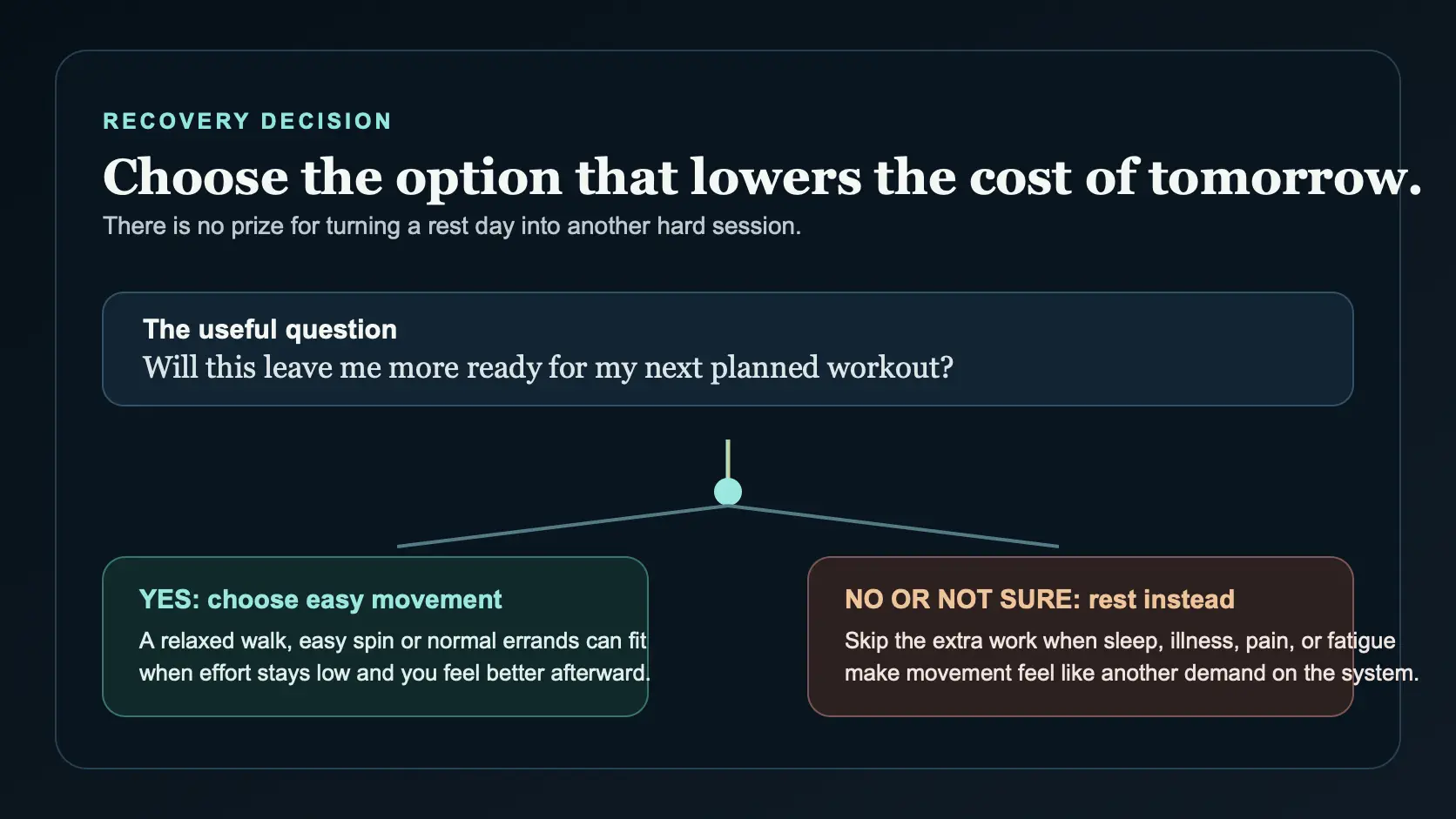
Start with the next session, not the activity you feel you should do today. Ask three questions:
- Is there a clear reason to move lightly, such as feeling stiff from sitting, wanting fresh air, or enjoying an easy routine?
- Can I keep the effort low without turning it into a workout?
- Will I probably feel more ready for my next planned session after this than if I rested?
If the answer is yes, choose the easy movement and keep it genuinely easy. If the answer is no or uncertain, rest without trying to compensate for it later. The decision does not have to be permanent. A person may prefer an easy walk after a desk-bound day and complete rest after a long shift. That is normal adjustment, not inconsistency.
The same caution applies to a week that keeps feeling hard. Several flat sessions, poor sleep, and persistently low motivation are not solved by choosing a better recovery modality. Fatigue, Overreaching and Overtraining Are Not the Same Thing explains why a pattern needs more context than one rough day. Look at the training dose, life stress, sleep, and symptoms before assigning a label.
Know when to step outside the article
Light activity and rest are everyday training choices, not treatment plans. Do not use either option to manage chest pain, fainting, significant swelling, sudden weakness, severe shortness of breath, or pain that is sharp, persistent, or worsening. Stop the activity and get appropriate individual advice.
The same applies to unexplained fatigue that lasts, interferes with daily life, or arrives alongside other concerning symptoms. Training may be part of the context, but it is not automatically the cause. The responsible answer is not a more elaborate recovery routine; it is an assessment that fits the situation.
Conclusion
Active recovery and complete rest are both useful tools. Neither deserves a moral label. Use easy movement when it is truly easy, fits your day, and makes the next session feel more achievable. Choose rest when more movement would be another demand or when life has already made the week expensive.
The practical goal is not to win the rest day. It is to arrive at the next important workout with enough energy, attention, and willingness to train well.
FAQ
Is walking always active recovery?
No. A relaxed walk can be active recovery, but a long, fast, or goal-driven walk may be additional training. The label depends on the cost it creates and how it affects your next session.
Should I do active recovery when I am sore?
Sometimes easy movement can feel good with ordinary soreness, but soreness alone does not require a protocol. Keep the effort low and stop if pain is sharp, worsening, or changes how you move. Choose rest or seek individual advice when symptoms call for more caution.