

A deload is supposed to make training less expensive for a short time. That part is straightforward. The confusing part is deciding what to remove: sets and repetitions, load on the bar, proximity to failure, exercise variations, or some combination of all of them.
There is no universal percentage that turns a normal week into the correct deload. A hard strength block, a high-repetition phase, a difficult work week, and travel do not create the same problem. The useful question is: which part of this week is creating more cost than you can currently recover from?
For many lifters, volume is the clearest first lever: fewer hard sets mean fewer demanding repetitions and a simpler session while familiar movements stay in the routine. But load and effort should also fall when warm-ups feel unstable, technique is drifting, or a heavier bar creates more concern than useful practice.
This is a general programming guide, not a diagnosis or an injury plan. Do not use a self-directed deload to manage chest pain, fainting, severe shortness of breath, sudden weakness, significant swelling, or sharp, persistent, or worsening pain. Stop the activity and seek appropriate individual advice when those situations apply.
- What volume and intensity each change
- Why volume is often the first lever
- When intensity also needs to come down
- Three practical deload decisions
- How to return without undoing the point
Volume and intensity solve different problems
In everyday gym language, volume is the amount of work you do: hard sets, repetitions, exercises, and sometimes the total workload across the week. Intensity usually means the load relative to what you can lift, although people also use it to mean how hard a set feels. That is why a useful deload should name the actual change instead of relying on the word alone.
Cutting volume might mean doing two controlled squat work sets rather than five, dropping a back-off set, or removing the final accessories. Cutting intensity might mean using a lighter load, choosing a simpler variation, or keeping more repetitions in reserve. Volume reduction lowers the number of demanding exposures; intensity reduction lowers the cost of each one.
When Your Program Is Asking for a Deload covers the broader decision. A lighter week is a programming adjustment, not an award for suffering.
Cut volume first when the movement still feels trustworthy
If technique is stable, warm-ups feel normal enough, and the goal is to maintain familiarity with a strength movement, reducing volume first is often the most useful place to start. Keep the main lift, make fewer hard sets, and leave more room before failure. The session keeps its shape without carrying the same accumulated cost.
This approach is common in practice, but it is not a law of physiology. A 2024 survey of 204 strength and conditioning coaches found that most respondents reported reducing volume during planned deload periods, most often by 0 to 25 percent. The coach survey on planned deload prescriptions describes reported practice, not an optimal percentage for every lifter.
The attraction is simple: you can keep a familiar squat, press, pull, or hinge without repeating every hard set that made the previous week costly. That continuity matters when the movement itself is a skill.
Volume reduction is especially sensible when sessions run long, accessories keep expanding, or several sets are close to failure. The 2025 systematic review of resistance-training fatigue variables identified total volume, set duration, and proximity to failure as important drivers of acute fatigue responses. It is context, not a personal prescription.
Lower intensity when load is no longer giving you useful practice
Keeping some familiar loading can be useful, but it is not an obligation. Intensity should come down when the load itself is making the session unreliable: warm-ups feel unexpectedly heavy across more than one session, positions are hard to hold, normal technique is deteriorating, or every set needs a disproportionate amount of focus just to feel controlled.
Travel, disrupted sleep, unusual work stress, or a compressed week can also reduce the attention and recovery you can bring to heavier work. Cutting sets alone may preserve the most expensive part of the workout.
Lowering intensity does not require turning a lifter into a different kind of trainee for a week. It can be as modest as using a load that allows clean repetitions, stopping further from failure, or replacing a variation that demands more setup than the day can support. The goal is to maintain a useful relationship with the movement, not to rehearse a maximum attempt in disguise.
This distinction also matters because strength training can become too binary in people’s heads: either lift heavy exactly as written or stay home. The Difference Between Training Hard and Making Every Session a Test explains the middle ground. A small, proportionate change can protect the part of the program that matters without turning one difficult week into a referendum on the entire plan.
Use the decision that matches the kind of fatigue
The same word, “tired,” can describe several different situations. A useful deload separates them before changing the plan.
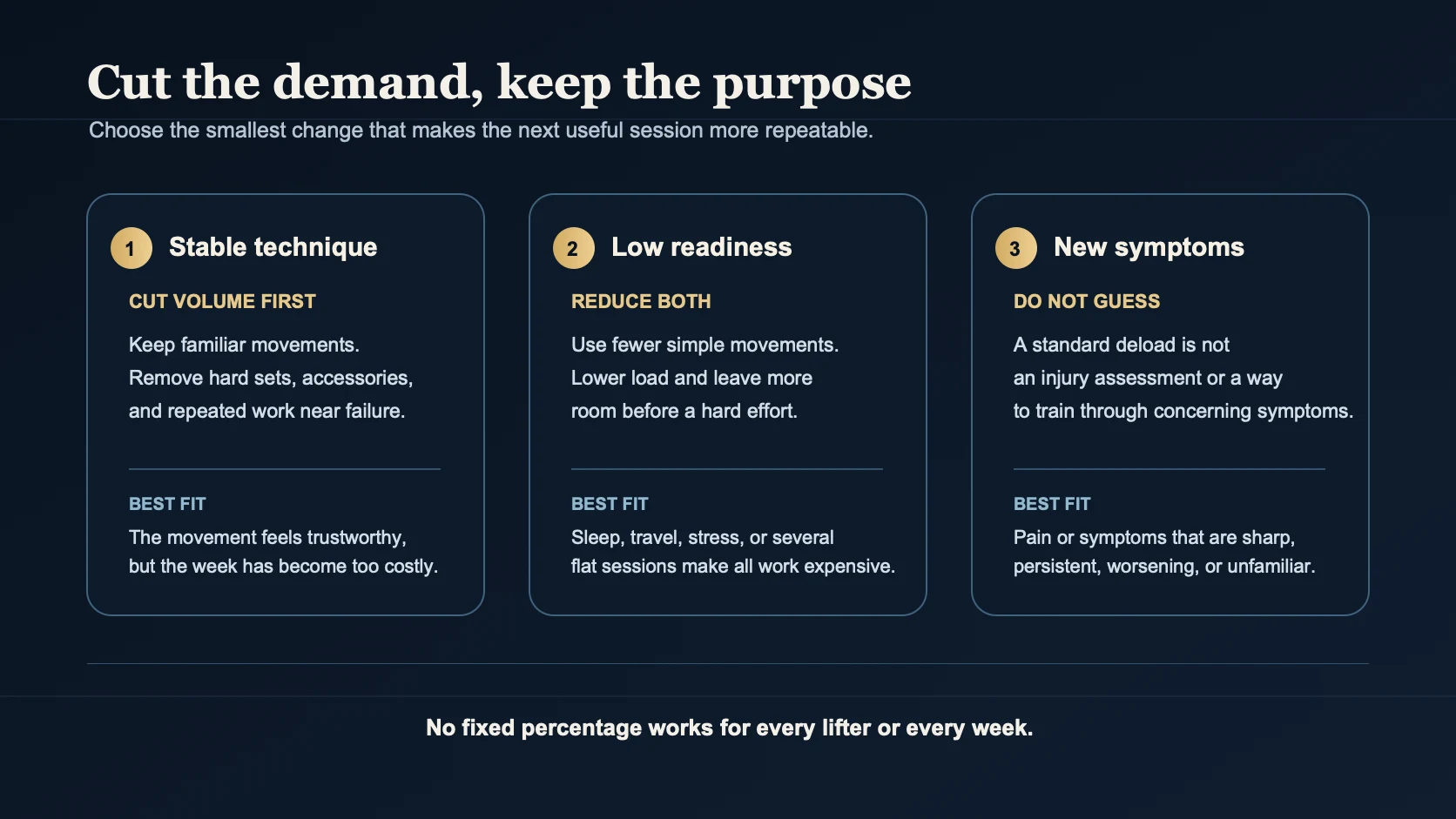
1. Stable technique, too much accumulated work
If your lifts look and feel broadly normal but the week has become bloated, cut volume first. Keep the few movements that serve your immediate goal. Remove the extra sets, drop optional accessories, and stay clearly away from failure. A strength-focused lifter might keep a small amount of controlled, familiar work with the main lift, then leave before the session asks for its usual volume.
This is not a promise that strength will rise because you did less. It is a way to reduce the bill while preserving normal practice. The survey of deloading practices in strength and physique sports similarly describes athletes reducing repetitions and weekly sets while generally keeping familiar exercise selection.
2. General fatigue, low readiness, or an unusually demanding week
When the entire week feels expensive, reduce both volume and intensity. Choose a few simple movements, controlled loads, and end with plenty left. This often fits poor sleep, travel, heavy work demands, or several flat sessions better than preserving a hard top set and hoping fewer accessories will solve everything.
What a Good Rest Day Actually Looks Like makes the related point: recovery does not need to become a performance task.
3. Pain, new symptoms, or a movement that no longer feels safe
Do not treat this as a normal volume-versus-intensity decision. Cutting the load may make a session more tolerable, but it does not tell you what a symptom means or whether training through it is appropriate. A standard deload is a tool for managing ordinary training stress; it is not an assessment.
If a symptom is sharp, persistent, worsening, associated with numbness or sudden weakness, or changes how you move, stop trying to solve it by rearranging sets. Get guidance that fits the situation. The same boundary appears in Fatigue, Overreaching and Overtraining Are Not the Same Thing: a persistent decline or concerning symptom needs more context than a training article can provide.
Before the deload starts, write down what you reduced and why. “Two fewer hard sets because the week was accumulating fatigue” is actionable. “I did whatever felt easier” is harder to learn from.
Do not reduce one variable and quietly add another
A deload fails when “less volume” becomes extra mobility circuits, conditioning intervals, experimental exercises, or lighter sets taken to exhaustion. Keep the week plain, use familiar movements, and avoid turning removed sets into another training goal.
Direct evidence on deload design is limited. The consensus paper on deloads in strength and physique training defines the purpose as reduced training stress, not a single template for every lifter.
Return by restoring the plan, not by making up the work
A deload has an exit. Before it starts, decide whether you will restore the previous set count, use a more manageable version, or revise the schedule if life was the real limit. The first normal session does not need to repay skipped work; it shows whether the usual dose is repeatable again.
Notice what changed. Did fewer hard sets make the main lifts feel familiar? Did lower loading restore control? If the usual plan still looks impossible, review the program, sleep, scheduling, and persistent symptoms with appropriate support. Recovery Is Part of the Program cannot compensate forever for a dose that does not fit your current life.
Conclusion
For many lifters, volume is the first thing to cut during a deload because fewer hard sets reduce the accumulated cost while preserving familiar practice. Intensity should also fall when heavier loading no longer produces clean, useful work or when the week has reduced the capacity to handle it.
Keep the decision tied to the problem you actually see. Cut volume when repeated work is the cost. Reduce both variables when the whole week is demanding. Step outside the standard deload framework when symptoms need individual assessment. The best deload is not the most dramatic one. It is the one that makes normal, useful training possible again.
FAQ
Should I always cut volume before intensity during a deload?
No. Volume is often a practical first lever when technique and readiness are stable, but intensity should also fall when load is disrupting control or the broader week has made heavy work unnecessarily costly.
Can I keep heavy singles during a deload?
Possibly, if they are familiar, controlled, and clearly serve a strength-specific plan. They are optional, not required. If they turn the day into a test or technique is no longer reliable, use a lower-cost version instead.
How much volume should I remove?
There is no universal percentage. Reduce enough that the week is meaningfully easier, keep the change simple enough to understand, and use your return to training to judge whether the original dose still fits.