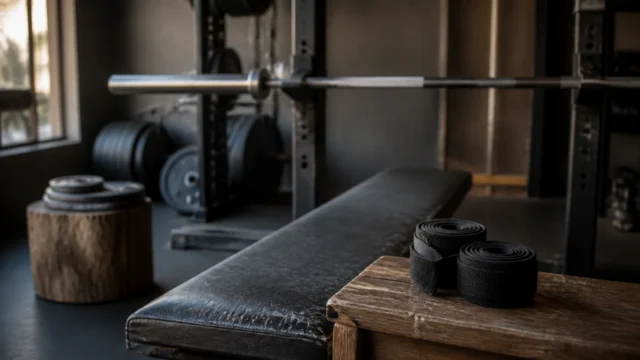
Wrist wraps are a small piece of gear that can change a heavy press. Their useful job is narrow: when applied consistently, they can help a lifter hold a chosen wrist position under a familiar load. That can make a familiar press feel more stable.
That is not the same as making the wrist stronger, fixing pain, or turning a poor setup into a safe one. Wraps are elastic fabric with a closure. They change the feel and external support around the joint; the lifter still needs to control the bar, stack the wrist sensibly, use an appropriate load, and stop when a movement is not tolerable.
This is a specification-and-use guide, not a hands-on review of a particular brand. No wrap model was directly tested for this article. The criteria below come from the construction of the item, public competition rules, and the limited research available on wrist wrapping.
- What a wrist wrap changes
- What it does not promise
- Length, stiffness, and tension
- How to test wraps in normal training
- Competition rules and maintenance
A wrap supports a position, not the whole lift
In a pressing movement, the wrist is part of a larger chain: hand, wrist, forearm, elbow, shoulder, trunk, and the path of the weight all have to work together. A wrap sits around the wrist and can resist unwanted movement away from the position you chose. Its practical value is often a more repeatable sensation when a barbell, dumbbell, or handle is loaded heavily.
The wrap does not lock the wrist into a perfect position, and it cannot decide what that position should be for you. If the bar sits poorly in the hand, the elbow is in an awkward place, or the load is beyond what you can control, more tension around the wrist does not fix the larger task. It may simply make a bad setup feel more committed.
This is why wrist wraps make most sense after the movement is already familiar. They are an optional setup tool for planned work, not an entry requirement for every press. The same function-first rule appears in You Need Less Gym Gear Than You Think: buy or use equipment when it solves a repeated problem, not because it signals that training has become serious.
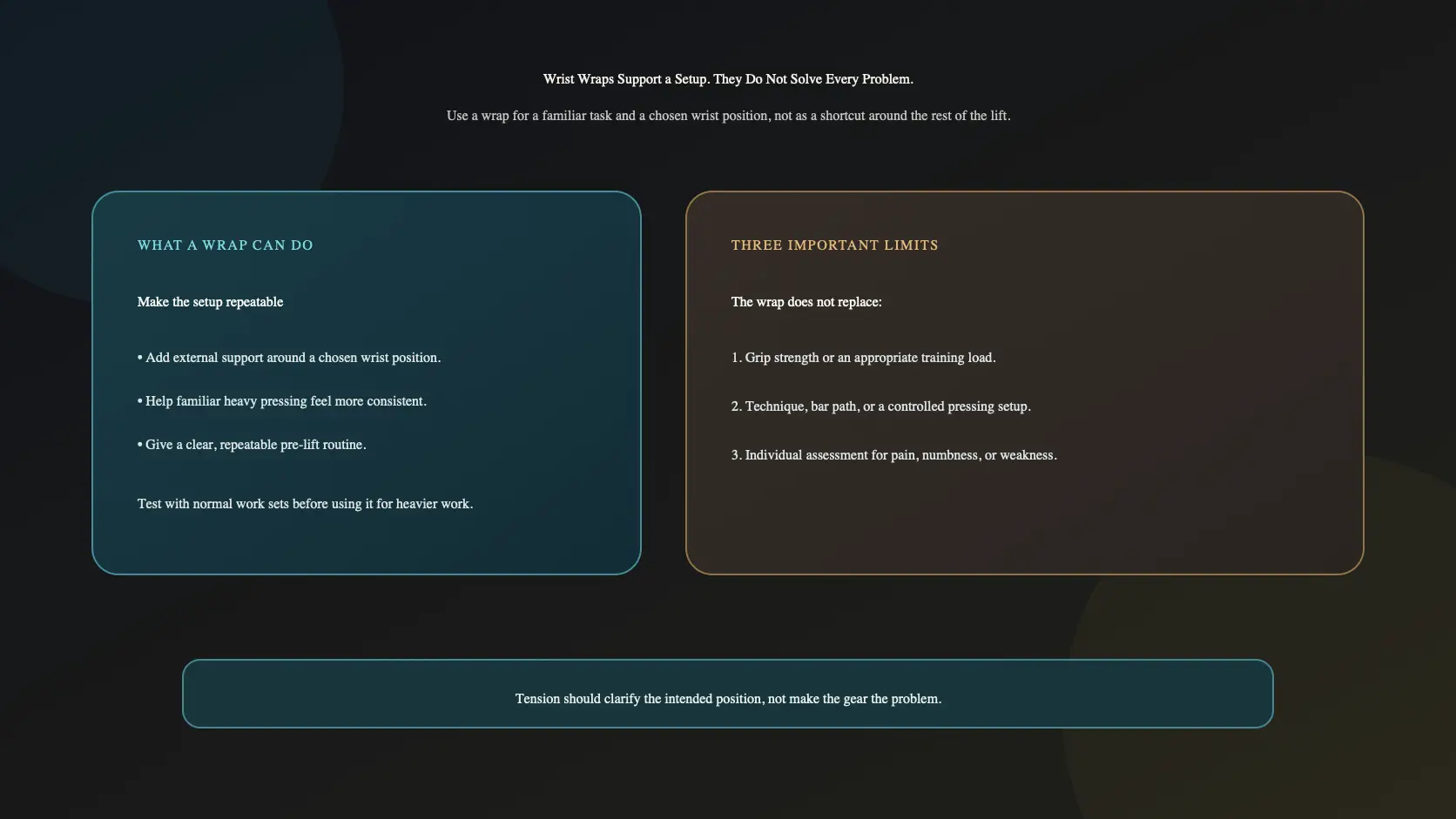
What wraps do not promise
Marketing often makes wrist wraps sound as if they improve every upper-body lift. The evidence does not support that broad claim. A 2023 randomized crossover trial in 54 CrossFit participants compared functional wrist wrapping with a placebo wrap during grip testing. It found no meaningful increase in maximal handgrip strength, dynamic grip endurance, or the measured fatigue response. Read the wrist-wrap grip-strength trial for the specific test and population.
That study does not answer every question about bench press or overhead press. It does provide a useful boundary: wrist wraps should not be sold as a general strength upgrade. Their value is more specific to the setup and sensation of the movement where you use them.
Wraps also do not diagnose or treat pain. Sharp pain, numbness, tingling, sudden weakness, or a symptom that changes how you grip or press deserves individual assessment rather than a tighter wrap. Do not use fabric tension to force through a movement that no longer feels safe. General gear guidance cannot determine the cause of a symptom or provide a personal injury plan.
Length and stiffness change the experience
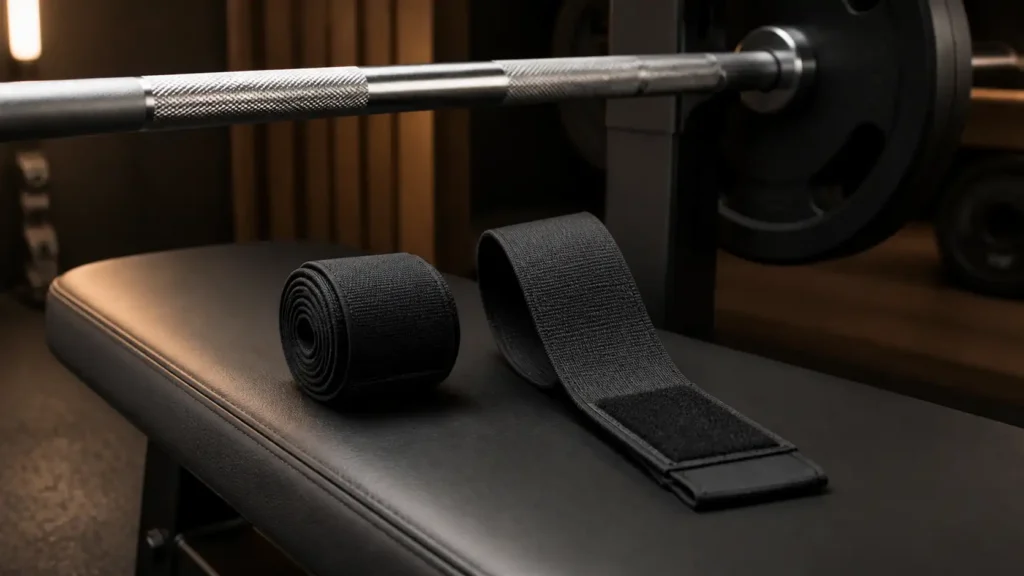
Most wrist wraps use woven elastic material, a loop to help apply the wrap, and a hook-and-loop closure. The details matter because they affect how much overlap and tension you can create.
Shorter wraps usually create a faster, simpler setup with less material around the wrist. Longer wraps allow more overlap and a broader range of tension, but they can take longer to apply and can feel restrictive if you wind them too aggressively. A stiffer material may feel more secure under a heavy press, while a more flexible wrap can be easier to tolerate across several movements. Neither is automatically better.
Choose according to the task you actually repeat. A lifter who wants a little more consistency on a familiar bench-press work set may prefer a straightforward, moderate setup. Someone practicing a competition-style press may want a tighter, more repeatable configuration. If you need a radically different tension from set to set just to make the movement acceptable, the wrap is probably not the main question.
Avoid a common error: placing the wrap so high or low that it no longer supports the area you intended, then tightening it until the hand feels numb or the wrist cannot move naturally enough to set up. Tension should make the planned position clearer, not make the gear itself the problem.
Test the setup before the heavy work
Start with a familiar warm-up, not a new maximum. Put the wrap on in the same place each time, use a moderate tension, and perform controlled repetitions with a load you already understand. Notice whether the wrist position feels easier to repeat, whether you can grip the bar normally, and whether the setup takes more attention than it saves.
Then compare a few ordinary planned work sets on separate sessions. Keep the movement, load range, and rest periods broadly similar. If you also change grip width, bar path, training volume, and load in the same workout, you will not know what the wrap changed.
The goal is not to chase a dramatic first impression. A wrap can feel unusually firm the first time you use it simply because the sensation is new. The better question is whether it makes a normal session more repeatable without adding discomfort, rushing your setup, or obscuring a problem you should address directly.
This is the same restraint that matters for heavy lifting in general. Why Heavy Loads Still Rule When Strength Is the Goal explains why heavy work should rehearse a controlled strength task rather than become a maximum attempt every session. Wrist wraps should support that plan, not encourage you to skip the plan.
Rules matter if you compete
For recreational lifting, a wrap only has to suit the exercise and feel you can reproduce. Competition adds another requirement: the exact federation’s current rulebook. The International Powerlifting Federation’s January 2026 technical rules, for example, limit wrist wraps to one metre in length and eight centimetres in width, with further restrictions on where the covering may sit around the wrist. The thumb loop may assist application but cannot remain over the thumb or fingers during the lift. Check the current IPF Technical Rules rather than relying on a retailer description.
Those limits are not universal. Other federations, divisions, and meet organizers may use other dimensions, approved-equipment lists, or inspection procedures. If a competition is the reason for the purchase, verify the rule set before you buy and practice the exact legal item during training. The broader checklist in Your First Powerlifting Meet: The Gear That Actually Belongs in Your Bag can help keep that task organized.
Care, cost, and a simple decision
Wrist wraps are usually durable because they are mechanically simple, but they still need a quick inspection. Check the stitching, elastic rebound, thumb loop, and closure. Let damp wraps dry between sessions, keep hook-and-loop surfaces free of lint, and replace a pair that no longer fastens reliably. A cheap pair that constantly comes loose is not a bargain if it disrupts the setup.
Use wraps when they have a clear job: a familiar movement, a chosen wrist position, and planned heavier work where the added consistency is useful. Leave them off when the movement does not need them, the setup is still being learned, or they are being used to override symptoms. The best wrap is the one that becomes a boring, reliable part of a sensible session.
Conclusion
Wrist wraps can make a noticeable difference under heavy weight because a small change in wrist stability can change how a press feels. That does not make them a strength shortcut or an injury solution. Their value is a repeatable setup in a movement you already know how to control.
Choose the length and stiffness for the job, test the wrap with familiar training, and keep the tension within a tolerable, reproducible range. When a wrap has a clear role, it can be useful gear. When it is being asked to solve pain, poor technique, or an inappropriate load, it is the wrong tool for the question.
FAQ
Should beginners use wrist wraps?
They are optional. Beginners usually benefit more from learning a comfortable, repeatable pressing setup and choosing sensible loads. A wrap can be introduced later if it solves a specific, repeated setup problem.
Do wrist wraps make you weaker without them?
There is no good reason to treat wraps as automatically making the wrist weak. They are external gear, not a replacement for training. Use them selectively when they support a planned task rather than making them compulsory for every exercise.
Are wrist wraps and lifting straps the same thing?
No. Wrist wraps support the wrist area. Lifting straps loop around the wrist and bar to change the grip demand in pulling exercises. They solve different problems and should not be evaluated as interchangeable gear.
Continue with a related guide
For a broader buying framework, read You Need Less Gym Gear Than You Think. For another small piece of support gear with a different job, continue with Sleeves or Wraps? Two Very Different Ways to Support the Knee.