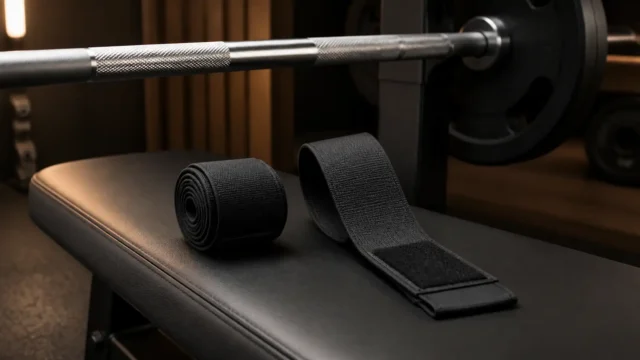
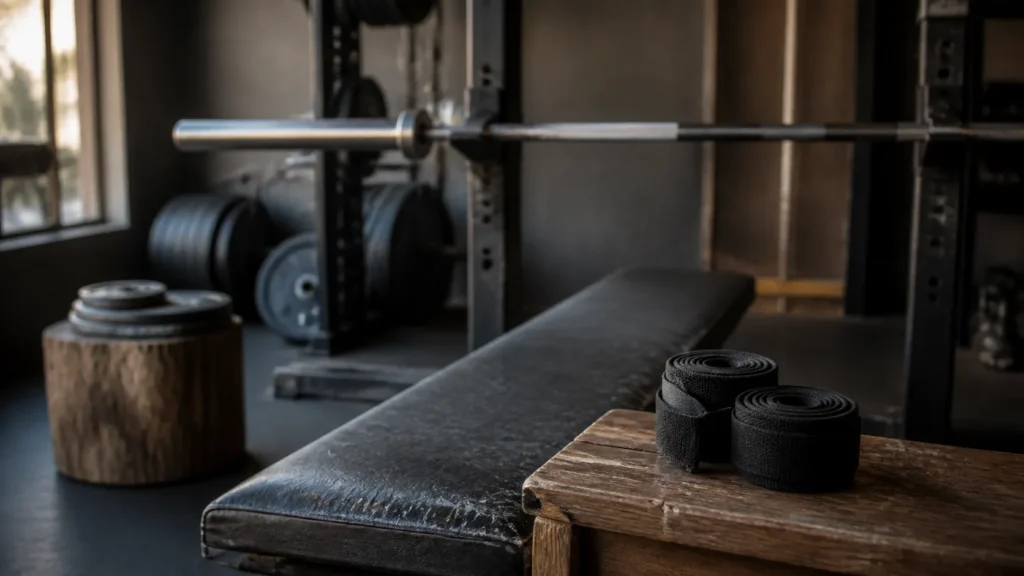
Wrist wraps show up around bench presses long before most people need them. A new lifter sees experienced benchers wind a pair tightly before a heavy set and assumes wraps are part of the lift itself. They are not. A bench press can be learned, progressed and performed well without them.
Wraps become worth considering when they solve a narrow, repeatable setup problem. On a familiar barbell bench press, they may help you hold the wrist position you have already chosen while the load becomes more demanding. That is a useful job. It is also a much smaller claim than “wraps make bench press safer” or “wraps make you stronger.”
The question is not whether serious lifters use wrist wraps. Many do, and many do not. The question is whether they improve the planned work you are doing today without replacing the skill, judgment and control that the lift still requires.
- What wraps can add to bench press
- Three signs they may have a job
- When to wait instead
- How to test wraps without changing everything
- Competition rules and simple maintenance
The wrap supports a position, not the press
In a barbell bench press, the wrist is only one part of a longer setup. How the bar sits in the hand, the line from hand through forearm, the position of the elbows, the contact you create with the bench and the path of the bar all matter. A wrist wrap goes around one small part of that system. It can make the chosen position feel more supported or more repeatable. It cannot choose the position for you.
That is why wraps are a poor first answer when bench press feels inconsistent. If the grip changes every set, the bar sits differently in each hand, or the load forces you to lose control, fabric around the wrist does not solve the source of the problem. It can make an unstable setup feel more committed without making it better.
The broader guide, Wrist Wraps: Small Piece of Gear, Big Difference Under Heavy Weight, explains what the item can and cannot do across pressing movements. For bench press specifically, the test is simpler: does the wrap help you reproduce a setup you already understand during planned work?
Three signs wraps may have a real job
There is no universal load percentage or bodyweight milestone that justifies wrist wraps. A number on the bar does not tell you whether your setup is stable. Instead, look for three practical conditions.
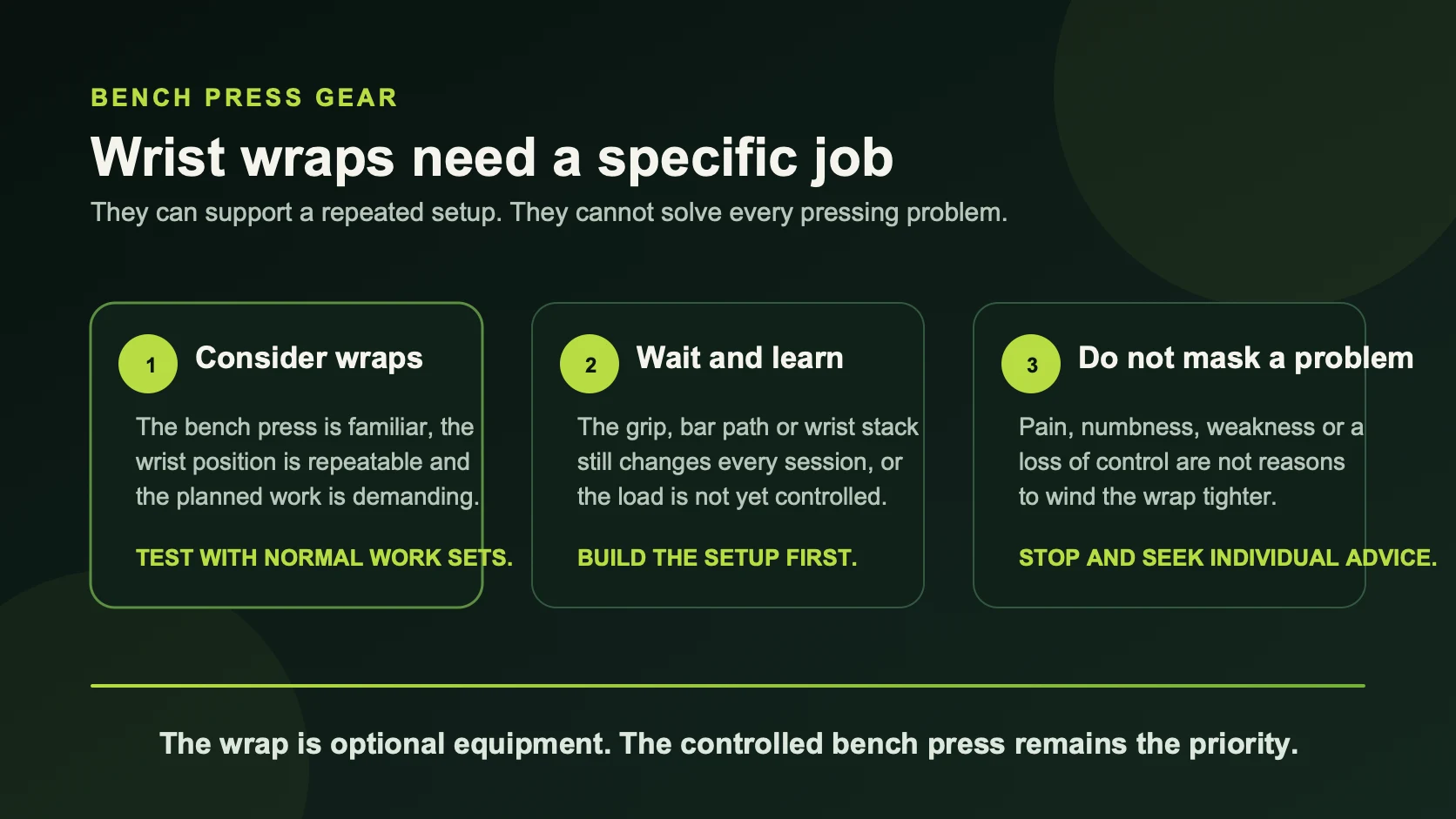
First, the bench press should be familiar. You should know how to set your grip, unrack with control, lower the bar and finish a normal repetition without changing your plan halfway through the set. Wraps work best as a small addition to a movement you can already repeat.
Second, the work should be deliberately demanding. That does not mean every hard-looking set needs wraps. It means the training plan includes bench work where a more consistent wrist position would be useful: a planned top set, a heavier strength-focused set or competition practice. They are less likely to add much to easy warm-ups, light technique practice or a session where the main goal is to learn the lift.
Third, the wrap should make the setup simpler rather than more dramatic. You should be able to apply it in the same place, at roughly the same tension, and still grip the bar normally. If putting on wraps turns the warm-up into a ten-minute ritual or changes the way you handle the bar, the gear may be adding more noise than value.
When it is better to wait
New lifters usually benefit more from repeatable practice than from more equipment. If your bench press is still changing quickly from week to week, keep the setup plain. Learn where the bar sits comfortably in your hand, use loads you can control and give yourself enough repetitions to notice what is improving. There is no prize for introducing support gear early.
Waiting is also sensible when the problem is really programming. A press can feel unstable because the load jumped too quickly, rest periods were cut short or the session added more fatigue than you expected. In those cases, adjusting the load, volume or session structure is more useful than deciding that your wrist needs a tighter wrap.
The same restraint applies to any symptom that changes how you press. Sharp pain, numbness, tingling, sudden weakness or a loss of control are not reasons to wind the wrap tighter and continue. Stop the activity and seek appropriate individual advice. A wrap is equipment, not a diagnosis, treatment or permission to force a movement that no longer feels tolerable.
Test wraps inside normal training
The first session with wraps should not be a max attempt. Start with your normal bench warm-up and let it tell you whether the setup is already under control. Then apply the wraps at a moderate, repeatable tension for a planned work set you understand. Keep the grip, bar path, rest period and load range as normal as possible.
Notice a few specific things. Can you set the hand around the bar the same way? Does the wrap stay in place through the set? Can you rerack without the closure shifting? Does the wrist position feel easier to reproduce without making the hand feel numb, trapped or distracted? The useful answer may be subtle. You are looking for a cleaner setup, not a dramatic new sensation.
Compare across a few ordinary sessions. Do not change wraps, grip width, loading, volume and bar path in the same workout. If you change everything, the result will only be a feeling, not useful information. A simple training log helps: note whether wraps were used, the main work set, the tension you chose and whether the setup stayed consistent.
This approach belongs beside the program rather than above it. The Big Three: Why the Squat, Bench and Deadlift Still Rule Strength Training makes the larger point that strength lifts reward repeated practice. Wrist wraps can support that practice, but they should never become the reason a session succeeds or fails.
Competition is a separate use case
If you bench press in competition, wrist wraps may be part of rehearsing the exact setup you will use on the platform. That is a valid reason to use them in training, but it adds a rulebook question. The International Powerlifting Federation’s current technical rules set limits for wrist-wrap length, width, placement and thumb-loop use. Check the official IPF Technical Rules before buying or using a pair for an IPF event.
Those specifications are not automatically shared by every federation or meet. A product listing that says “competition legal” is not the authority for your event. Read the rulebook for the exact federation and confirm any approved-equipment requirements. Then practice with the same legal item before meet day, rather than treating equipment check as the first test.
For a wider preparation list, Your First Powerlifting Meet: The Gear That Actually Belongs in Your Bag covers the items that deserve attention before a competition. Wrist wraps are only one small part of that setup.
Keep the choice boring
The useful wrap choice is usually boring. Use a pair that fastens reliably, stays where you place it and fits the work you actually do. Check the stitching, elastic rebound and closure occasionally. Let damp wraps dry before storing them, and replace a pair that no longer holds its tension or closure.
Do not tighten a wrap until your hand goes numb, and do not make the pair part of every press simply because you own it. Use it for the role you chose: support for a familiar bench press setup under planned demanding work. Leave it off when you are learning, warming up or when the problem calls for a different response.
The practical answer
Bench press justifies wrist wraps when they make an already competent setup more repeatable for work that has a clear reason to be demanding. That is enough. They do not need to be mandatory, impressive or a shortcut to a bigger lift.
Build the bench press first. Add wraps only when they have a specific job. Test them with normal training, follow the rules if you compete and keep the equipment secondary to the controlled repetition in front of you.
Continue with a related guide
For the general function and fit of the equipment, read Wrist Wraps: Small Piece of Gear, Big Difference Under Heavy Weight. For a broader decision about buying support gear, continue with You Need Less Gym Gear Than You Think.