The usual belt-shopping question sounds simple: should you buy 10 mm or 13 mm? The unhelpful answer is that 13 mm is for serious lifters and 10 mm is for everyone else. Thickness is not a ranking. It is one construction detail that changes how rigid a belt feels, how long it may take to adapt to it, and how easily it fits the positions you actually train.
For many people, either thickness can be workable. The choice becomes clearer when you stop asking which option looks more substantial and start asking which one you can position, brace against and use consistently in a familiar lift. The belt still does not create the brace for you, replace a training plan or guarantee an outcome.
This is a general equipment guide, not medical advice. A belt choice cannot diagnose pain or make a movement safe when it feels wrong. If pain, numbness, weakness, breathing trouble or a recent injury changes how you lift, get qualified individual guidance rather than forcing a belt to solve the problem.
- What the two thicknesses actually change
- Why a thicker belt is not automatically better
- How fit and movement affect the decision
- What competition rules do and do not tell you
- How to test a belt without turning it into a big purchase decision
Thickness mostly changes stiffness and adaptation
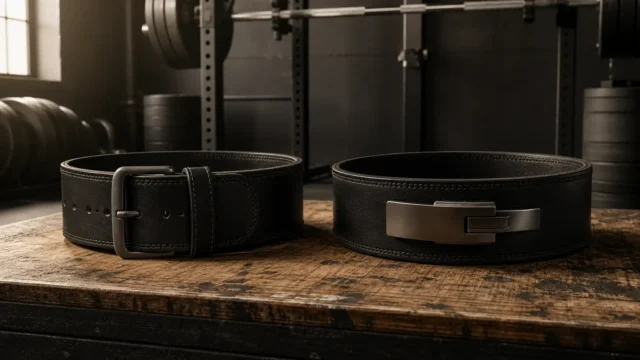
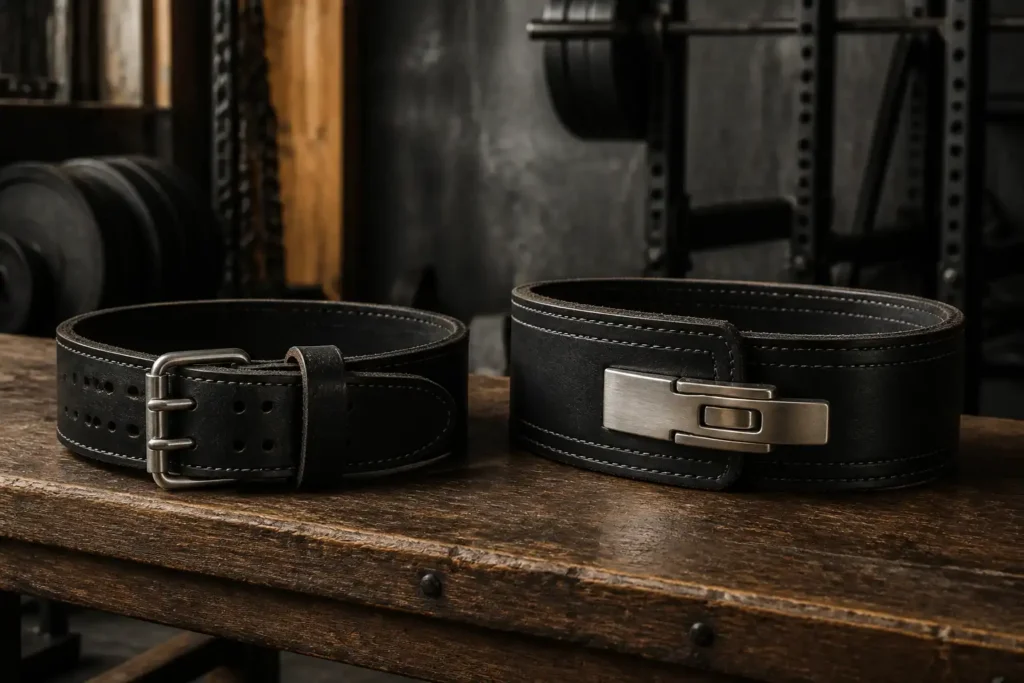
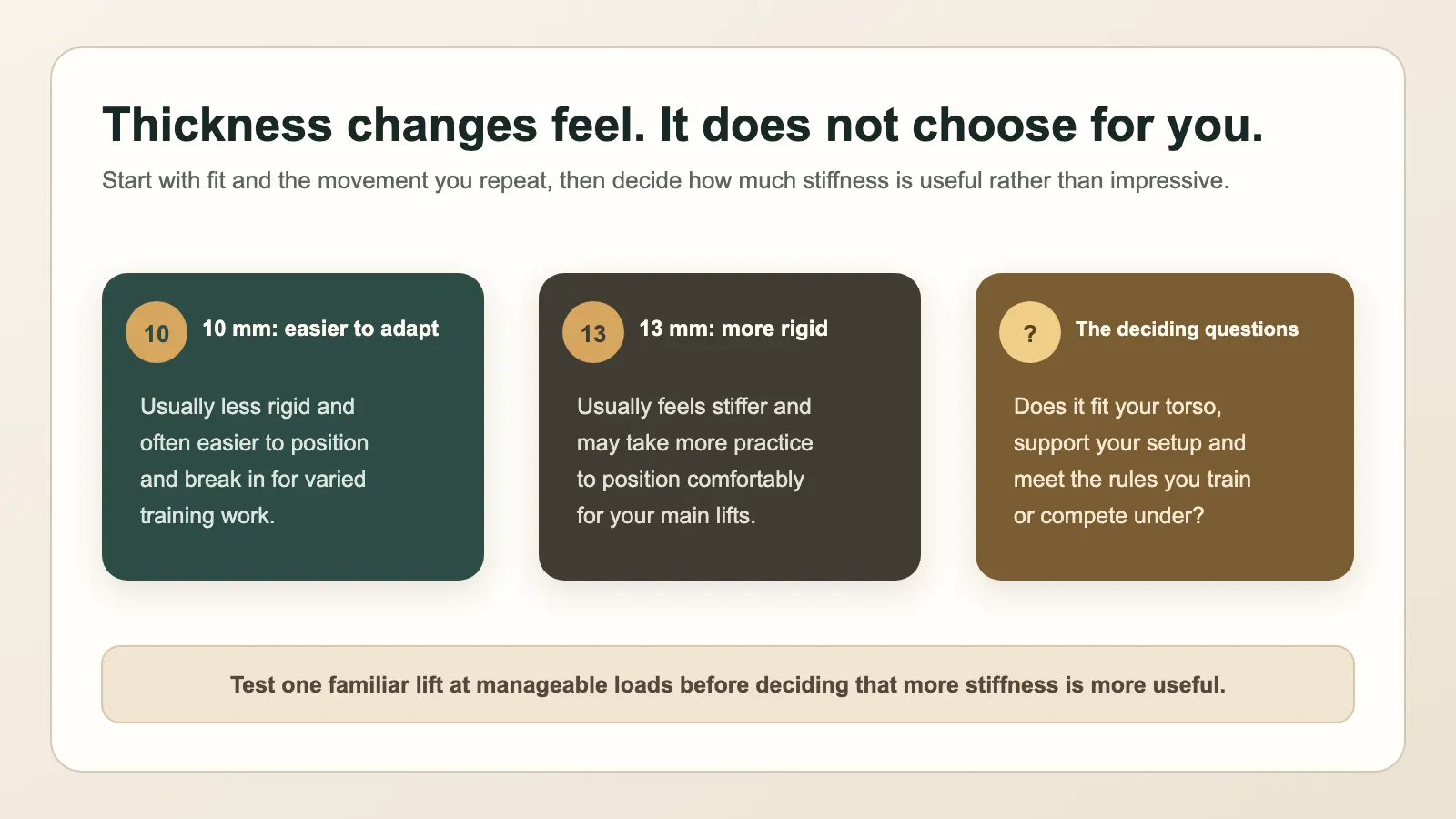
All else equal, a 13 mm leather belt is usually stiffer than a 10 mm belt. That can make the thicker option feel more substantial around the torso, but it can also make it less forgiving while you find a consistent position. A 10 mm belt is typically easier to break in and may feel less intrusive for lifters who move between squats, deadlifts and general strength work.
Those are tendencies, not guarantees. Leather quality, belt width, edge treatment, closure, taper, hole spacing and the shape of your torso all change the experience. Two belts advertised at the same thickness can still feel noticeably different. This is why a product specification is useful information, not a verdict.
The useful question is whether the belt lets you create a deliberate, repeatable brace in the movements you actually train. If you cannot find a position that works between your ribs and hips, extra stiffness does not become an advantage just because the number is larger.
A thicker belt is not a stronger decision
There is no good reason to assume that 13 mm is automatically the superior choice for strength. The research commonly cited about belts examines bracing conditions and belt stiffness, not a simple retail contest between 10 mm and 13 mm options. For example, a small in-vivo study of experienced weightlifters found that a stiff belt changed measured spinal-compression forces under specific lifting and breathing conditions. Read the study of a stiff lifting belt as a description of a narrow mechanism, not as a product recommendation.
The same caution applies to pressure research. A controlled deadlift study measured changes in intra-abdominal-pressure variables with belt use. That is evidence that a belt can change the lifting environment; it is not evidence that every additional millimeter of thickness produces a better lift for every person.
Your training task still decides the value. A lifter preparing for a familiar heavy squat may want a very rigid, consistent feel. Another lifter may value a belt that settles in faster and works across several movements. A person who is still learning basic bracing may need more practice, not a thicker belt.
Fit is more important than the number on the product page
Start with belt width and placement. A uniform-width powerlifting belt can be useful for a specific style of lifting, but it may crowd the space between ribs and hips for another torso or another movement. A belt that digs into the ribs, blocks a comfortable starting position or shifts during the repetition is providing information: the fit is not right for that task.
Position is not universal either. Some lifters wear a belt slightly higher for one movement and lower for another. The goal is not to copy an online setup exactly. The goal is to find a consistent position that lets you breathe, brace and perform the planned range of motion without fighting the equipment.
Thickness becomes worth considering only after that basic fit is plausible. If a 10 mm belt already gives you a repeatable setup, moving to 13 mm is not a mandatory upgrade. If a 13 mm belt fits well and the additional rigidity suits the task you repeatedly train, it can be a reasonable choice. Neither answer needs a status label.
Competition rules are a boundary, not a shopping recommendation
If you plan to compete, rules may narrow the choice. The IPF technical rules link to the current rule book, effective 1 March 2026. Under that rule set, belt construction and maximum dimensions are regulated, including a maximum thickness of 13 mm. Other federations, divisions and events can differ, so always check the exact current rulebook and approved-equipment list for your meet.
That ceiling does not mean every competitor should choose the maximum. It means a 13 mm belt can be legal under that rule set when the other requirements are satisfied. Legality, comfort and usefulness are different questions. A belt that passes inspection but disrupts your setup is not automatically the right training belt for you.
Test the choice with familiar work
The first belt sessions should be practice, not a test of toughness. Use a lift you already know at manageable loads. Set the belt in one position, fasten it so you can still create a full deliberate brace and record what happens: placement, tension, breath control, range of motion and whether the planned repetitions remain controlled.
Compare across several ordinary sessions. Do not buy, break in and judge a belt during a maximal attempt. Excitement, fatigue and a new setup can all make a single session hard to interpret. If possible, handle both thicknesses or borrow a trusted training partner’s belt briefly before treating an online specification as a permanent decision.
The broader equipment framework in Lifting Belts 101 covers width, closure and basic use. For the separate question of whether a belt improves a defined training task, read The Belt Question: When Does It Actually Make You Stronger?.
Choose the belt that keeps the decision simple
Choose 10 mm if you want a belt that is typically easier to adapt to and it fits your main lifts well. Consider 13 mm if you specifically prefer a more rigid feel, it fits your torso and movement positions, and any competition rules you care about permit it. Do not choose either thickness because it seems like the more legitimate option.
The correct belt is not the thickest one you can tolerate. It is the one that has a clear job in your program, lets you reproduce a stable setup and does not turn equipment shopping into a substitute for training.
FAQ
Is a 13 mm belt always better for powerlifting?
No. It can be a legal option under some federations and may provide a more rigid feel, but fit, setup and personal preference still matter. A 10 mm belt can also be a sensible competition or training choice when it works better for the lifter.
Is a 10 mm belt enough for heavy lifting?
It can be. Thickness alone does not decide whether a belt is useful for a lift. The more relevant questions are fit, repeatable bracing, the movement and the role the belt has in your plan.
Should beginners buy a 10 mm belt first?
Beginners do not need a belt by default. If a belt has a clear, repeatable job, a 10 mm option may be easier to adapt to, but learning movement and bracing skill remains the first priority.