“Does a lifting belt make you stronger?” sounds like a yes-or-no question, but it is really a comparison question. Stronger in which lift? At what load and repetition range? With what experience, setup, and belt fit? Over one exciting session or across a training block? A useful answer must keep those conditions visible.
This article does not promise that a belt will increase your strength or prevent injury. It explains how to test belt use as one training variable. It is not medical advice. If you have persistent pain, neurological symptoms, a recent injury, or a condition that changes how you train, seek individual guidance rather than using an equipment comparison to decide what is safe.
- Make the question specific
- Compare one variable at a time
- Separate a mechanism from a guarantee
- Choose when belt use belongs in a session
- Review quality, performance, and recovery
Make the question narrow enough to answer
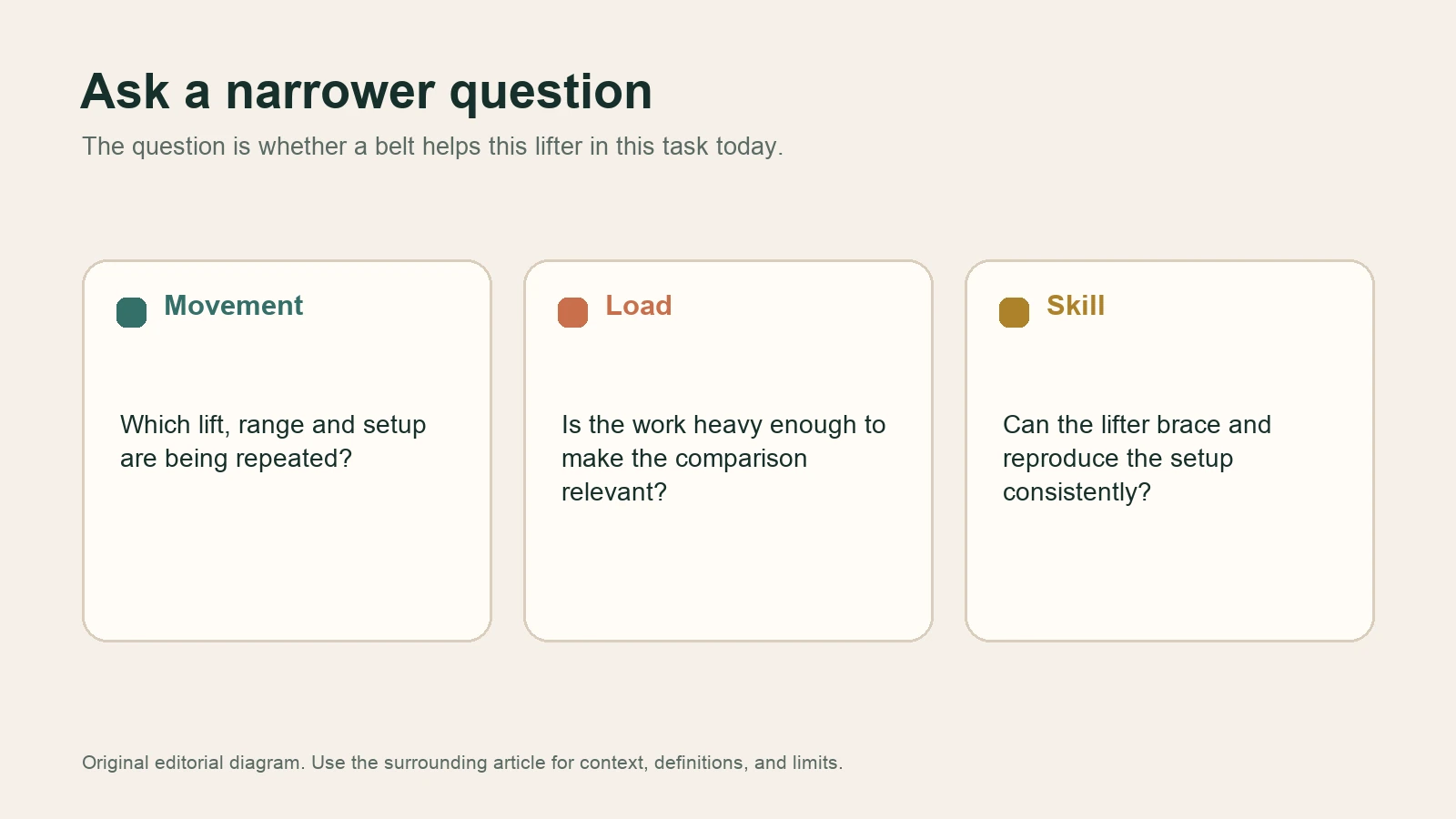
Start with a sentence that describes the task. For example: “During the final two work sets of my familiar squat variation, does a belt help me reproduce a stable brace and planned repetitions at the same load?” That question can be tested. “Does this belt make me a stronger lifter?” cannot, because it bundles every lift, load, program, and future outcome into one product claim.
Three conditions matter: movement, load, and skill. The movement determines the position and setup. The load determines whether belt use is even relevant to the planned task. Skill determines whether you can brace, position the belt, and perform a repeatable repetition. If any of those conditions changes, the answer may change too.
For a beginner, the first priority is usually to build a stable pattern and a manageable training dose. A belt may have no immediate job. The first useful progression could be another controlled repetition, a cleaner setup, or a small load increase. The approach in the first 100 days of strength training keeps those foundations visible. Adding equipment does not need to be the next milestone.
For a more experienced lifter, belt use may become relevant in specific training exposures or competition practice. That still does not mean the belt should be used automatically. The decision is better when it names the purpose: practice a meet setup, compare a familiar heavy set, or make a certain working range more repeatable.
Compare it like one variable
The cleanest practical comparison changes as little as possible. Keep the same exercise, warm-up structure, load, repetition target, rest interval, and time of day where practical. Use a familiar belt and a known position. Then record what happened with the belt and without it across several comparable sessions. You are not trying to create a perfect laboratory. You are trying to avoid a comparison so noisy that it proves nothing.
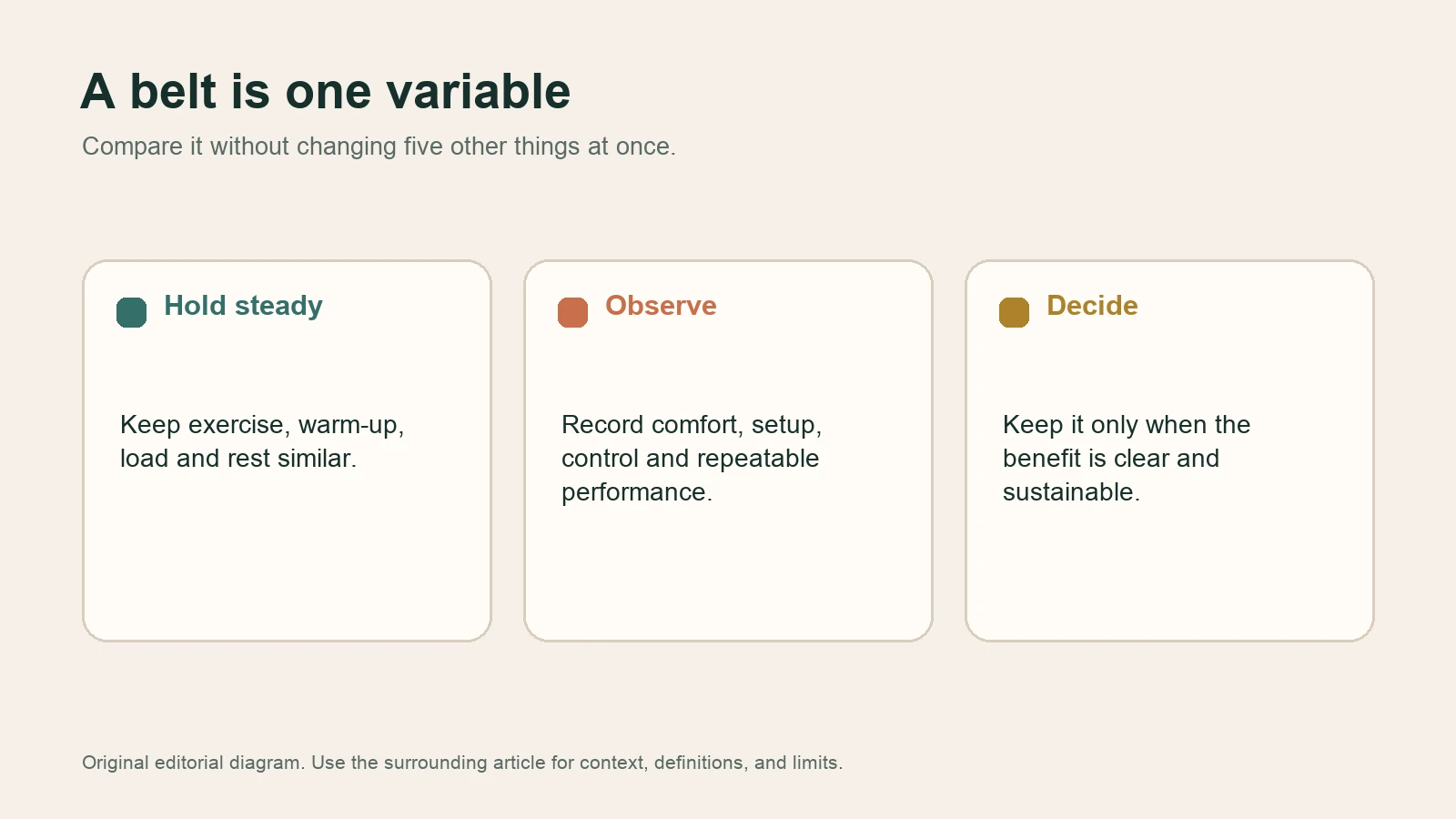
Record the outcome you actually care about. It might be repetition quality, ability to reproduce setup, bar path consistency, completion of planned work, perceived control, or a small change in performance under a familiar condition. Avoid making pain disappear into a score. Sharp pain, new neurological symptoms, dizziness, or a concerning response are stop-and-reassess signals, not data points to train through.
A comparison does not need maximal attempts. In fact, maximal attempts can add fatigue and excitement that make ordinary observations less useful. Use a load you already train with and enough repetitions to observe your setup. If belt use changes your routine, do not assume the change is positive just because it feels more serious.
Mechanism is not a personal guarantee
There is a reason belts are discussed in strength sports. In a controlled deadlift study, the belt increased several intra-abdominal-pressure measures. Related work has examined trunk muscle activity and pressure during squatting, and an in-vivo study investigated how a stiff belt affected modeled spinal compression during lifting. These findings describe specific measured conditions in small research samples. They do not establish that every lifter should use a belt, nor do they guarantee injury prevention.
The difference is important. Training outcomes depend on the whole system: exercise selection, load progression, technique, fatigue, sleep, nutrition, coaching, previous experience, and the ability to return for the next session. A belt can change the bracing environment inside that system. It does not take ownership of the system. This is why “I felt stronger with it” is a starting observation, not a conclusion about what every lifter needs.
The 1990 study of an abdominal belt during squat lifts also shows why simple slogans are inadequate: breathing and trunk mechanics are part of the question. If a belt makes it difficult for you to use a controlled breath or stable setup, the individual fit is not good for that task, regardless of the product’s reputation.
Use belt sessions deliberately
There are several reasonable ways to organize belt use. You might keep early warm-ups and lighter practice unbelted, then use the belt for a specific planned heavy exposure. You might use it for competition-style practice only. You might decide it offers no meaningful benefit for your current program and leave it out. The right choice is the one that makes the program clearer and the work more repeatable.
Write the rule before the session. “Belt for the final two sets above a planned load,” or “belt only for a single competition-setup exposure,” is much clearer than deciding in the moment. It also prevents the belt from becoming a requirement for movements where it has no defined purpose. The same principle applies to all accessories: use them as tools inside the plan, not as rituals that obscure the plan.
If you are unsure whether your training structure is doing too much, return to the variables. Frequency, volume, intensity, and recovery explain more than the number of accessories in the gym bag. A well-built strength program gives every tool a job and leaves room to review whether it is still needed.
Judge the outcome over time
After several comparable exposures, review three categories: quality, performance, and recovery. Quality asks whether the setup and repetitions were more controlled. Performance asks whether you completed the intended work under the intended conditions. Recovery asks whether the choice created a new problem, discomfort, or inability to train as planned later. One category alone can mislead. A bigger number with worse control or a poor response afterward is not automatically a useful result.
The outcome may be that the belt helps a specific lift on a specific day. It may be that it has no meaningful effect. It may be that it helps only after more practice with the fit and setup. All three answers are useful because they replace marketing with information from your own training.
A belt can make someone stronger only in the practical sense that it may help them perform a defined training task more effectively or consistently. It cannot make the work disappear. Ask a narrow question, compare carefully, keep the limits honest, and let repeatable evidence decide whether the belt belongs in your program.
Continue with a related guide
Start with the equipment framework in You Need Less Gym Gear Than You Think. For fit and selection details, continue with Lifting Belts 101: What They Do, What They Don’t and How to Choose One.