

A strength program is more than a list of exercises followed by a number of sets. It is a set of decisions about what you are trying to improve, what movements best serve that goal, how much work you can recover from, and how you will know whether the plan is working. When those decisions are hidden, training often becomes reactive: add an exercise because it looked useful, change the split because a session felt boring, push harder because progress slowed for a week.
A great program makes the important decisions visible. You should be able to explain its purpose in one sentence, know what each session is for, see how progression is meant to happen, and recognize what information would justify a change. That does not require a complicated spreadsheet. It requires a clear structure.
This article is a practical framework for healthy adults building or evaluating a general strength program. It does not diagnose pain or prescribe individual rehabilitation. If pain, neurological symptoms, a medical condition, or a recent injury changes how you train, use individual professional advice rather than treating a general template as a medical plan.
- Start with one clear training goal
- Make frequency, volume, and intensity visible
- Choose exercises that fit the goal and the trainee
- Order the session around attention and skill
- Use a progression rule and review loop
Start with a goal that can guide decisions
“Get stronger” is a legitimate goal, but it becomes more useful when you add context. Stronger in which movements? For what kind of life, sport, or task? With what equipment and how many weekly sessions? A program for a first strict push-up, a more confident barbell squat, and general strength during a busy work season can all be strength programs, but they will not make identical exercise choices.
Write the goal in a sentence that includes the person and the constraint. For example: “Build general lower- and upper-body strength with three full-body sessions that fit into 60 minutes.” That sentence rules out a lot of unnecessary complexity. It tells you that exercise selection needs to be broad, the session has a time limit, and the weekly schedule needs to be sustainable.
The ACSM progression models position stand is useful here because it treats resistance training as a collection of variables that should be chosen in relation to training status and goals. A program is not great because it contains fashionable exercises. It is great when the variables support the stated outcome.
Make the training dose visible
Three related inputs shape the practical dose of a program: frequency, volume, and intensity. They overlap, but they are not interchangeable.
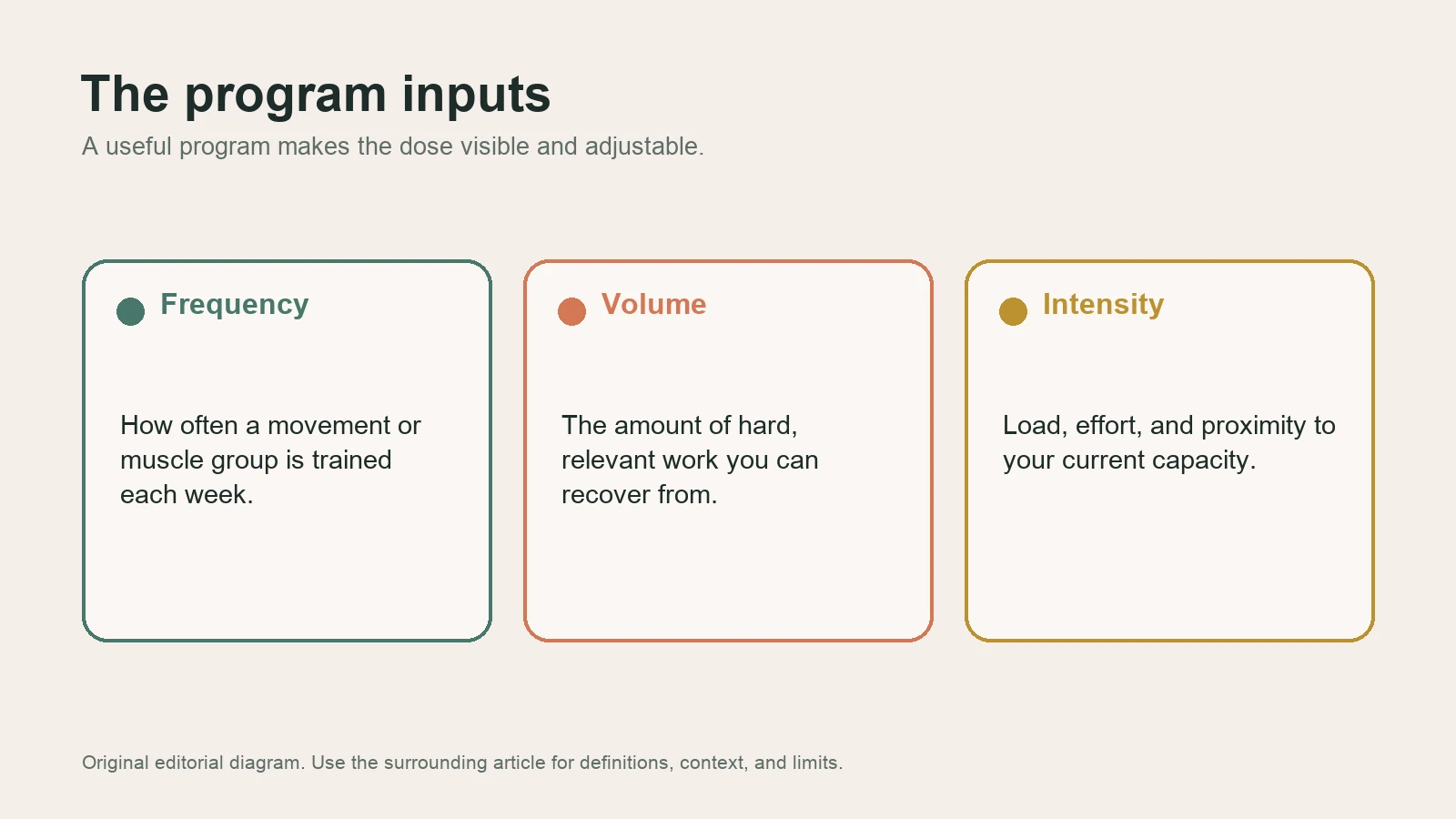
Frequency is how often you train a movement or muscle group each week. Volume is the amount of relevant work you complete, often described through sets, repetitions, and load. Intensity can mean the load relative to your maximum, but in ordinary programming it is also useful to consider how close a set is to your current capacity. A plan with many easy sets is different from a plan with fewer very demanding sets, even when the exercise names match.
The 2023 systematic review and Bayesian network meta-analysis found that multiple resistance-training prescriptions can improve strength in healthy adults. Higher-load prescriptions tended to maximize strength gains, while multiple approaches supported hypertrophy. The practical implication is not that every program should become heavy immediately. It is that the dose should be chosen deliberately rather than inherited from an arbitrary template.
For a closer look at how to judge that weekly amount, use The Volume Sweet Spot rather than assuming more sets are automatically better.
For a beginner, a manageable dose might be two or three weekly sessions, two or three controlled work sets for the main movements, and a repetition range that allows practice without constant maximal attempts. As skill and recovery capacity change, the dose can change too. The starting point only needs to be enough to create a repeatable signal.
Choose exercises that solve the program’s problem
Exercise selection should answer a question. What pattern or capacity does this movement train? Can the person set it up? Can they perform it with a controllable range of motion? Can they recover from it and record it? If an exercise does not have a clear answer, it may be decoration rather than programming.
Use movement families rather than treating one implement as sacred. A squat pattern can be a goblet squat, leg press, split squat, or barbell squat. A horizontal press can be a push-up variation, machine press, dumbbell press, or barbell bench press. A hinge can be a Romanian deadlift, trap-bar deadlift, hip bridge, or cable pull-through. The variation should match the person’s goal, equipment, and current skill.
This is especially important for beginners. You do not need the most technically demanding version to train the movement family well. The classic barbell lifts are useful tools without being mandatory requirements. A program becomes stronger when its exercise choices are repeatable, not when every choice looks advanced.
Organize the session around the work that needs attention
Session order is not cosmetic. The movement that requires the most focus, coordination, or load usually belongs early enough that fatigue does not turn it into a different task. Smaller accessory work can come later because it normally asks less of your setup and attention.
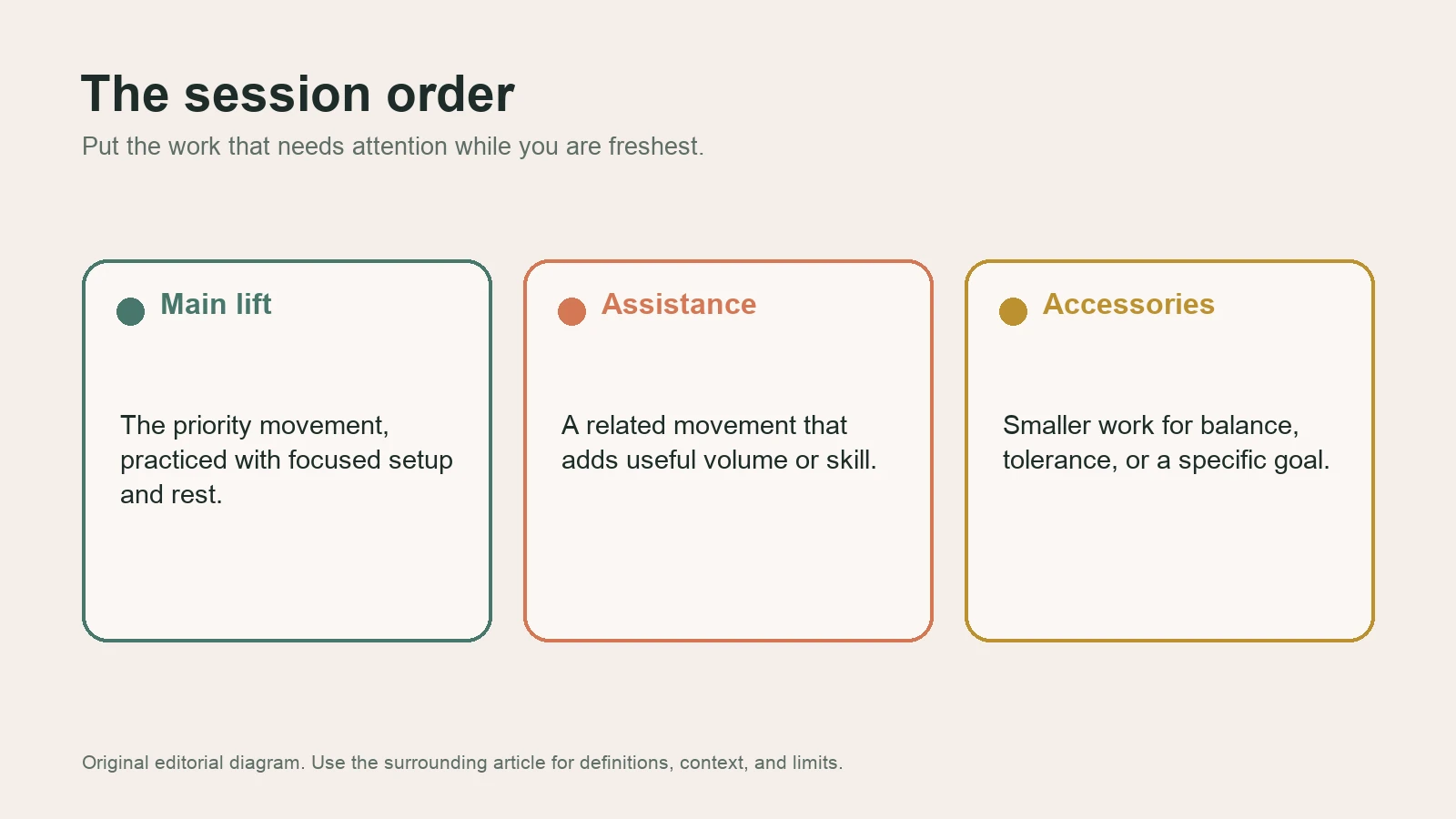
A simple session sequence can look like this:
| Session layer | Question it answers | Example |
| — | — | — |
| Main lift | What movement matters most today? | squat pattern, press, deadlift variation |
| Assistance work | What related capacity needs more quality work? | row after pressing, split squat after a squat pattern |
| Accessories | What smaller need improves balance, tolerance, or enjoyment? | calf raise, carry, arm work, trunk work |
The order can change when the goal changes. If pull-up strength is your main goal, pulling may come first. If a new hinge variation needs the most attention, it may lead the session. The key is to make the choice intentional rather than following a fixed ritual.
Use a progression rule before you need one
Many programs fail because progression is defined only as “add weight every week.” That works briefly for some beginners, then it turns normal variation into a perceived failure. A better program has a small, flexible rule.
One reliable option is a repetition range. Choose a load and a range, such as six to ten repetitions. Keep the load steady until you can complete the planned sets near the top of the range with controlled setup and no sharp symptoms. Then make a small increase and build again. You can also progress by using a cleaner range of motion, more consistent pauses, or a better-controlled tempo when those qualities serve the movement.
The rule should fit the goal. If you are practicing a technically demanding barbell lift, a smaller load increase and a narrower repetition range may be appropriate. If you are using a machine or dumbbells for general strength, a broader repetition range may make the small available load jumps easier to manage.
Do not confuse progression with constant escalation. A repeated week can be productive when it consolidates skill or lets fatigue settle. The meta-analysis of periodization found a modest overall advantage for periodized training in one-repetition-max strength when volume was equated, with clearer differences in trained participants than untrained ones. For beginners, the lesson is not to invent elaborate phases. It is to organize changes rather than making them randomly.
Review the program like an experiment with a human in it
Run the plan long enough to create a pattern. Then review the data. A useful review asks whether you completed the planned sessions, whether the main movements are becoming more controlled or stronger, whether recovery is reasonable, and whether the schedule still fits life.
Change one meaningful variable at a time where possible. If sessions are too long, first consider spreading work or removing low-value accessories. If a main lift has stalled, check whether the load, repetition target, rest, setup, or recovery is the actual constraint before adding more exercises. If the schedule does not survive an ordinary week, reduce the frequency or simplify the sessions.
This is where research can protect you from false rules. The three-versus-six-days study found no additional strength benefit from higher frequency when volume and intensity were equated in trained men. A fifth or sixth day is therefore not automatically the answer to a stalled plan. Sometimes the answer is a better distribution of the work you already have.
A great program is clear enough to improve
The anatomy of a great strength program is simple: a clear goal, exercises that fit the person, a visible dose, a sensible session order, a modest progression rule, and a review loop. None of those parts must be perfect. They need to be understandable and adjustable.
A program should make tomorrow’s decision easier. You should know what to train, what counts as progress, what discomfort means stop and seek help, and what evidence would justify a change. That clarity is more valuable than a complicated plan that cannot explain its own purpose.
Continue with a related guide
For a repeatable first template, read Your First Strength Program Should Be Boring — That’s Why It Works. Continue with The First 100 Days of Strength Training, then choose a realistic schedule with Three, Four or Five Days?.