

“How many sets should I do?” sounds like a simple strength question. It is usually several questions hiding inside one. Sets for which lift? At what load and effort? How many of those sets are direct practice for the result you want? Can you repeat them next week with similar quality? A weekly total only becomes useful when it answers those questions.
The volume sweet spot is not a magic number. It is the smallest amount of relevant work that moves a strength goal forward without burying the rest of the program in fatigue. That point changes when the lift changes, when your technique improves, when life becomes busier, and when a few extra sets stop looking like the same quality of work.
This guide is for healthy adults planning general strength work. It does not diagnose pain or prescribe rehabilitation. If pain is sharp, escalating, or joined by neurological symptoms, stop the exercise and seek individual assessment rather than trying to solve it by adding or subtracting sets.
- What strength volume is actually counting
- Why direct work matters more than a large total
- How to start with a manageable weekly dose
- When to distribute, add, or remove work
- How to review the sweet spot without chasing a magic number
Volume is useful work, not gym time
For a strength goal, volume is best thought of as the number of relevant work sets you can perform and recover from across a week. The word relevant does a lot of work. Three controlled squat sets are direct practice for becoming stronger in a squat pattern. A hard lunge or leg press may help build general leg capacity, but it is not identical squat practice. Both can matter; they should not be counted as if they answer the same question.
This is why two programs with the same number of sets can produce different results. One might place most of its work around a lift that the athlete wants to improve. The other might spread effort across many variations, finishers, and accessories. The total looks similar, but the first program has more specific practice.
The 2026 dose-response meta-regression on resistance-training volume and frequency made this distinction explicit by classifying sets according to how directly they served the measured strength or hypertrophy outcome. It found evidence that more volume can support strength gains, while also finding more pronounced diminishing returns for strength than for hypertrophy. More work can help, but the next set is not guaranteed to be as valuable as the previous one.
Count direct sets first
Start the volume conversation with the lift or movement quality you actually want to improve. If the goal is a stronger bench press, count the work sets of bench press and close variations that you can honestly compare from week to week. Then note the supporting work separately: rows, triceps work, shoulders, and general upper-body training may support the goal without replacing the main practice.
This avoids a common planning error. A lifter may say they are doing plenty of chest and arm work, while their bench press receives only a few rushed exposures. Another may do a large number of squats, hinges, and accessories, but have little energy left for the deadlift pattern they want to improve. The issue is not always too little total volume. It is often unclear allocation.
The ACSM progression models position stand is useful because it treats resistance training as a set of variables chosen for the training status and goal. Volume cannot be separated from load, exercise choice, order, rest, and the trainee’s ability to perform the plan. A work set that arrives after a long, exhausting session may not be worth the same as a comparable set done while attention and positioning are intact.
Begin with a dose you can describe
A practical starting point does not need to be impressive. Suppose a beginner trains a squat pattern twice each week and performs two controlled work sets on each day. That creates four direct weekly exposures to record. The exact total is less important than the fact that it is clear: the exercise, setup, range, load, repetitions, and rest can all be compared next time.
From there, let the log tell you whether the dose is enough. Are repetitions, load, or control improving over several comparable sessions? Are you arriving able to practice? Do the final sets still resemble the first sets? If yes, the current amount may be doing its job. A program does not need more work simply because another plan contains more work.
For a more experienced lifter, a higher dose may be useful when the target lift needs extra practice or when the existing work has stopped producing a useful trend. The change should still be small and specific. Add a single direct set to one weekly session, or add a light, technically focused exposure, rather than adding multiple exercises, days, and intensity techniques at once. Otherwise the next review will not reveal what changed the result.
Distribute work before you multiply it
Volume and frequency are related, but they are not the same lever. A third set of a movement may be high quality when it is performed two days later, yet low quality when it is attached to the end of the same session. Splitting work can create better practice without necessarily increasing the weekly total.
The three-versus-six-days study in resistance-trained men illustrates the point: when volume and intensity were equated, the different frequencies produced similar changes in the measured outcomes. More gym visits are not automatically more strength. They can be useful when they make the same weekly work easier to perform well.
Use session quality as the first test. If the later sets regularly shorten their range, lose the planned position, require much longer rest, or turn into guesswork, consider distributing the work before adding more of it. If the schedule cannot support another visit, trim lower-value accessories before assuming the only answer is to push through a poorer session.
Our guide to choosing three, four, or five training days covers that scheduling decision in more detail. The important part is that frequency should solve a problem: practice, session length, or recovery. It is not a badge of seriousness.
The sweet spot has a fatigue boundary
The right dose leaves enough room for the next useful session. That does not mean every workout feels easy. Challenging work is part of strength training. It means you can distinguish normal effort from a pattern in which extra sets consistently reduce performance, motivation, sleep, or the ability to repeat the plan.
The 2023 network meta-analysis of resistance-training prescriptions compared common training approaches and estimated the largest strength gains for higher-load options. It does not identify one universal weekly set total. Its practical lesson is that strength work needs a deliberate prescription, not simply more fatigue.
Very low-volume approaches can be useful historical case studies, but they do not remove the need to measure the work you can repeat. Mike Mentzer’s Heavy Duty training philosophy is most useful when read as a specific response to this dose-and-recovery problem, not as a universal set prescription.
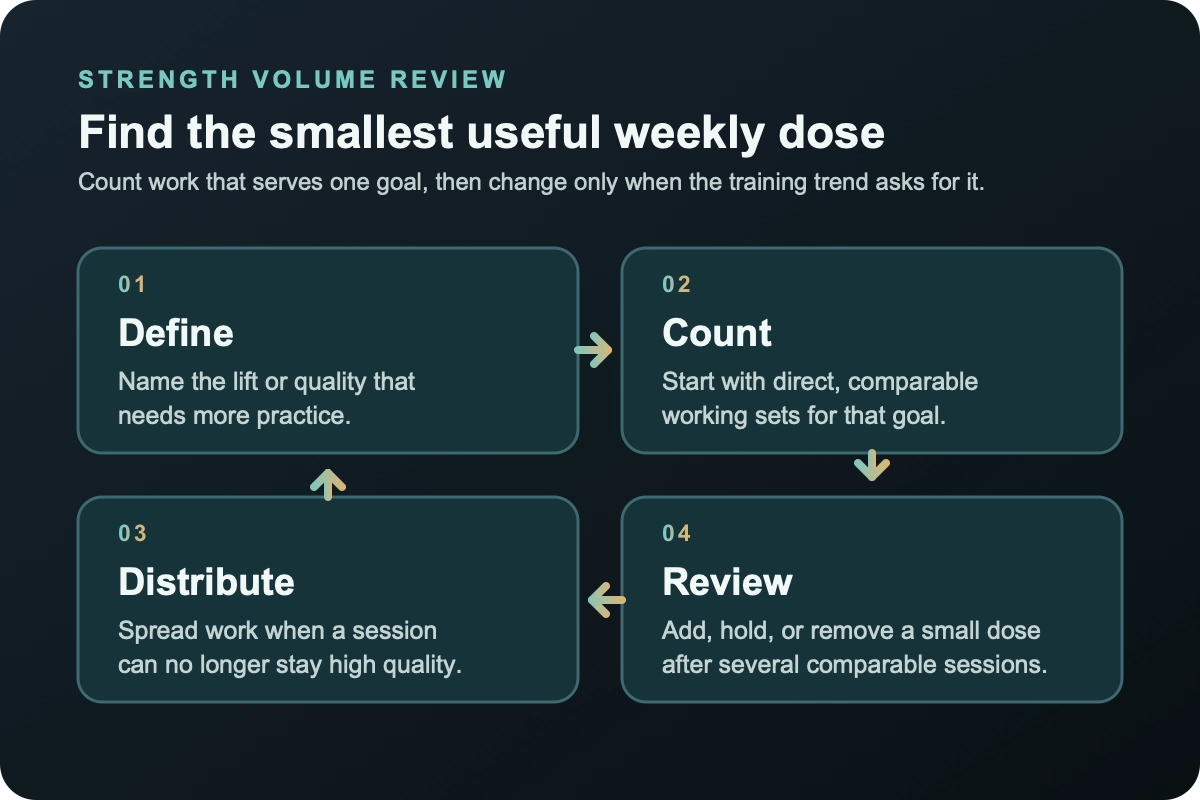
Review after several comparable sessions, not after one unusually good or bad day. Hold the dose when the work is progressing and recovery is reasonable. Add a small amount of direct work when performance is flat but the existing sets remain crisp and the schedule has room. Reduce or redistribute work when quality and recovery decline together. Why More Training Isn’t Always More Progress offers the recovery lens for that final decision.
Build the smallest useful next week
When the current dose is working, progression can be as small as another controlled repetition or a modest load increase. Progressive overload is the broader principle; adding sets is only one way to apply it.
Strength volume is not something to win. It is a dose you manage. Define the lift, count the most specific work first, spread it so the sets stay meaningful, and review the outcome before you change the plan again.
The sweet spot is not the largest number you can survive. It is the smallest weekly amount that gives you enough practice and challenge to become stronger, while leaving you able to return and do it well.
Continue with a related guide
For the broader program framework, read The Anatomy of a Great Strength Program. For the next scheduling decision, continue with Three, Four or Five Days? Finding the Training Frequency That Fits Your Life.