

“How many days should I train?” sounds like a question with a clean numerical answer. In practice, it is a scheduling question disguised as an exercise-science question. Three, four, and five days can all work. The more important question is whether the schedule lets you perform enough useful work, recover from it, and keep showing up when the rest of life is not arranged around your gym plan.
Frequency is the number of training sessions you perform in a week. It is not the same as volume, which includes how much work you perform across those sessions. It is also not the same as effort, which describes how demanding the individual sets are. Mixing those ideas together is why people often assume that a five-day plan must be more effective than a three-day plan. It may simply spread similar work across more visits.
For a healthy adult, there is no moral hierarchy of training schedules. This guide helps you choose a starting frequency for strength training. If your schedule, recovery, or health status is complicated by pain, illness, shift work, pregnancy, or a return from injury, individual professional guidance can be more useful than forcing yourself into a generic split.
- What frequency does and does not control
- What three, four, and five days can look like
- How to distribute weekly work without overcomplicating it
- How to choose a schedule from your real life
- When to add or reduce a training day
Frequency is a way to distribute work
Imagine two people who each perform six hard sets of pressing and six hard sets of pulling in a week. One completes the work in three sessions. The other divides it across five shorter sessions. Their experience in the gym may feel very different, but the weekly amount of relevant work is not automatically different.
This distinction is central to the evidence. A systematic review and meta-analysis of resistance-training frequency and strength found that higher frequencies appeared beneficial in the full analysis, but the advantage was no longer significant when training volume was equated. The authors concluded that higher frequency can be useful for adding or distributing volume, while its independent effect is less clear.
The same idea appears in the meta-analysis of frequency and hypertrophy: when volume was equated, frequency did not significantly or meaningfully change hypertrophy outcomes. That does not mean frequency is irrelevant. It means the best frequency is often the one that helps you perform your planned work with quality.
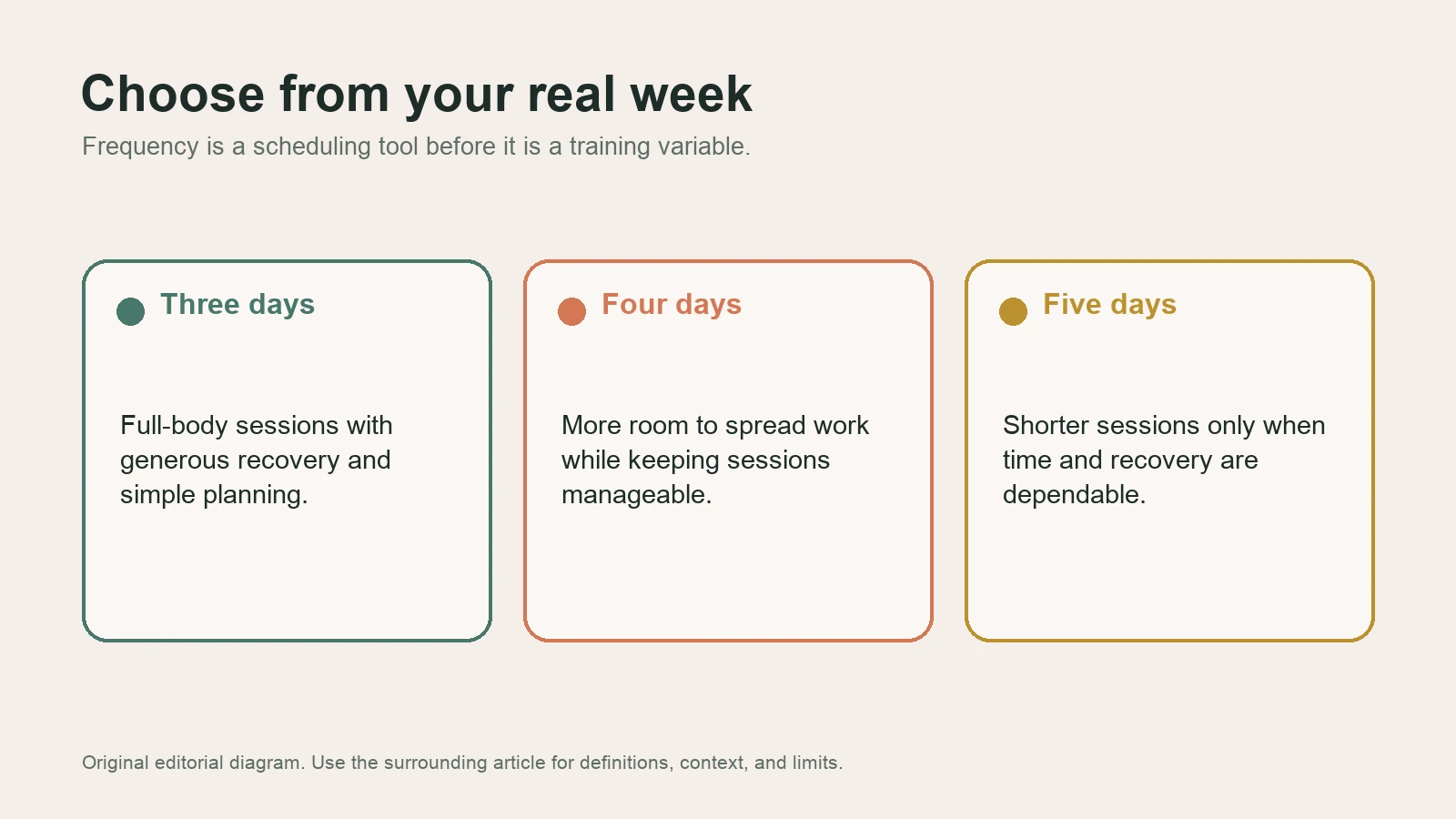
What three days can do well
Three days per week is a strong default for many beginners and busy intermediates. It creates room for full-body sessions, gives a clear rest day between most training days, and makes a missed session easier to recover from without redesigning the week.
A simple three-day schedule might be Monday, Wednesday, and Friday, or any pattern that leaves reasonable recovery space. Each session can include a lower-body movement, a press, a pull, and one or two supporting exercises. Because the work is concentrated into fewer sessions, you may need to keep the exercise list focused and rest adequately between demanding sets.
Three days is often a good choice when:
- you are still learning the main movement patterns;
- your gym time is limited but you can train for 45 to 75 minutes;
- your work or family schedule changes from week to week;
- you want enough recovery space to see how the program affects you.
It is not a “beginner-only” schedule. Plenty of experienced lifters use three well-organized days when it matches their goal and life.
What four days can do well
Four days gives you another option: you can spread the same weekly work across shorter sessions or use an upper/lower structure. A common format is two upper-body and two lower-body sessions. Another is four full-body sessions with fewer exercises per day.
The main benefit is logistical. If a three-day session has become too long because you are adding useful work, a fourth day can make individual sessions more focused. It can also let you practice a movement more often without placing all of the related work on one day.
Four days is often a good choice when you can reliably protect four training windows and when the shorter sessions make the program easier to execute. It is not automatically an upgrade. If adding the fourth session creates rushed workouts, poor sleep, or repeated missed days, the extra frequency is not serving its purpose.
What five days can do well
Five days can work very well for someone who enjoys short, frequent sessions and has a stable schedule. It can allow more exercise variety, more movement practice, or smaller doses of work per session. It can also be a poor fit when it turns the gym into a daily obligation that collapses as soon as one meeting, trip, or family event appears.
For many people, five days should be earned by logistics rather than ambition. If you already complete three or four sessions consistently and want to split the work into shorter visits, it can be a sensible adjustment. If you struggle to complete two or three sessions, a five-day plan usually adds more opportunities to feel behind rather than more opportunities to progress.
Keep weekly volume and session quality in view
The point of more days is not to accumulate random exercises. It is to distribute work you can recover from. Think in three layers: total useful work across the week, the amount of work in one session, and the recovery gap before you ask the same muscles or movement to perform again.
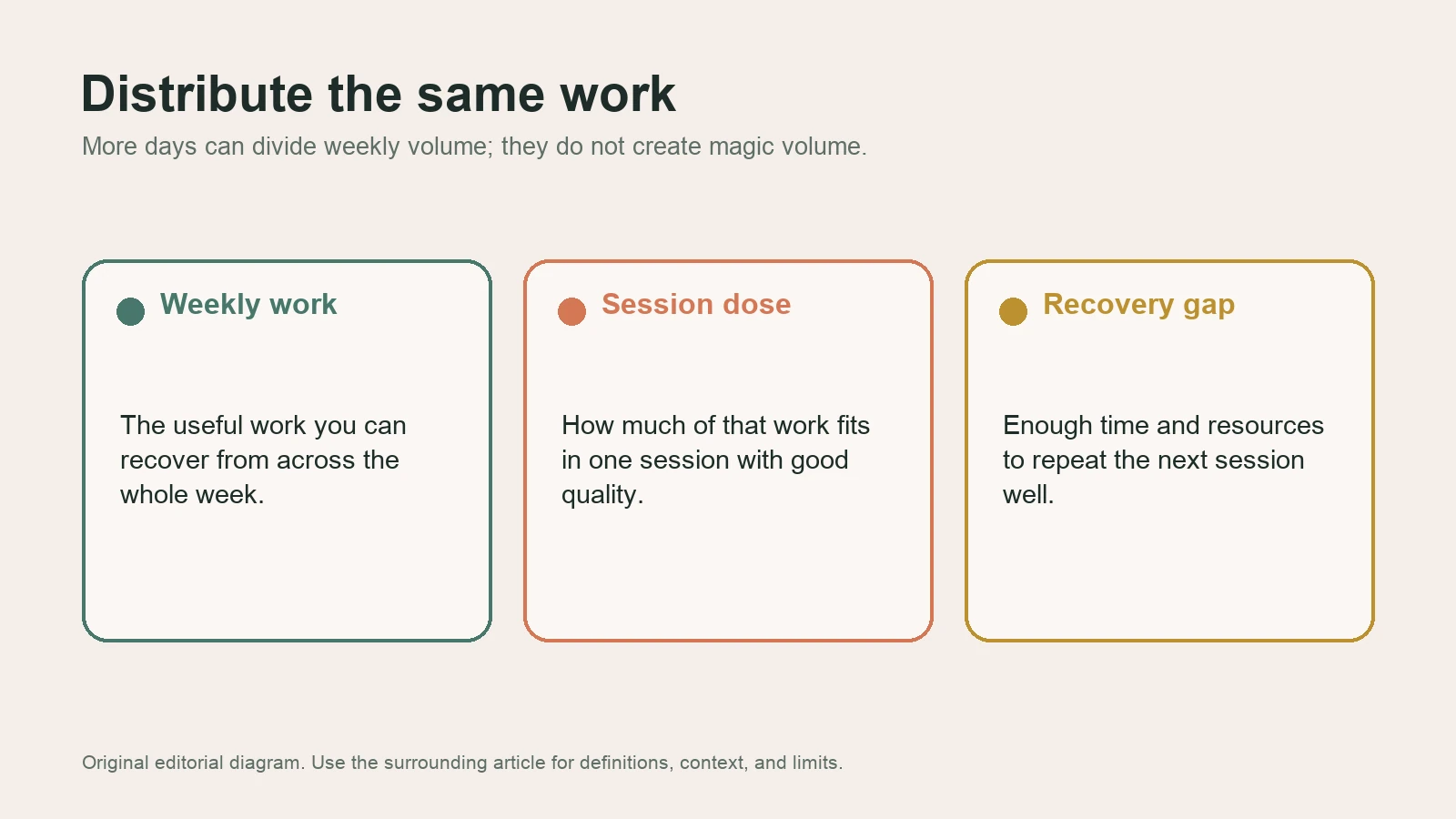
In a small trial involving resistance-trained men, three and six weekly training sessions produced similar strength and body-composition changes when volume and intensity were equated. It is one study, not a universal prescription, but it illustrates the larger principle clearly: adding days does not guarantee additional adaptation if the overall dose is effectively the same.
Use frequency to solve a practical problem. Perhaps four sessions make lower-body work less exhausting in a single visit. Perhaps three sessions leave room for another sport. Perhaps five short morning sessions suit your commute. The useful answer is the one that improves execution without creating a recovery or adherence problem.
Choose by the constraints that actually matter
The best frequency is rarely chosen from a research abstract alone. Use three questions.
First, how many training windows are real? A real window includes travel, changing, a warm-up, and enough time to do the planned work. Do not count a theoretical 20-minute gap that disappears whenever life becomes normal.
Second, how are you recovering? You do not need perfect energy after every session, but the plan should leave you able to perform the next session with useful effort and controlled movement. Repeatedly declining performance, persistent exhaustion, or pain that worsens with training are signals to reduce or reassess the dose, not reasons to add another day.
Third, what structure do you prefer? Preference is not a soft variable. A plan you enjoy enough to repeat has a practical advantage over a supposedly optimal schedule you resent. The split-versus-full-body meta-analysis found similar outcomes when volume was equated, which gives you permission to choose a structure that fits your week.
Use your recent calendar as evidence. Look at the last four weeks, not an ideal future month. Count the evenings you were genuinely free, the mornings when you had enough sleep, and the days when travel or family commitments made a gym visit unrealistic. A schedule built from that record is usually more durable than one built from enthusiasm on a quiet Sunday. If three sessions are reliably possible and a fourth is only occasionally possible, plan for three and treat the fourth as optional rather than turning a normal week into a missed target.
When to change frequency
Add a day when your current sessions are consistently too long, when you have a stable extra window, and when spreading the work would improve quality. Do not add a day simply because progress slowed for one or two sessions. Check sleep, total workload, exercise setup, and whether you have actually repeated the current plan long enough to see a trend.
Reduce a day when you are repeatedly missing sessions, dreading the schedule, or stacking so much work that later exercises become rushed. A well-executed three-day plan is more useful than a five-day plan that exists only on paper.
Start with the smallest schedule you can execute consistently for six to eight weeks. Record the work, recovery, and attendance. Then change frequency only if it solves a real constraint. Your training frequency should fit your life closely enough that the plan still works on an ordinary week, not only on a perfect one. Consistency is the evidence that the schedule deserves to stay.
Continue with a related guide
For the complete programming framework, read The Anatomy of a Great Strength Program. For a simple way to apply the schedule, continue with Your First Strength Program Should Be Boring — That’s Why It Works.