Knee sleeves and knee wraps often get grouped together because both sit around the knee and both appear in strength gyms. That is where the similarity mostly ends. A sleeve is a pull-on tube that gives the same general feel from set to set. A wrap is a long elastic strip that is wound tightly around the joint and can meaningfully change the way a squat feels and moves.
Neither item fixes a painful knee, guarantees safety, or substitutes for a sensible training plan. The useful choice is not "which one is better?" It is which tool, if any, matches the lift, the goal, the rules, and the way you want to train.
- What sleeves and wraps actually are
- How their squat effect differs
- When a sleeve is the simpler choice
- When wraps deserve a specific purpose
- How to choose without turning gear into a solution for symptoms
Start with the construction
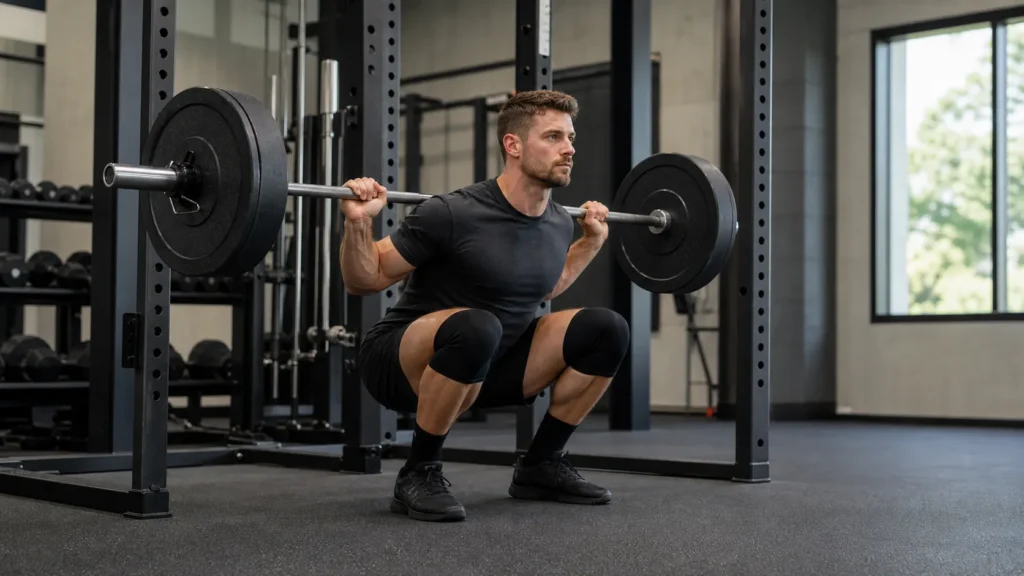
Most knee sleeves used for lifting are continuous neoprene or fabric cylinders. You pull them over the knee and leave them in roughly the same position throughout the session. Their main practical appeal is repeatability: the fit, warmth, compression, and sensation are relatively consistent once you have found a tolerable size. They take little time to put on, and they do not require a new winding strategy before every work set.
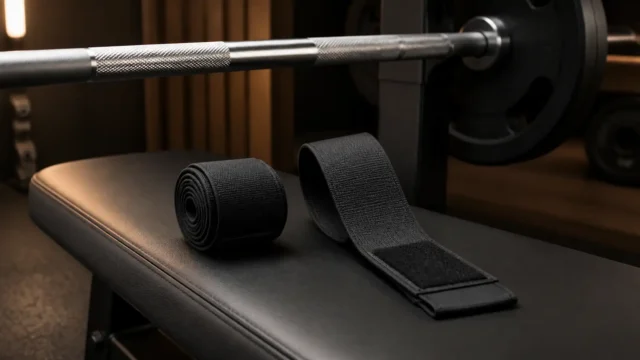
Knee wraps are long strips of woven elastic. The lifter stretches and winds them around the knee, usually with more tension and overlap than a sleeve can create. Small choices change the result: how tight the wrap is, where it starts, how much overlap it has, and how it is secured. That variability is not a flaw, but it makes wraps a more technical tool. A pair applied casually can feel completely different from the same pair applied tightly and consistently.
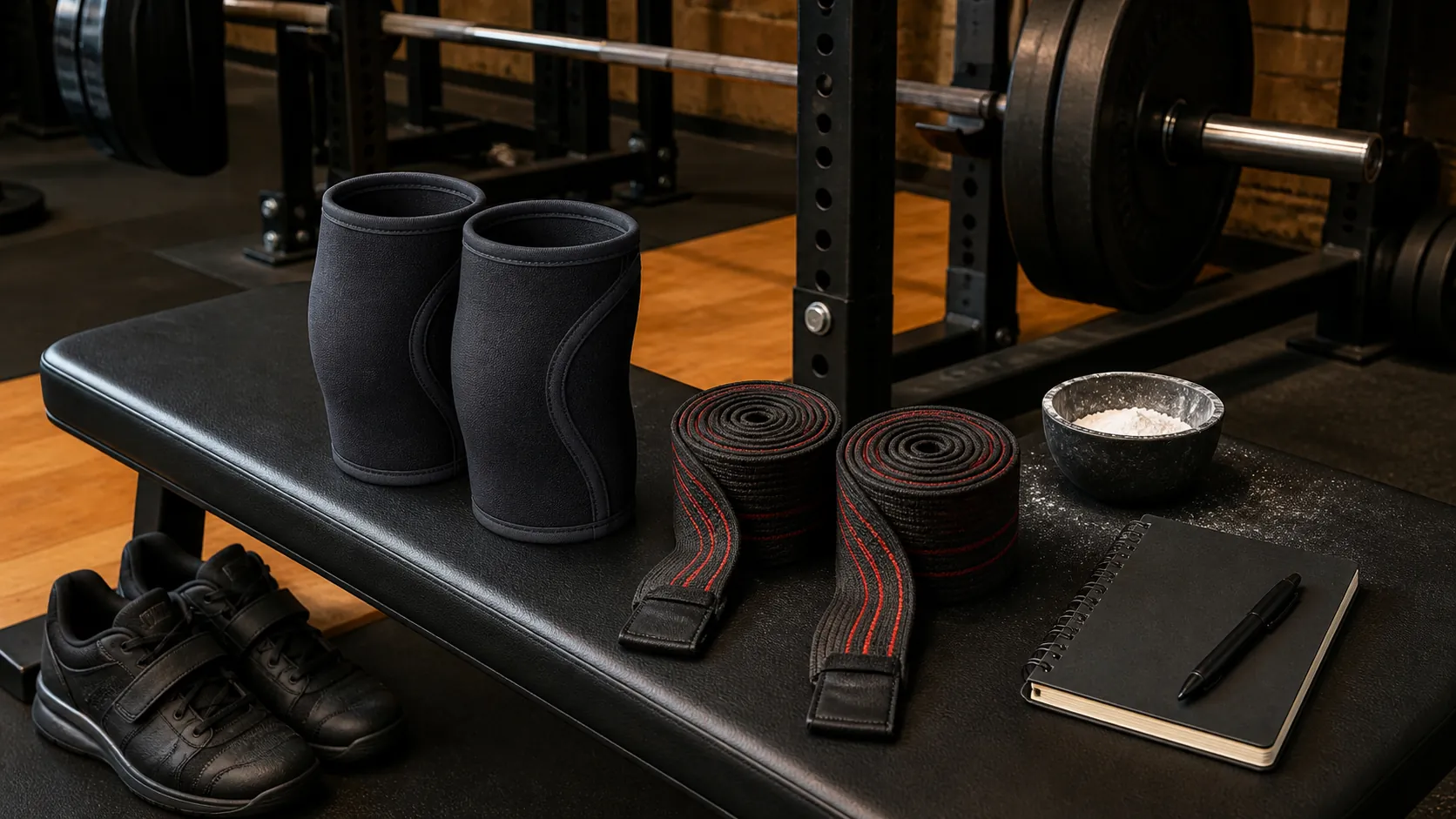
This construction difference should shape the expectation. A sleeve is usually a comfort and setup choice. A wrap is more likely to be a performance-specific choice for a squat that is already practiced. If your actual issue is that your program, stance, load jumps, or recovery are inconsistent, neither product is the first lever to pull. The wider buying framework in The Powerlifter’s Gear Guide is a useful place to start: define the repeated training problem before choosing an accessory.
The performance effect is not the same
Wraps are designed to store and return elastic energy as the knee bends and straightens. In a small study of trained men performing back squats at 80% of one-repetition maximum, wearing knee wraps changed the lowering phase and increased measured mechanical output compared with squatting without wraps. Read the study on knee wraps and back-squat mechanics for what it is: a controlled, acute comparison in a small group, not a reason to assume the same outcome for every lifter, load, wrap style, or depth.
That distinction matters because the wrap is not merely making the knee feel held. It can change the task you are practicing. A lifter who uses wraps for a heavy competition-style squat may find that useful. A lifter who wants every training repetition to resemble an unwrapped squat may make a different choice. The decision is about specificity, not toughness or seriousness.
Sleeves can also affect a squat, but the available evidence does not make them interchangeable with wraps. In a randomized crossover study of resistance-trained men unfamiliar with sleeves, both normally sized and tighter neoprene sleeves increased the tested back-squat one-repetition maximum compared with a minimally supportive control sleeve, while the other measured strength, power, and endurance tests did not differ between conditions. The knee-sleeve study suggests a possible exercise-specific effect, but it does not establish that sleeves build strength faster or prevent injury.
For ordinary training, subjective information still counts. Some lifters prefer the warmth or awareness a sleeve provides before squatting. Others dislike the pressure or the time needed to pull on a thick pair. Treat that preference as a preference. It is enough to justify using a comfortable tool when it helps a session run smoothly; it is not evidence that the tool is medically necessary.
Choose sleeves when you want a quiet, repeatable setup
Sleeves usually make the most sense when you want the same simple setup across warm-ups and work sets. They are easy to bring to a commercial gym, quick to remove, and less likely than wraps to become a ritual that changes from set to set. They can be a reasonable option for a lifter who likes the sensation during squats but does not need a major change in the movement’s feel.
A useful test is boring on purpose. Use the same sleeves for several familiar squat sessions. Keep the exercise, loading progression, rest periods, and general technique stable. Record only practical observations: did they stay in place, did they distract you, could you achieve your planned depth and stance, and did they make the session easier to execute? That is a better decision process than judging a purchase from one unusually good workout.
Do not size down aggressively to turn a sleeve into a wrap. Excessive pressure, numbness, tingling, color changes, or a marked change in control are reasons to take the item off rather than force the set. A sleeve should not be used to push through persistent pain, swelling, instability, or a sudden loss of function. Those problems call for appropriate professional assessment, not a tighter accessory.
Use wraps only for a defined squat context
Wraps deserve a more specific reason because their tension and rebound are part of the lift. They are most relevant to lifters training for a rule set or a heavy squat context where wraps are allowed and familiar. That does not mean every strong squatter needs them. It means their upside is clearer when you deliberately want to practice the wrapped variation rather than simply make training feel more equipped.
The cost is friction. Wraps take time to apply, can be uncomfortable when pulled very tight, and are difficult to reproduce if you have not practiced a consistent method. They also encourage a useful question: what does this set need to teach? If you are developing a stable, repeatable squat with moderate loads, an unwrapped or sleeved set may give cleaner feedback. If you are preparing for a competition division where wraps are permitted, it can make sense to practice the actual equipment before meet day.
Competition rules are a separate issue from gym preference. The International Powerlifting Federation’s current technical rules distinguish knee sleeves from wraps and do not permit them together in the same lift. Other federations, divisions, and meet organizers can use different specifications and approved lists. Check the current rules for the event you entered, not an old product page or a general article. For the practical meet-day process, see Your First Powerlifting Meet: The Gear That Actually Belongs in Your Bag.
Keep gear in its lane
The wrong question is whether sleeves or wraps will make your knees "safe." Neither can make that promise. A better question is whether the item supports a known, already tolerable training task without obscuring useful feedback. That keeps the priority on planned exposure, technical practice, recovery, and adjustments you can repeat.
It also prevents a familiar shopping trap: using equipment to solve a problem that has not been defined. If squat performance has stalled, look at the program, total work, load progression, sleep, and practice before assuming the missing variable is fabric. The same logic applies to belts. The Belt Question offers a comparable method: test one tool in a repeatable context instead of turning it into a universal rule.
If you compete, choose the tool your division permits and practice it well before the meet. If you train recreationally, sleeves are generally the lower-friction option when you simply prefer their feel. Wraps are the more specialized option when their altered squat is the point. In both cases, the best piece of equipment is the one with a clear job and clear limits.
Continue with a related guide
Start with the equipment framework in You Need Less Gym Gear Than You Think. For another support-equipment decision, continue with Lifting Belts 101: What They Do, What They Don’t and How to Choose One.