Strength and muscle size are related, but they are not the same thing. Bigger muscles can usually produce more force, which is why adding muscle often helps long-term strength. But anyone who has trained for a while has seen the mismatch: a smaller lifter can outlift a bigger lifter, a beginner can get stronger before looking much bigger, and a bodybuilder may not automatically outperform a powerlifter in a one-rep-max test.
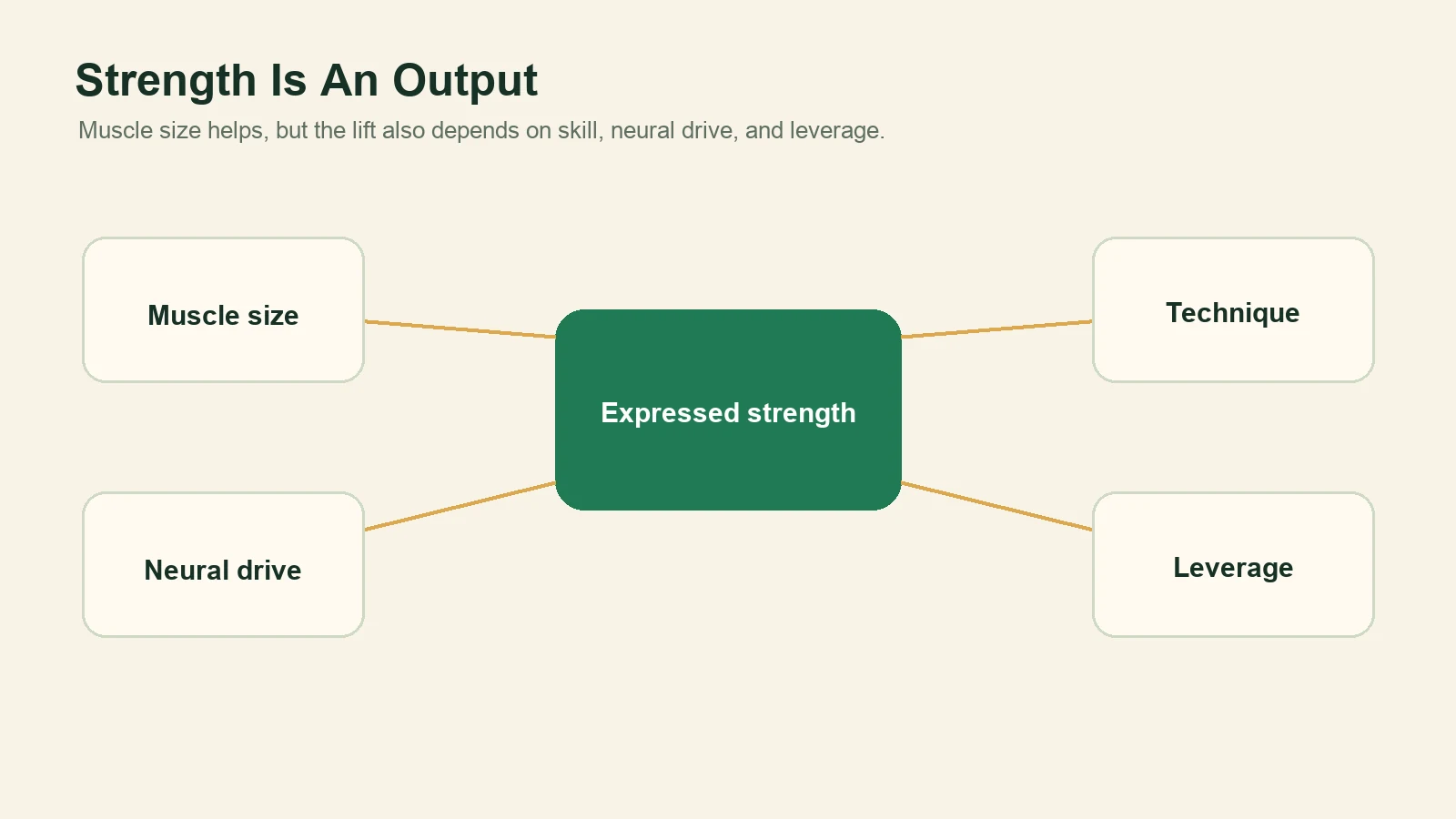
That mismatch is not a contradiction. It is the point. Strength is an expressed performance in a task. Muscle size is one contributor to that performance. The nervous system, skill, leverage, range of motion, confidence under load, and the exact way strength is tested all influence the result.
This article explains the relationship in plain English. The short version: muscle size helps raise the ceiling, but strength depends on how well the whole system uses that tissue in a specific movement.
- Why muscle size helps strength
- Why bigger does not always mean stronger
- How neural and skill adaptations change performance
- Why the test matters
- How to train for both size and strength
Muscle size matters, but it is not the whole model
Muscle produces force through contractile proteins inside muscle fibers. If training increases the amount of contractile tissue, the muscle has more potential to produce force. That is the simple reason size and strength are connected.
But strength in the gym is not measured by isolating one fiber in a lab. It is measured by doing a squat, bench press, deadlift, row, chin-up, machine press, or another task. The body has to coordinate joints, stabilize positions, recruit the right muscles, and produce force at the right time.
The Folland and Williams review on strength training adaptations is useful here because it separates neurological and morphological contributions to strength. Morphological changes include muscle size and structure. Neurological changes include the way the nervous system drives and coordinates the movement.
So the question is not whether muscle size matters. It clearly does. The better question is how much of a given strength result is explained by size versus the other pieces of the system.
Bigger muscles raise potential
For long-term strength, more muscle is often helpful because it gives the body a larger engine. A bigger quadriceps group can contribute more to knee extension. Bigger pecs, triceps, and delts can support pressing. A larger back and hip musculature can support pulling and hinging.
This is why strength athletes often care about hypertrophy, especially in muscles that limit their lifts. A stronger bench press is not only a bench press skill problem. It can also be a pec, triceps, shoulder, and upper-back development problem. A stronger squat may need more quad, glute, adductor, and trunk capacity.
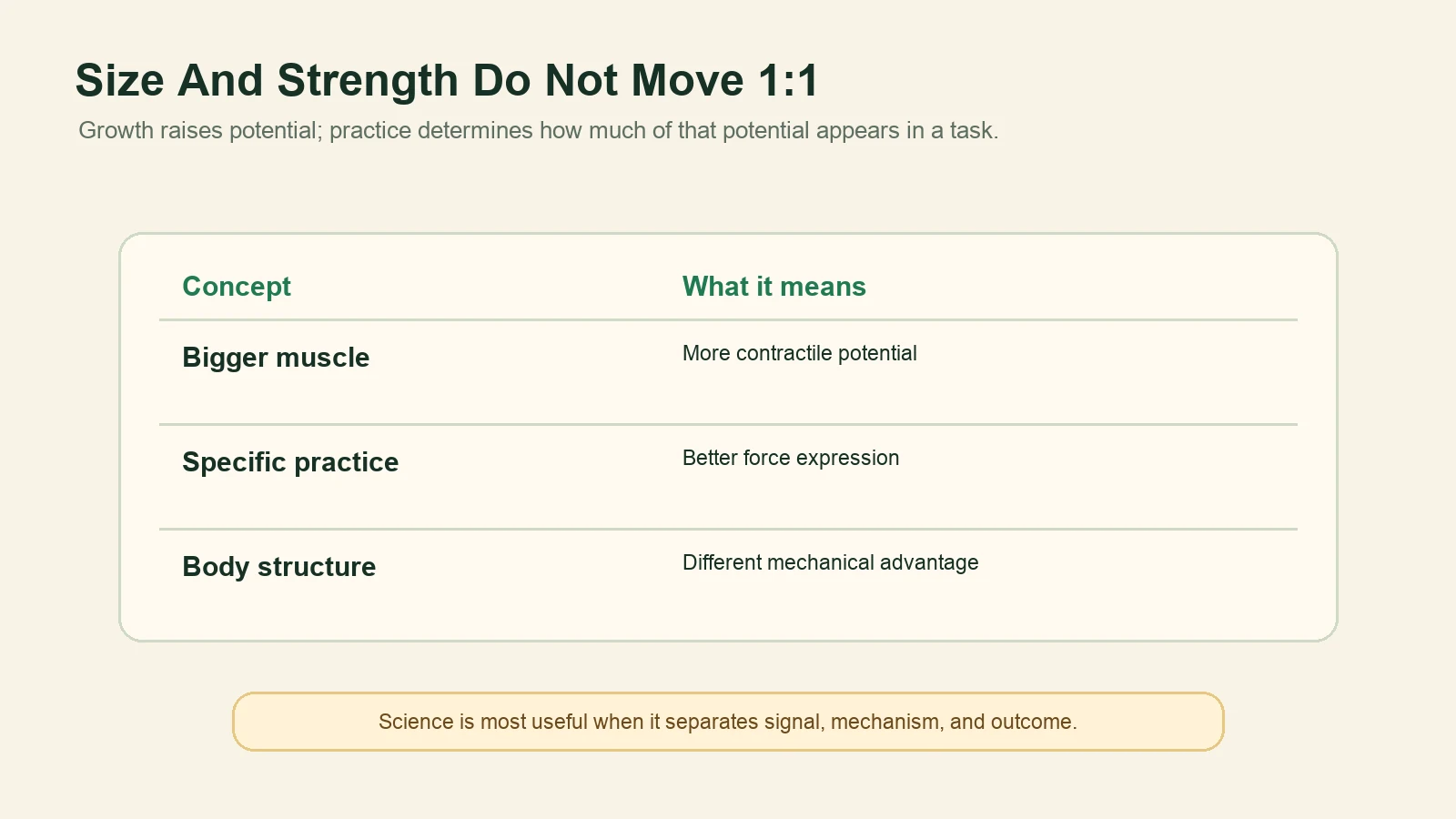
But that potential has to be expressed. If two lifters have similar muscle mass but one has practiced the lift more specifically, uses better positions, and is less inhibited under heavy load, the stronger-looking person may not win the test. Size gives capacity. Practice teaches access.
This is one reason hypertrophy blocks and strength blocks can both be useful. Hypertrophy work can build more tissue. Strength-specific work can teach the body to use that tissue in the task that matters.
Neural adaptations can change strength before size changes much
Early strength gains often happen faster than visible muscle growth. That does not mean the muscle is irrelevant. It means the nervous system can improve performance quickly.
The review by Gabriel, Kamen, and Frost discusses neural adaptations to resistance training, including changes in motor unit behavior and coordination. In practice, this means the body gets better at recruiting muscle, reducing wasted effort, and producing force in the trained pattern.
A newer systematic review and meta-analysis on neural adaptations also supports the idea that resistance training changes more than the muscle tissue itself. The exact mechanisms can vary by task, population, and study design, but the practical takeaway is stable: strength is partly a nervous-system skill.
This explains why a beginner can add weight to a squat quickly. They learn how to brace, stay balanced, descend consistently, and push through the floor. Those changes may appear before large visible hypertrophy.
Strength is specific to the task
If you improve your leg press, your squat may improve somewhat, especially if the same muscles were limiting you. But the transfer will not be perfect because the tasks are different. A squat includes balance, trunk stiffness, hip and ankle positions, bar path, and skill under a free weight.
This specificity is why strength is not just "muscle in general." It is muscle plus task. The more specific the goal, the more specific the training should become.
For example, a bodybuilder may have excellent muscle size but train mostly in moderate rep ranges with controlled machines. A powerlifter may have less total muscle size but better skill, leverage, and neural readiness for a one-rep-max squat, bench, or deadlift. Neither approach is automatically superior. They train different expressions.
The same principle applies to everyday lifters. If you want stronger pull-ups, you need to build back and arm strength, but you also need to practice the pull-up pattern. If you want a stronger deadlift, rows and hamstring curls can help, but you still need hinge skill and heavy-enough exposure.
Load changes what you get better at
One reason strength and hypertrophy get confused is that muscle can grow across a range of loads, especially when sets are hard enough. But maximal strength tends to respond better to heavier loading because heavy loading is more specific to the test.
The Lopez network meta-analysis on resistance-training loads reported broadly similar hypertrophy across loads taken to failure, while strength gains favored moderate and high loads more than low loads. That finding is often misunderstood. It does not mean low-load training is useless. It means training outcome matters.
If the goal is muscle size, several rep ranges can work when volume, effort, and progression are appropriate. If the goal is maximal strength, you usually need practice with heavier loading because the nervous system, technique, and confidence demands are different.
Measurement changes the relationship too
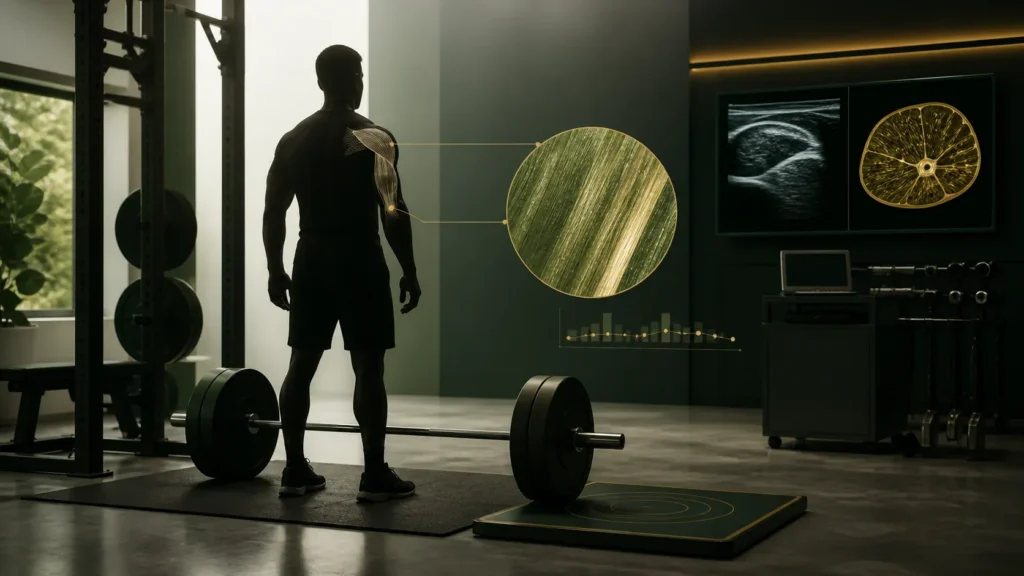
The relationship between size and strength also depends on how both are measured. Muscle size can be estimated with ultrasound, MRI, circumference, skinfolds, or visual comparison, and those methods do not all measure the same thing with the same precision. Strength can be measured with a one-rep max, multiple-rep max, isometric test, machine test, or sport-specific task.
If a study measures quadriceps thickness and knee-extension strength, the size-strength relationship may look different from a study measuring whole-body lean mass and barbell squat performance. The closer the size measure is to the muscle doing the task, and the closer the strength test is to the trained movement, the clearer the relationship may become.
For readers, this is a useful warning. A statement like "muscle size predicts strength" is incomplete unless we know which muscle, which strength test, which population, and what training history. Science rarely asks the vague gym question. It asks a measured question under specific conditions.
Leverage and anatomy influence expression
Two lifters with similar muscle size can have different strength because bodies are built differently. Limb lengths, tendon insertions, joint structure, and torso proportions change mechanical advantage. A long-armed lifter may have a different deadlift and bench press experience than a short-armed lifter. A lifter with long femurs may need different squat positions than someone with shorter femurs.
This does not make strength genetic destiny. It simply means muscle size is filtered through structure. Some people express strength more easily in certain lifts. Others need different techniques or exercise selections to train the same muscles effectively.
This is another reason not to judge strength only by appearance. The visible body does not show every lever, skill, and adaptation that affects performance.
Muscle size is capacity. Strength is capacity expressed through a specific task under specific conditions.
How to train for both
If you want both size and strength, do not force a false choice. Use enough hypertrophy work to build the muscles that matter, and enough specific practice to express strength in the lifts that matter.
A practical structure might include:
- heavy or moderately heavy work for the main lift;
- back-off sets in a moderate rep range;
- accessory work for limiting muscles;
- progressive overload across weeks;
- enough recovery to repeat quality sessions.
For a beginner or intermediate lifter, this often works better than chasing one-rep maxes every week. Build the tissue, practice the movement, and test strength occasionally rather than constantly.
What this means for programming blocks
A size-focused block and a strength-focused block can both serve the same long-term goal. During a hypertrophy block, you might use slightly higher volume, moderate loads, and accessories that build limiting muscles. During a strength block, you might reduce some accessory volume and spend more energy practicing heavier work in the specific lifts.
This does not require complicated periodization for every lifter. It can be as simple as spending several weeks building muscle and clean technique, then several weeks practicing heavier sets while keeping enough accessory work to maintain the tissue you built.
The mistake is expecting one style of training to maximize every outcome at once. If you never build muscle, your strength ceiling may be lower. If you never practice heavier, specific lifts, you may not express the muscle you have.
Continue with a related guide
For the next practical step, read What Actually Causes Muscle Growth?. Continue with Does Muscle Damage Cause Muscle Growth?, then compare those adaptations with what the nervous system learns first.
Conclusion
Muscle size and strength are connected, but they are not interchangeable. Bigger muscles can raise strength potential, yet the nervous system, skill, leverage, and task specificity decide how much of that potential shows up in a real lift.
If you want to get stronger, build muscle where it matters and practice the movements you care about. If you want to get bigger, train with enough tension, volume, and progression. The best long-term plan usually respects both sides: grow the engine, then learn how to drive it.
FAQ
Can someone be strong without being very muscular?
Yes, especially in a specific lift. Neural adaptations, technique, leverage, and practice can allow a smaller lifter to express strength very well.
Does gaining muscle always make you stronger?
It usually helps potential, but it does not guarantee immediate strength in a specific task. You still need practice and appropriate loading to express that size as strength.