RPE and RIR are often taught as if they are two competing systems. One coach says to use RPE. Another writes every set with two repetitions in reserve. A lifter hears that an RPE 8 means two RIR, then sees a session RPE of 8 out of 10 and assumes the numbers are interchangeable.
They are not always interchangeable, but they are not enemies either. The confusion comes from using one acronym for several related jobs. In resistance training, RIR usually describes how many more technically acceptable repetitions you believe you could have completed in one set. RPE can describe a set using a scale linked to RIR, or it can describe the perceived difficulty of an entire session. Those are different measurements.
The practical goal is not to become perfect at guessing your capacity. It is to describe the work consistently enough that you can adjust the next session without pretending that every percentage, rep target, or difficult day feels identical.
- What RIR describes
- Why RPE needs its scale named
- When RPE and RIR map to each other
- What the research can and cannot tell us
- How to use both without creating noisy data
RIR is a question about one set
RIR means repetitions in reserve. After a set, you estimate how many more repetitions you could have completed with the same exercise, load, range of motion, and reasonable technical standard. If you stop a set of eight squats believing two more clean repetitions were available, you record roughly 2 RIR.
That last phrase matters. RIR is not a count of any movement you could force out by changing depth, shortening the range, pausing for a long time, or abandoning the standard you intended to train. It is an estimate of proximity to task failure under the rules of that set.
This makes RIR useful for autoregulation. A written plan may call for three sets at two RIR. The load can then rise or fall slightly depending on what that day allows, while the intended effort remains visible. It is a more individualized target than assuming the same percentage of a one-repetition maximum creates the same number of possible repetitions for everyone.
The original resistance-training-specific RPE study by Zourdos and colleagues compared RPE values tied to repetitions in reserve in experienced and novice squatters. Read the 2016 RPE/RIR scale study for its specific laboratory question and population. It introduced a useful language for prescription; it did not create a universal conversion that works perfectly for every exercise, lifter, or rep range.
RPE only has meaning when you name the scale
RPE means rating of perceived exertion, but the label does not identify one universal scale. Borg-style RPE scales, OMNI scales, resistance-training RPE scales, and session RPE can all use the term while asking slightly different questions. Before you compare numbers, ask: what scale was used, and what was being rated?
On a resistance-training RPE scale explicitly anchored to RIR, the relationship is intentionally simple near the top end:
- RPE 10 means approximately 0 RIR: no further clean repetition was available.
- RPE 9 means approximately 1 RIR.
- RPE 8 means approximately 2 RIR.
In that context, RPE and RIR are two ways of reporting the same set-level problem: how close did this set finish to the point where another good repetition was unlikely? One starts with a scale score; the other starts with repetitions left.
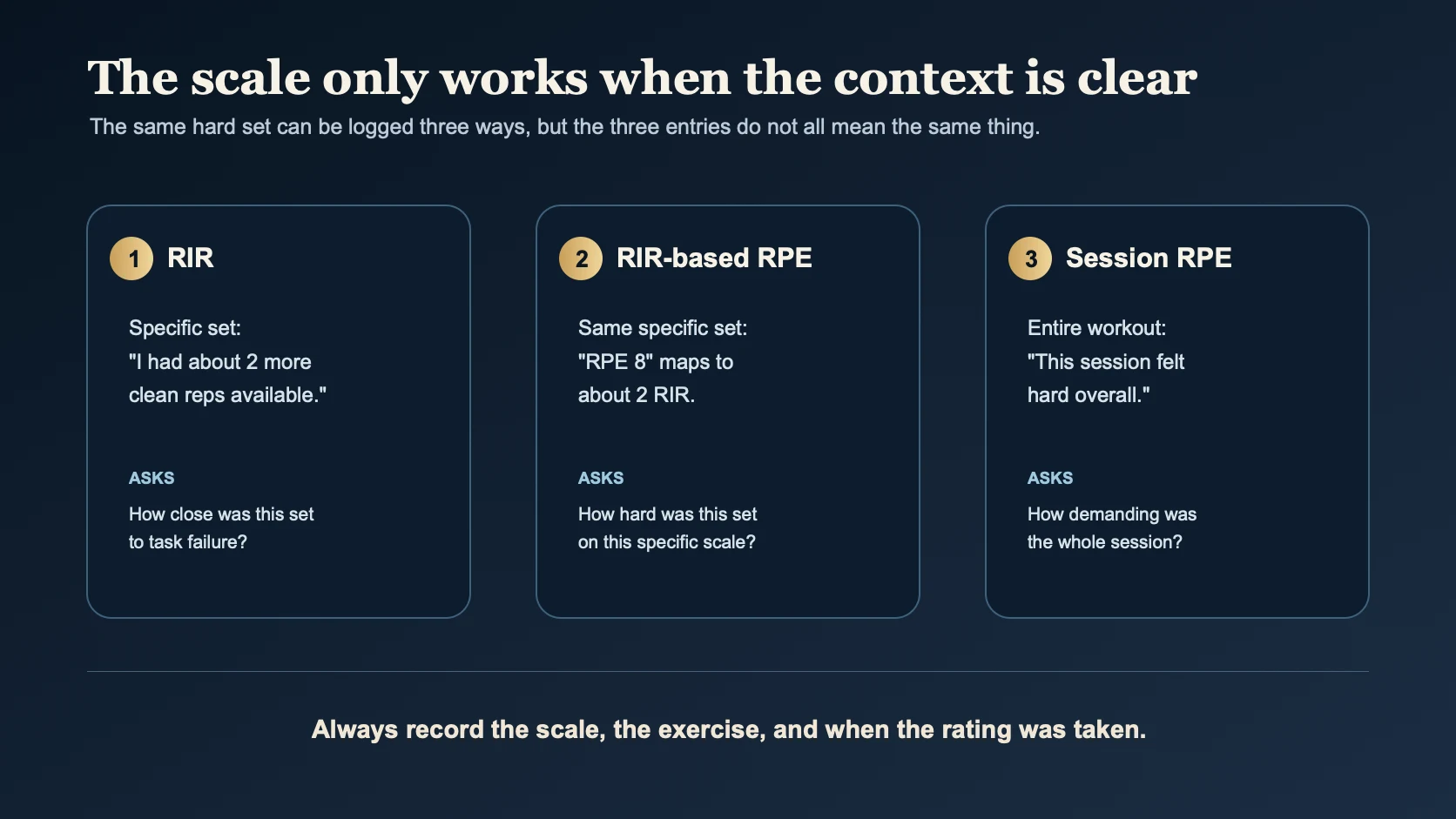
But a post-workout session RPE is different. If you rate the whole session as an 8 out of 10, you are describing the overall experience of the workout: its effort, density, duration, accumulated fatigue, and context. That number cannot be translated to "two repetitions left" because it does not belong to one set or one exercise.
The same number can mean different things
Imagine a bench-press work set that ends with two clean repetitions likely left. You could log it as 2 RIR or RPE 8 if your program uses the RIR-based RPE scale. Both entries describe the same local estimate.
Now imagine the rest of the workout included rows, presses, accessories, a rushed warm-up, and shorter rest periods than usual. A session RPE of 8 out of 10 may be an honest summary of the whole hour. It does not tell you that every set was RPE 8, and it does not tell you how many repetitions remained on the bench press.
The distinction keeps a training log interpretable. Write "bench press: 8 reps, 2 RIR" when you want to regulate that set. Write "session RPE: 8/10" when you want to notice that the entire workout was unusually demanding. Do not combine them in one field and expect the number to answer both questions.
This is also why a program should not attach a moral label to a higher RPE. A difficult session can reflect useful hard work, but it can also reflect short rest, poor sleep, a new exercise, heat, time pressure, or a load that was simply too ambitious. The Difference Between Training Hard and Making Every Session a Test explains why hard work needs a defined purpose rather than a demand to feel maximal every time.
What the research says about the estimate
RIR is a subjective estimate, not a hidden camera pointed at future repetitions. That does not make it useless. It means the estimate improves with practice and needs context.
A 2024 scoping review identified 31 RIR-scale studies involving 855, mostly male, adult participants. The authors concluded that RIR scales appeared feasible and useful for selecting and adjusting resistance-training intensity in the studied settings. They also noted that RIR predictions tended to be more accurate closer to task failure, while questions about sex, training experience, exercise selection, and conditioning remain. Read the RIR feasibility and usefulness review for the included designs and limitations.
RPE has a broader evidence base, but that does not make it an objective replacement for every training measurement. A systematic review and meta-analysis of RPE during resistance exercise included 75 studies and 99 unique cohorts. It reported a large overall association with the exercise-intensity and physiological measures it compared, alongside very high between-study heterogeneity. The RPE validity meta-analysis supports RPE as a practical signal, while the variation between studies is a reason not to treat one rating as a laboratory verdict.
Both findings point to the same practical restraint: use the scale to improve a repeated decision, not to prove exactly what happened inside a muscle or nervous system on one set.
Use the smallest useful system
Choose the reporting method that answers the question your program actually has.
For a main lift where you want to adjust load, a set-level RIR target is often clear: "three sets of five at 2 RIR." If your coach or template uses RIR-based RPE instead, "three sets of five at RPE 8" can mean the same thing. Keep the convention stable for a block so the log remains comparable.
For a broader workload note, record session RPE after the workout and label it as such. You can use it beside duration, a short recovery note, or completed work, but do not convert it into an RIR target for a particular exercise. The 2020 review of resistance-training monitoring methods describes RIR-based ratings and post-set or sessional RPE as practical tools among several others. The useful lesson is not to collect every metric. It is to choose measures that match the decision you need to make.
When the next session arrives, compare like with like. Same exercise. Similar setup. Same scale. Similar technical standard. If the estimate is repeatedly far from the target, adjust the load, repetitions, rest, or program rather than assuming the scale has failed. A log can be imperfect and still reveal a useful trend.
For the broader question of how effort fits into training progression, Progressive Overload Is Biology, Not Just More Weight explains why more load is only one way to progress. For the recovery side, Volume or Intensity: What Should You Cut During a Deload? shows how RIR can help make a lower-cost week more deliberate.
Conclusion
RIR and an RIR-based RPE scale can describe the same set-level question from different angles. RIR says how many clean repetitions you think remained. RPE gives that estimate a scale score. Session RPE is a different tool: it describes the whole workout and should not be converted into repetitions left.
The useful choice is not which acronym sounds more advanced. It is whether the number is clearly labeled, recorded at the right moment, and used consistently enough to improve the next training decision.
FAQ
Is RPE 8 always the same as 2 RIR?
Only when you are using a resistance-training RPE scale explicitly tied to repetitions in reserve. A Borg-style or session RPE rating may use a different scale and ask a different question.
Should beginners use RIR?
Beginners can use simple RIR targets, but estimates improve with familiar movements and honest technique standards. Start with a modest target, record what happened, and use the log to learn rather than trying to guess perfectly from day one.
Is session RPE less useful than RIR?
No. It answers a broader question. RIR can help regulate one set; session RPE can show how the total workout felt. They are useful together when they are not forced to mean the same thing.
Continue with a related guide
For the practical role of effort in a planned session, read The Difference Between Training Hard and Making Every Session a Test. For a second perspective on load progression, continue with Progressive Overload Is Biology, Not Just More Weight.