Progressive overload is often reduced to a visual: more plates on the bar than last time. That can be a useful sign of progress, but it is not the biology of progress. Your muscle does not read the label on a plate. It responds to the work it performs, the tension it experiences, the resources available afterward, and whether that challenge is repeated long enough to matter.
This distinction is not an excuse to make training vague. It is a way to make it more accurate. Added weight is one way to change a training task. More controlled repetitions, a longer useful range of motion, a more demanding exercise variation, or a similar amount of work performed with less assistance can also change the challenge. None of those levers guarantees an adaptation by itself.
The useful question is not, "Did the number go up today?" It is, "Did this exposure create a meaningful, repeatable reason for the body to adapt?" That is where progressive overload becomes biology rather than bookkeeping.
- Why external load is only a proxy
- What a muscle-level stimulus actually means
- Why effort, range and repetition context matter
- What studies can and cannot tell us about load
- How to use the idea without turning training into a lab
A plate is an external signal, not the adaptation
The barbell, dumbbell or machine pin is an external load. It tells you something important about the task, but it does not describe the full dose received by the person doing it. The same 100 kilograms can produce very different work depending on the exercise, range of motion, stability demands, repetition speed, rest period, proximity to failure and the muscle that is actually limiting the set.
That is why a larger number is not automatically a larger useful stimulus. A heavier squat performed through a much shorter range is not directly comparable with a controlled squat at a lower load. A row that is limited by grip, balance or a rushed setup may tell you less about the back muscles than the number on the stack suggests. Biology responds to the local problem being solved, not to a scorecard in isolation.
This is also why a good log needs context. The practical guide to progressive overload beyond adding weight covers how to choose a next change. The science underneath it is simpler: compare like with like before deciding that the body has been asked to do more.
Mechanical tension is local
Mechanical tension is often used as a catch-all phrase, but it does not mean that every kilogram on an implement becomes identical tension in every muscle. A muscle produces force within a particular joint position, movement path and level of fatigue. Other tissues, the machine setup, balance requirements and nearby muscles can change how much of the task reaches the muscle you want to train.
When a muscle is recruited and challenged through a useful range, mechanical signals are part of what starts the adaptation process. Those signals interact with cellular pathways involved in protein turnover and remodeling. That model is strong enough to guide practice, but it is not a reason to claim that one set activates a single switch called growth. The recent review of load-induced human skeletal-muscle hypertrophy makes the same important distinction: mechanical tension is central, while the downstream response is complex and shaped by more than one acute marker.
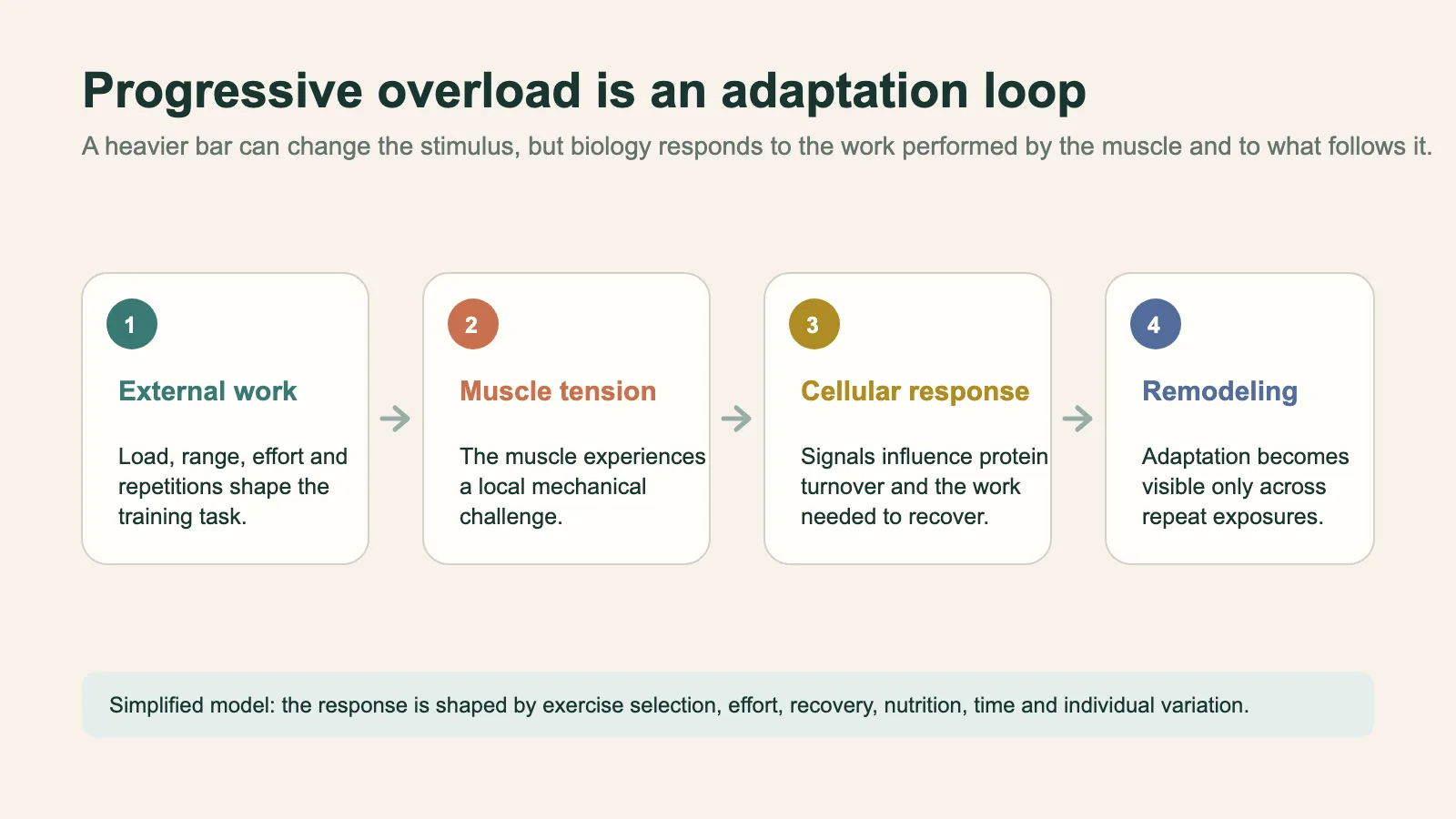
The diagram is deliberately a simplified loop. It does not show every molecule, and it cannot predict an individual’s response. Its value is in separating the training input from the adaptation that may accumulate later. The session is not the finished product; it is the signal.
Effort changes what a load means
The same external load can be light for one person and demanding for another. It can also become more demanding across a set as fatigue builds. This is one reason low, moderate and high loads cannot be treated as completely separate biological worlds.
In a small 2016 unilateral study, participants trained elbow flexion either with a conventional 70% one-repetition maximum load or with maximal voluntary contractions through the same range without an external load. The researchers reported similar increases in ultrasound muscle thickness across the measured sites, while the conventionally loaded condition improved one-repetition maximum strength more. That study is narrow, short and not a prescription to abandon weights. Its useful lesson is that the external object alone does not fully explain the muscle-growth response.
The broader evidence needs the same restraint. A 2021 network meta-analysis of 28 studies in healthy adults found no overall difference in hypertrophy among low-, moderate- and high-load programs when sets were taken to volitional failure, while strength improvements favored moderate and high loads. That does not make load irrelevant. It means load is more specific to some outcomes than others, and it has to be interpreted alongside effort and the rest of the program. Read the full review and its eligibility criteria before turning a headline into a universal rule.
Repetition is what gives the signal a chance to accumulate
One difficult set can be useful. One difficult set does not explain a months-long change in strength or muscle size. Adaptation is a repeated-exposure problem. The body has to receive a challenge, recover from it, and encounter enough comparable work for a longer-term change to become visible.
That is where progressive overload earns its name. The goal is not permanent escalation. It is to keep the training stimulus meaningful after the current version of the task becomes familiar. Sometimes that means more load. Sometimes it means repeating the same prescription because the last session was not yet stable enough to compare. Sometimes it means changing the exercise because the old one no longer serves the target well.
This is close to the idea behind mechanical tension, but the two concepts are not interchangeable. Mechanical tension describes part of the local stimulus. Progressive overload describes how a program changes exposure over time. One is a biological explanation; the other is a planning strategy built around that explanation.
Recovery decides whether more work becomes more adaptation
An increase in the gym only has value if it can be recovered from and repeated. That is not a motivational warning; it is part of the mechanism. Training creates both a stimulus and a cost. Sleep, nutrition, stress, training frequency and the total work already in the program influence whether the next exposure can be productive.
For that reason, more work is not always better work. If adding a set makes the next two sessions less consistent, or a heavier load changes the exercise into a different movement, the biological case for the change is weaker than the plate count suggests. Our article on why more training is not always more progress explains the practical side of keeping a dose recoverable.
It is also important not to use biology to self-diagnose. Persistent pain, weakness, numbness, dizziness, or symptoms that worsen with training call for appropriate individual assessment, not a more aggressive overload strategy.
What research does not give you
Research can show average changes in groups under particular conditions. It can compare loads, measure strength tests, estimate muscle thickness, or examine parts of the cellular response. It cannot tell you that a particular session "caused growth" because a muscle felt sore, a pump was large, or a wearable reported a high training load.
Acute measures are especially easy to overread. A temporary increase in protein synthesis, muscle swelling or fatigue may be related to the process without functioning as a personal scoreboard. Long-term outcomes depend on what happens across many sessions, not on one impressive response after one workout.
That uncertainty is not a problem to solve with more complicated programming. It is a reason to make small, interpretable changes and give them time. The best plan is usually easier to evaluate than a plan that changes load, exercise, volume, rest and technique all at once.
Use the biology to ask better questions
You do not need to measure molecular signaling to apply this article. Start by asking whether the target muscle is doing a repeatable job, whether the work is hard enough to matter for the goal, and whether you can recover well enough to repeat it. Then change one variable when the current dose has stopped moving you toward that goal.
For strength in a specific lift, heavier practice often matters because the skill and the test are specific. For muscle growth, a range of loads can work when sets provide a sufficient local challenge. For both goals, a training log becomes useful when it records the conditions that make sessions comparable, not only the heaviest number achieved.
The point of progressive overload is not to prove that every workout was harder than the last. It is to give biology a series of reasons to adapt while keeping the work legible enough to learn from.
Continue with a related guide
For a deeper look at the local signal, read Mechanical Tension Explained. To turn the idea into a practical progression rule, continue with Progressive Overload Is More Than Adding Weight to the Bar.
Conclusion
Progressive overload is biological because training changes tissue only when a meaningful challenge is repeated, recovered from and allowed to accumulate. More weight can be a powerful way to change that challenge, especially when strength in a specific lift is the goal. It is not the only useful change, and it is not the adaptation itself.
Treat the number on the bar as evidence to interpret, not as the whole story. The stronger signal is a pattern of comparable work, sensible adjustments and a trend that holds up across a training block.
FAQ
Is adding weight the best form of progressive overload?
It is often useful, especially for strength in a specific lift, but it is not automatically the best next change. The relevant question is whether the new task remains comparable and serves the goal of the exercise.
Does a pump prove that progressive overload worked?
No. A pump is an acute sensation, not a direct measure of long-term adaptation. Use performance trends, repeatable training conditions and time to judge progress.