A lifting belt is easy to turn into a milestone. You see stronger lifters wearing one, a product page frames it as essential, and the question becomes, "Am I strong enough for a belt yet?" That is the wrong test. A belt is not a reward for reaching a number, and it is not a requirement for taking strength training seriously.
The better question is whether a belt has a clear job in the work you already do. For most lifters, that happens after three things are true: the movement is familiar enough to repeat with control, a specific use case keeps showing up in the training log, and the belt can be fitted and practiced without making the lift less clear. There is no universal bodyweight, age, or percentage-of-max threshold that can replace those checks.
This is not a medical guide and a belt is not a treatment. Persistent pain, numbness, weakness, dizziness, breathing difficulty, a recent injury, or a health condition that changes how you train calls for individual guidance rather than an equipment decision.
- Why a belt is not a beginner milestone
- The first sign: a familiar movement
- The second sign: a repeated job for the belt
- The third sign: practice in the real context
- Reasons to wait and what to do instead
A belt is not a graduation ceremony
Belts are common in strength sports because they can change the bracing environment during a lift. That does not make them a compulsory stage of progress. A beginner can make excellent progress with simple equipment, manageable loading, and enough practice to learn the movement. A more experienced lifter can also choose to train without a belt for many or all sessions. The tool only makes sense when it supports a decision that is already present in the program.
Start with the foundations instead. Can you set up consistently? Can you create a deliberate brace without rushing? Can you complete your planned repetitions at loads you know how to manage? The framework in Your First Strength Program Should Be Boring is deliberately useful here: repeated basic work usually teaches more than adding equipment early.
First, make the movement familiar enough to observe
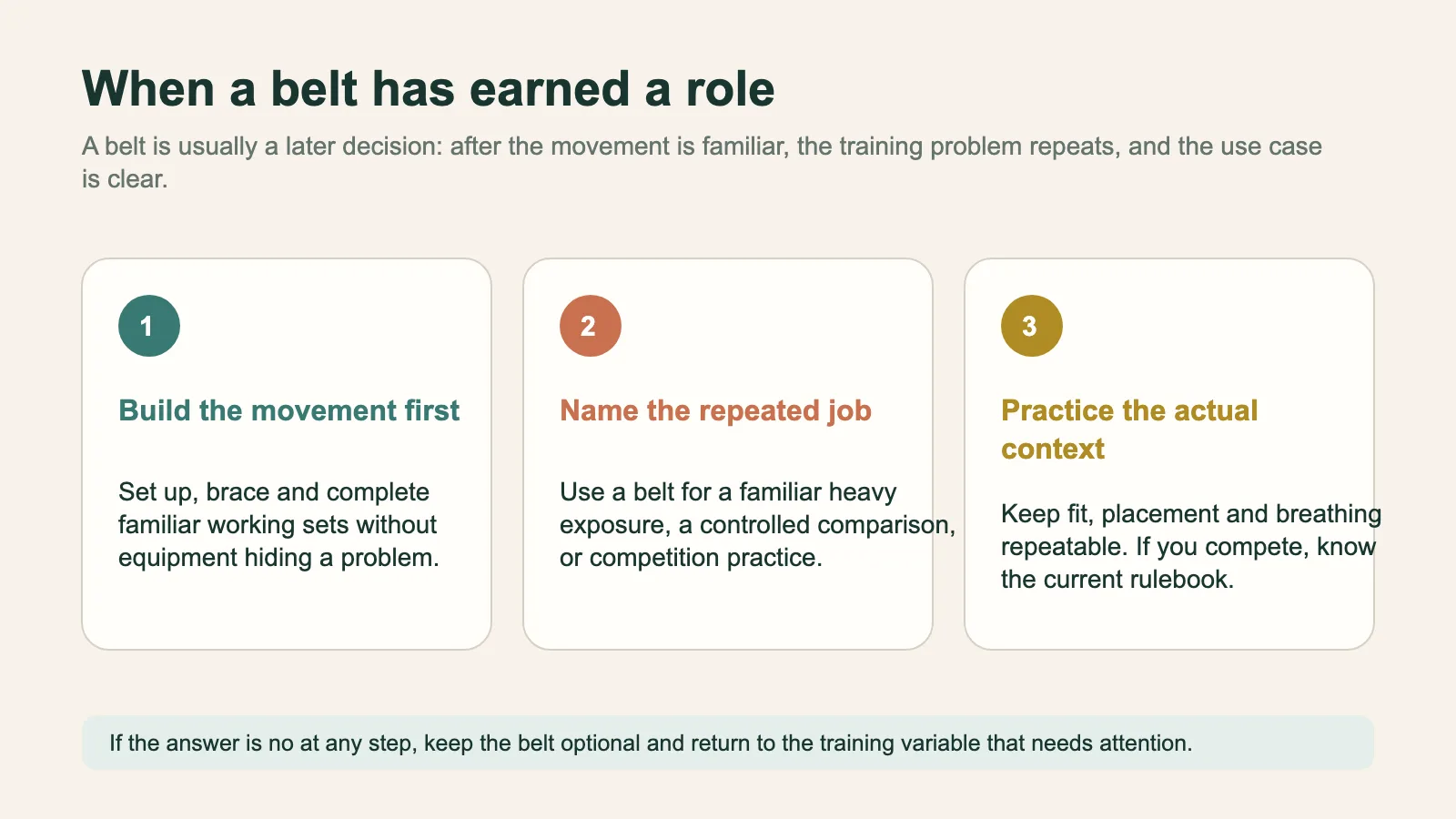
The first useful sign is not strength in the abstract. It is a movement that you can recognize from one session to the next. You know your general setup, you can control the repetitions you have planned, and you can notice when something changes. That might be a back squat, front squat, deadlift, or another lift where a belt is relevant to the way you choose to train.
This is also why belts should not be used to force a movement that already feels wrong. A belt may feel firm around the torso, but that sensation does not diagnose the reason a lift is uncomfortable or make a concerning symptom safe to ignore. Reduce the task, review the setup, and seek qualified help where appropriate. Gear should clarify a familiar task, not cover up a problem you have not identified.
Then give the belt one repeated job
A belt has earned consideration when you can describe its intended job in one sentence. Examples include: "I want to practice the setup I will use in a competition division," "I want to compare a belt during the final planned sets of a familiar squat," or "I want a repeatable external surface to brace against during a specific heavy exposure." Those are narrow, testable reasons.
"Everyone at my gym has one" is not a job. Neither is "my progress has slowed" without knowing whether training volume, load jumps, sleep, food, exercise selection, or consistency changed first. A belt cannot make an unclear program clear. Before buying or wearing one, look at the larger structure in The Anatomy of a Great Strength Program: exercise practice, progression, total work, and recovery are still the main levers.
A controlled deadlift study found that wearing a belt changed several measured intra-abdominal-pressure variables during lifting. Read the study of belts and intra-abdominal pressure as a description of a possible mechanism, not as a readiness test or an injury-prevention guarantee. The research does not tell an individual reader the exact load at which they should begin wearing a belt. The practical decision still depends on the lift, the person, the setup, and the role the belt is meant to play.
Practice the context before making it routine
Once you have a real use case, treat the first few belt sessions as practice rather than a test of toughness. Use a familiar lift and a manageable load. Choose a placement that allows you to set up normally, fasten the belt with room to create a deliberate brace, and notice whether it changes your breathing or range of motion in an unhelpful way. Keep the rest of the session as ordinary as possible.
Record a few useful observations: placement, tension, setup quality, comfort, repetition control, and whether you completed the planned work. You do not need a complicated scoring system. You are looking for a pattern over several exposures, not a dramatic result from one day. If the belt constantly shifts, pinches, makes bracing harder, or turns the lift into a different movement than the one you intend to practice, it has not earned a permanent role yet.
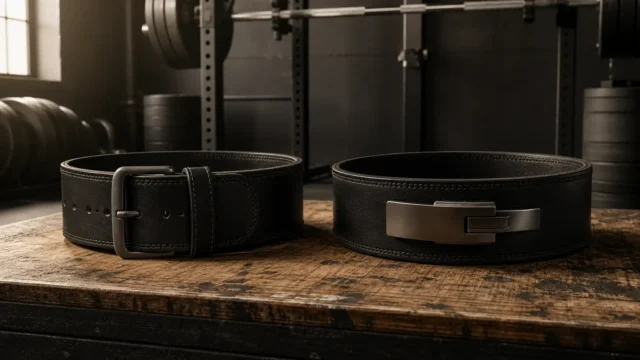
The fit and selection details belong in Lifting Belts 101. That article covers width, thickness, closure, and basic setup. Here, the important distinction is timing: learn those details after you can explain why the tool belongs in your plan, not because you feel pressure to own what stronger lifters own.
Competition is a separate context. If you have entered a meet, practicing the equipment allowed by your division can be sensible well before meet day. The International Powerlifting Federation’s current technical rules are an example of why you should check the actual federation and current event information rather than relying on a retailer’s label. Different organizations can use different specifications and approved-equipment requirements.
Do not confuse "heavy" with a universal number
People often ask for a percentage: should a belt start at 70, 80, or 90 percent? A fixed rule is attractive because it sounds decisive, but it leaves out the context that makes the decision useful. A set of five after a long workday, a paused competition-style squat, a technical deadlift variation, and a single at a meet can feel and function very differently even when the percentage looks similar.
Instead, define heavy in relation to your existing plan. The belt may be relevant when the work is familiar, demanding enough that you care about repeating the setup precisely, and specific enough that a comparison would teach you something. It may not be relevant for lighter practice, warm-ups, accessory work, or a movement you are still learning. Both choices can coexist in the same week.
That keeps belt use inside the plan. You might decide to use it only for the final planned sets of one lift, only for competition-style practice, or only after several unbelted working sets. The rule should be simple enough to write in a log and review later. The goal is not to appear equipped. It is to make the training decision visible.
Reasons to wait are useful information
Waiting is not falling behind. It is often the clearer choice when the belt has no specific job yet. Hold off if you are still changing basic technique every session, if the current program is inconsistent, if the belt is being used to push through symptoms, or if you have not practiced the exact fit and placement. Also wait if the purchase would take money away from equipment or access you actually need to train consistently.
Keep training the movements you can repeat. When a defined need repeats, introduce the belt for that one context and compare it calmly.
Conclusion
Start using a belt when the question has become specific. You can repeat the movement, name the task the belt should support, and practice the fit in that task without turning the accessory into a substitute for skill, programming, or individual advice. There is no universal load threshold, and there is no need to rush the decision.
For some lifters, that point arrives during structured heavier work or competition preparation. For others, it arrives later or not at all. The useful standard is simple: the belt should make a known piece of training more repeatable, not make an undefined problem easier to ignore.
FAQ
Do beginners need a lifting belt?
No. Most beginners benefit more from repeated practice, manageable loading, and a simple program. A belt can remain optional until there is a specific, repeatable role for it.
Should I wear a belt for every set?
Not by default. Use it only where it serves the rule you chose for the session, such as a familiar heavier exposure or competition-specific practice. Keep the decision visible in your training log.
Continue with a related guide
For fit and selection details, read Lifting Belts 101: What They Do, What They Don’t and How to Choose One. To compare belt use in a specific lift, continue with The Belt Question: When Does It Actually Make You Stronger?.