

Walking and running are often framed as a contest: one is supposedly too easy, the other is supposedly the only serious choice. For general fitness, that framing misses the decision that matters. The better option is the one you can perform regularly, at an appropriate effort, without turning the rest of the week into a recovery problem.
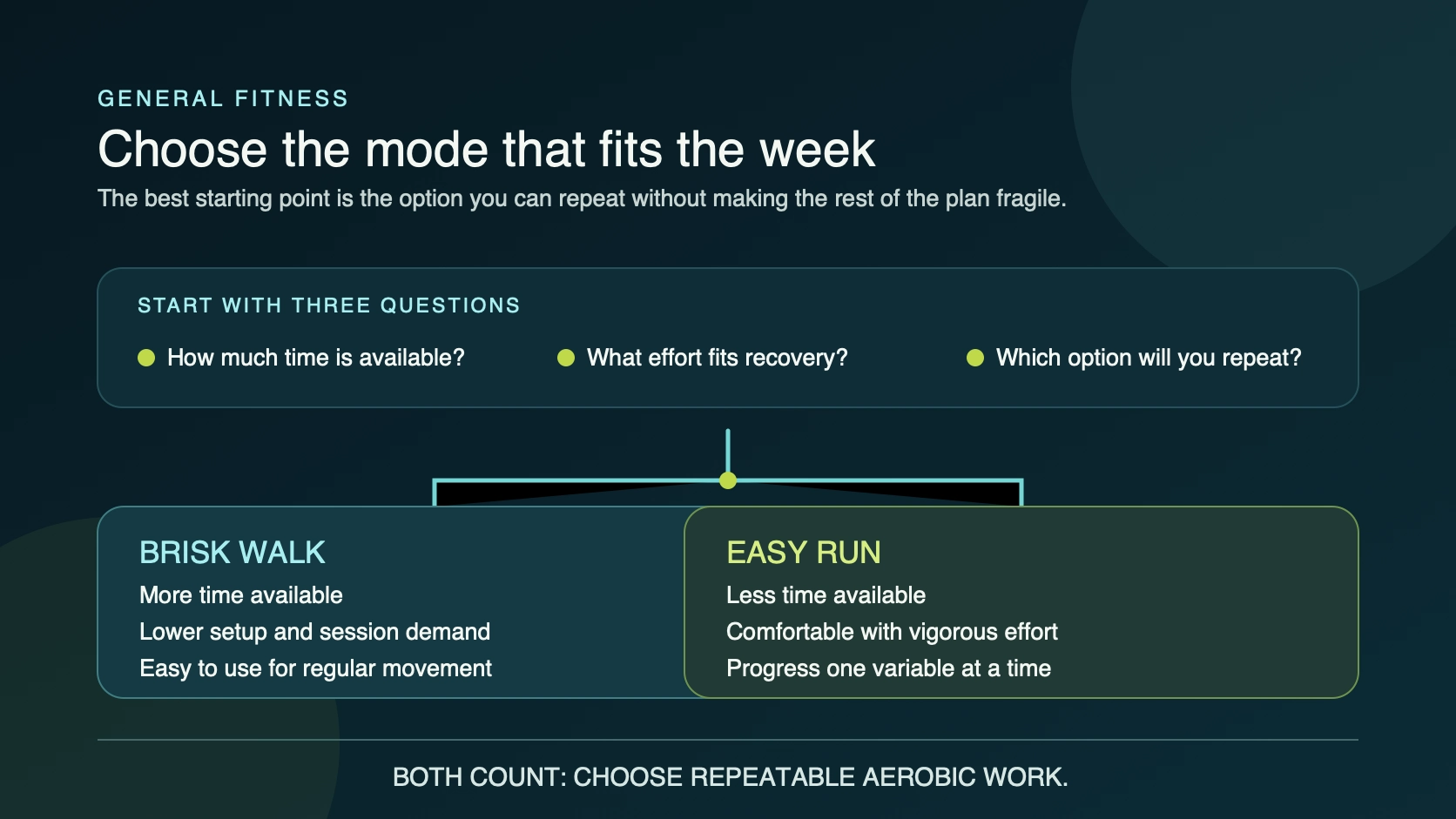
Running gives you vigorous aerobic work in less time. Walking is easier to place around work, lifting, family, and ordinary fatigue. Both can belong in a useful routine. You do not need to become a runner to be active, and you do not need to dismiss running because walking is valuable.
- Compare the work, not the identity
- When walking is the stronger default
- When running earns its place
- Build one week you can repeat
- Progress without turning a comparison into a test
Compare the work, not the identity
The practical difference is intensity. Brisk walking is commonly classed as moderate-intensity activity, while jogging and running are generally vigorous. The current CDC adult activity guidance uses 150 minutes of moderate activity, 75 minutes of vigorous activity, or an equivalent mix as broad weekly reference points. It also includes muscle-strengthening activity on two or more days. Those are population-level guidelines, not a command to hit a precise number every week.
That intensity difference changes the time equation. A short run can make sense for someone with a narrow lunch break or a schedule that will not support longer outings. A walk may take longer to create the same aerobic demand, but it can happen before work, after dinner, during a phone call, or on the way to an errand. The time cost is only one cost. The preparation, shower, route, clothing, energy, and next-day effect all count too.
For general fitness, the goal is not to prove that one mode is superior in isolation. It is to collect enough aerobic movement across the month while leaving room for strength work, sleep, meals, work, and relationships. That is why the useful question is not "am I a walker or a runner?" It is "what can I repeat this week without making the plan fragile?"
Walking is not the consolation prize
Walking is often the better starting point because it has a low barrier to entry. You can begin with a familiar route, ordinary shoes, and a pace that feels purposeful but controlled. You can make it social, split it into smaller blocks, or use it as a transition between work and home. Those details are not trivial. They are the conditions that decide whether an activity survives a busy month.
Walking also works well beside a strength plan. A person lifting two or three times per week may prefer walking on the other days because it adds movement without competing for the same mental and physical resources as another hard session. It can be a real training choice rather than the thing you do only when a workout is cancelled. The same sustainable approach appears in Fitness for People With Actual Lives: build around the week you actually have, not an idealized schedule.
Research does not make walking an inferior category. A prospective U.S. cohort study found that leisure-time walking and running were both associated with lower all-cause mortality compared with doing neither activity; walking and running had similar associations with cardiovascular mortality in that analysis. The study of activity types and mortality is observational, so it cannot prove that a particular walk or run caused the result. It is useful here because it challenges the idea that only running "counts."
Walking may be the stronger choice when you are new to planned exercise, returning after a break, managing a demanding lifting block, or simply more likely to go out when the pace is lower. It is also a good choice when the route is the reward: a walk to work, a park loop, a conversation with a friend, or a regular errand on foot. General fitness improves through accumulated behavior, not through winning an intensity argument.
Running is useful when the extra demand has a job
Running has a clear advantage when time is tight and you enjoy vigorous work. It can raise aerobic demand quickly, give a simple outlet for people who like pace and rhythm, and make short sessions feel substantial. A person who genuinely likes running is more likely to return to it, which matters more than a theoretical comparison of calorie estimates.
It does, however, ask more from each session. The sensible approach is to begin below the effort you could survive once. A new runner does not need to turn every outing into a continuous hard run. Short run-walk intervals, easy jogs, or a modest weekly amount can establish a repeatable starting point. Add one variable at a time: a few more minutes, a slightly longer route, or one additional easy outing. Do not increase pace, duration, hills, and frequency together simply because the first week felt manageable.
The evidence on running should also be read with its limits. A meta-analysis of trials in previously inactive, healthy adults reported improvements in several health measures after running programs, but the programs were structured interventions and the averages do not tell you how quickly any individual should progress. Read the meta-analysis of running interventions as support for running as a valid option, not as a prescription.
Running is a poor tool for forcing through warning signs. Stop and seek appropriate professional guidance for chest pain, fainting, marked shortness of breath out of proportion to effort, or persistent pain and swelling that change normal movement. This article cannot assess an individual history, medication, injury, or medical condition. The right response may be a different activity, a slower return, or a clinician’s input, not more discipline.
Build a week before choosing a side
For most people, a mixed week is more useful than an exclusive identity. Start with the activity you are ready to repeat. If walking is already reliable, make one or two walks a little brisker or longer before deciding you need to run. If you already enjoy running, keep enough easy movement and recovery around it that the sessions remain enjoyable.
Here are three simple ways to organize the choice without treating them as fixed programs:
- A walking-led week: regular brisk walks, two strength sessions, and one optional longer weekend route.
- A mixed week: walks for daily movement, one or two easy runs, and two strength sessions.
- A running-led week: a small number of planned runs, easy walking on other days, and strength sessions arranged so the total week remains manageable.
The details can change, but the logic stays stable. Place the most demanding session where you have the best chance of recovering from it. Do not stack a new running habit on top of maximal lifting, poor sleep, and an already overloaded calendar. If the week is chaotic, reduce the ambition before you remove the habit. How to Stay Consistent When Life Gets Chaotic offers the same principle in a broader context: keep the smallest useful version of the routine visible.
Use feedback that is simple enough to trust
You do not need a perfect wearable score to compare walking and running. Track the facts that help you make the next decision: how often you went out, roughly how long you moved, whether the chosen pace felt sustainable, and whether the session disrupted the rest of the week. If you like numbers, distance or a route time can be enough. If numbers make the habit feel like an exam, a basic calendar mark is enough.
Give a new choice several weeks before judging it. One hard run can make walking look boring; one pleasant sunny walk can make running look unnecessary. Neither is a useful comparison. The signal is whether you can repeat the activity, make modest adjustments, and still want to return. That is the version of consistency that supports general fitness, as explained in Consistency Beats Intensity.
Walking is a strong choice when it is the movement you will actually do. Running is a strong choice when its higher intensity fits your time, tolerance, and preferences. Choose the option that supports a durable week, then let the other remain available rather than treating it as the enemy.
Continue with a related guide
For a practical way to fit exercise around a normal schedule, read Fitness for People With Actual Lives. For a compact strength complement, continue with You Don’t Need to Live in the Gym to Become Strong.