

Fitness advice often sounds like it was written for people with empty calendars, quiet kitchens, perfect sleep, and no one asking them where the car keys are. That may be useful for a professional athlete. It is not useful for most people.
Fitness for people with actual lives has to begin with constraints. Time, energy, access, money, family responsibilities, stress, and health all shape what a plan can become. Ignoring those constraints does not make the plan more serious. It makes the plan easier to abandon.
The CDC adult physical activity guidance includes both aerobic activity and muscle-strengthening activity. That is the direction. Your job is to turn the direction into a version that fits the week you actually live.
- Use the actual-life filter
- Start smaller than your ambition
- Keep more than one training option
- Review the week without drama
Use the actual-life filter
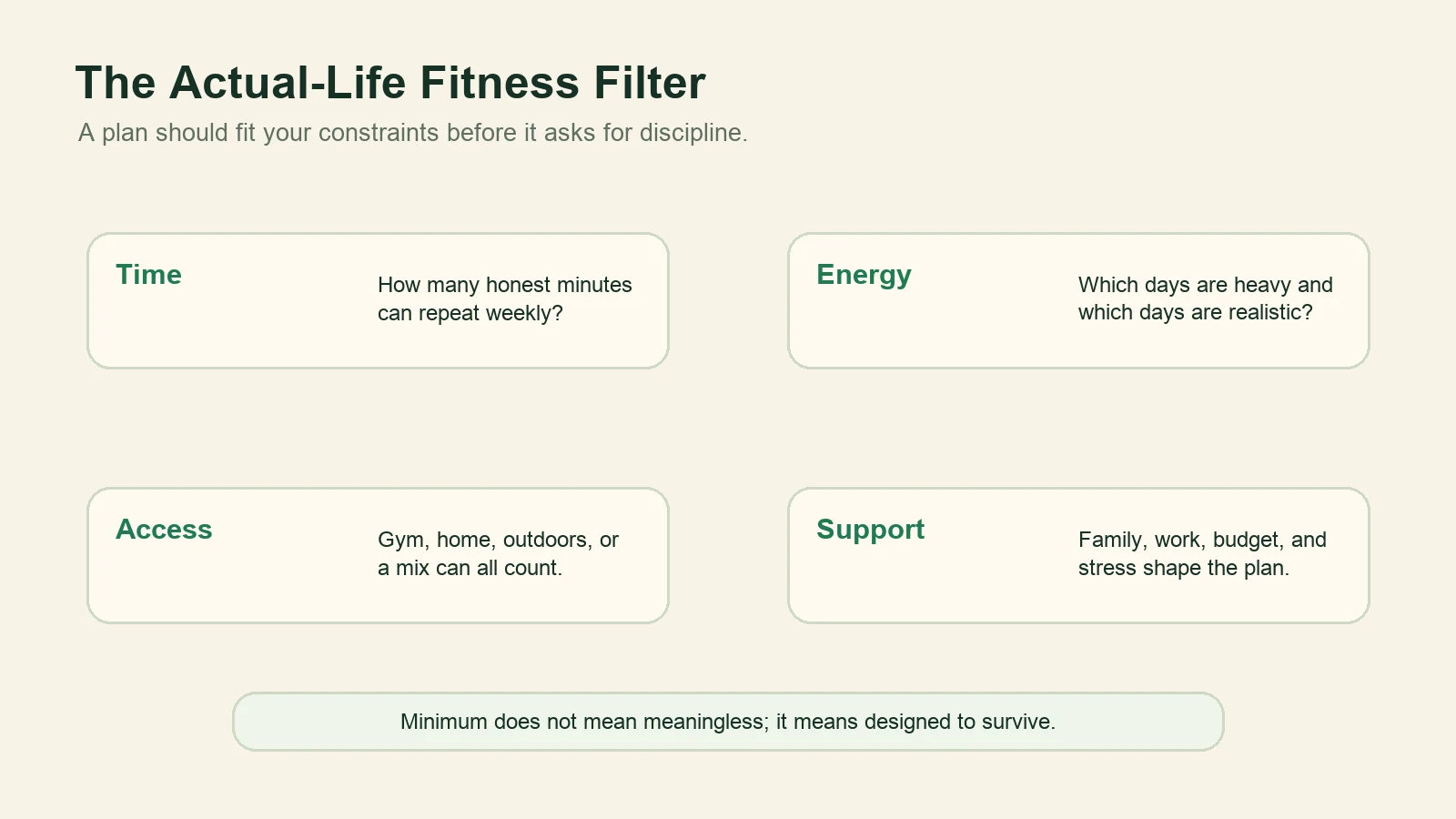
Before choosing a program, ask four questions.
First, how much honest time can repeat weekly? Not fantasy time. Honest time. If the answer is two 35-minute windows, start there.
Second, what does your energy look like? Some people can train hard after work. Others can barely cook dinner. Neither is a character flaw. Energy patterns should shape training days.
Third, what access do you have? Gym, home, outdoors, hotel room, resistance bands, dumbbells, bodyweight, stairs, or a mix can all count. A plan that depends on a gym you cannot reach is not practical.
Fourth, what support or friction exists around you? Family schedules, childcare, money, neighborhood safety, commute, and stress are real variables.
Start smaller than your ambition
Most people do not fail because their first plan is too easy. They fail because the first plan requires a life they do not have. Start with the smallest version that is still useful.
That might be two strength sessions per week, one longer walk, and a short mobility routine on busy days. It might be three 20-minute home workouts. It might be one gym day and one outdoor session. The shape matters less than repeatability.
The Physical Activity Guidelines for Americans emphasize that some activity is better than none and that activity can be accumulated. That idea is not a loophole. It is a lifeline for people whose weeks are not perfectly organized.
Keep more than one training option
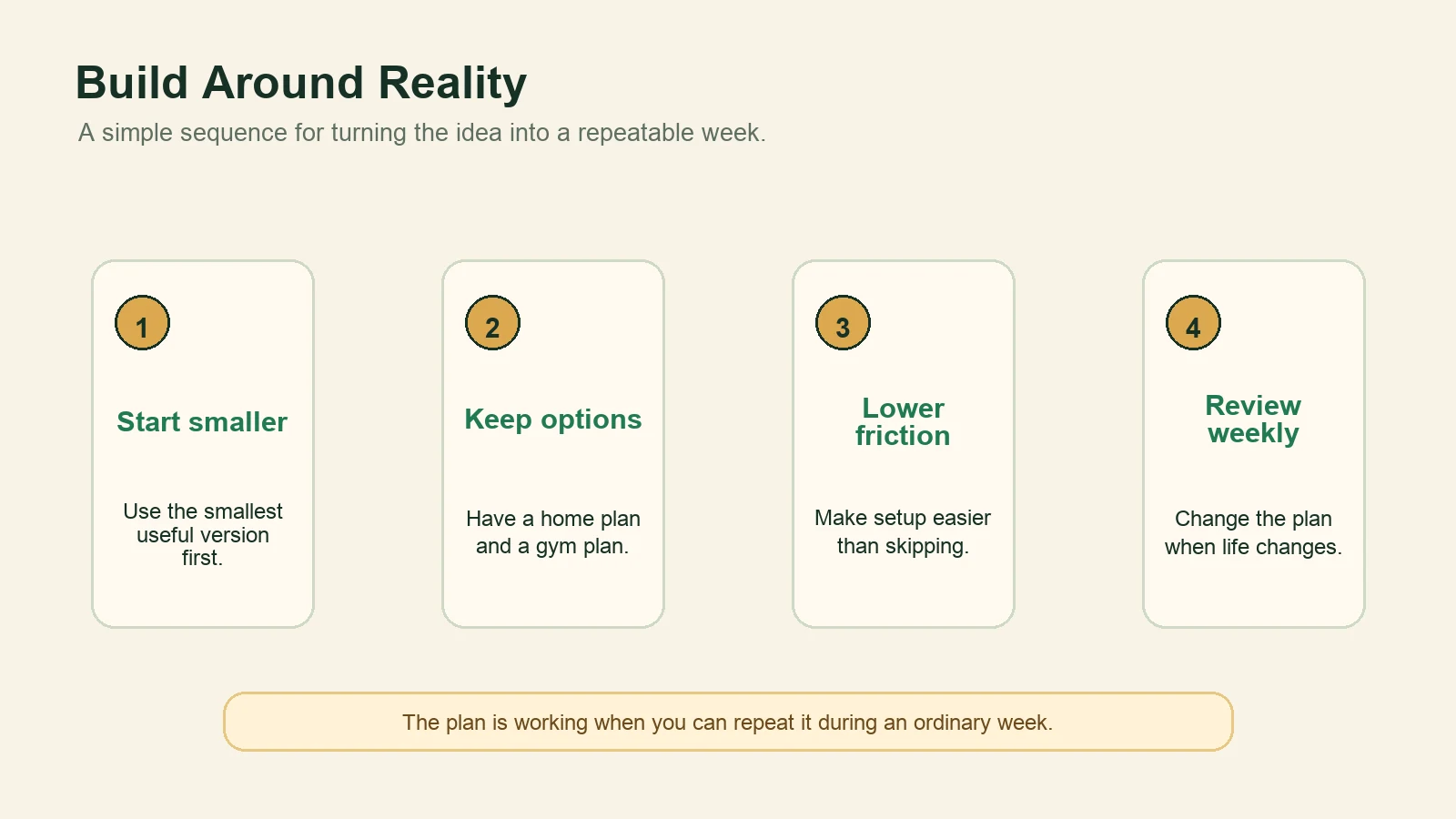
A real-life plan needs options. Have a gym version and a home version. Have a normal version and a short version. Have a tired-day version that does not require negotiation.
For example, the normal plan might be a 45-minute full-body workout. The short version might be three rounds of split squats, push-ups, rows, and carries. The tired version might be a walk and ten minutes of light strength work. The point is not that every option produces the same result. The point is that the habit does not vanish.
Review the week without drama
A weekly review should be boring. Ask what happened, what got in the way, and what needs to change. Do not turn every missed workout into a personality trial.
Habit research supports patience here. A study on habit formation in the real world found that automaticity develops gradually and varies between people. That means your routine may need many repetitions before it feels natural.
Use the review to adjust friction. If you skipped because clothes were not ready, prepare clothes. If you skipped because the gym was too far, create a home backup. If you skipped because the plan was too long, shorten the default.
Choose one movement, one walk, or one short session that keeps the week alive. The minimum version is a bridge, not a confession of failure.
The U.S. Department of Health and Human Services makes the same practical point through its Move Your Way resources: small changes can add up, and activity can be adapted to the person instead of forced into one ideal routine.
Let seasons change the plan
Actual lives do not stay the same. A parent with a newborn, a student during exams, a person caring for family, and someone in a demanding work season may all need a smaller plan for a while. That is not quitting. That is matching the dose to the season.
Use three versions. The normal version is what you do when life is steady. The busy version keeps the main sessions shorter. The emergency version protects one tiny thread of movement. When the season changes, move back up gradually instead of demanding an instant return to the old routine.
This approach also protects identity. You are not starting over every time life changes. You are changing the plan so the habit can keep belonging to you.
That mindset is especially useful after travel, illness, or stressful work periods. The next useful version may be smaller than the old one for a week or two, and that is fine.
Continue with a related guide
For a practical training structure, read You Don’t Need to Live in the Gym to Become Strong. For a long-term framework, continue with The Sustainable Lifter: How to Train for Years, Not Seasons. To decide how much room training should occupy, read How Much Space Should Fitness Take Up in Your Life?.
Conclusion
Fitness for people with actual lives is not watered-down fitness. It is fitness designed with the real inputs included. Time, energy, access, support, budget, and stress are part of the program whether you admit it or not.
Start small enough to repeat. Keep options. Lower friction. Review weekly. A plan that respects your life has a much better chance of becoming part of it.
FAQ
Can short workouts really count?
Yes. Short workouts can preserve consistency, practice movement patterns, and contribute to weekly activity. They may not replace every long session, but they are far better than disappearing.
What if my schedule changes every week?
Use a weekly planning window instead of fixed days. Pick the two or three best opportunities each week and keep a short fallback ready.