

Intensity feels convincing. A brutally hard workout creates sweat, soreness, and the emotional satisfaction of having done something serious. Consistency is quieter. It looks like showing up again, using appropriate loads, leaving a little energy in reserve, and repeating the process next week.
For long-term fitness, consistency usually beats intensity because training is cumulative. Strength, skill, conditioning, and confidence are built by repeated exposures. Intensity matters, but only when it is dosed inside a plan you can recover from and repeat.
This does not mean every workout should be easy. It means the hard work should serve the long game. If intensity keeps breaking the routine, the routine needs to come first.
- Why consistency compounds
- Where intensity fits
- How to tell if a plan is repeatable
- How to show up without going all out
Consistency gives training enough chances to work
Fitness adaptations need repeated signals. One hard session can be useful, but it cannot replace weeks of practice. A beginner who trains twice per week for six months will usually learn more, build more confidence, and create more momentum than someone who destroys themselves for ten days and disappears for three weeks.
Public health guidance reflects this weekly rhythm. The CDC adult activity guidance recommends regular movement and muscle-strengthening activity across the week. It is not written as a challenge to produce the most exhausting individual session possible.
Consistency also improves skill. Squats, hinges, presses, rows, carries, running mechanics, and pacing all benefit from practice. If the workout is always a maximal event, technique often becomes secondary to survival. If the workout is repeatable, the body gets more chances to learn.
Intensity is a tool, not the identity of the plan
Intensity has a real role. Lifting heavier, moving faster, doing challenging sets, or pushing conditioning can all support progress when applied well. The problem is not intensity. The problem is using intensity as proof that the workout counts.
A session can be productive without leaving you wrecked. A set can be useful without being a maximum. A week can build strength without every day feeling like a test.
Think of intensity like seasoning. Too little may make the plan bland or under-stimulating. Too much can ruin the meal. The right amount depends on your training age, goals, recovery, schedule, and current stress.
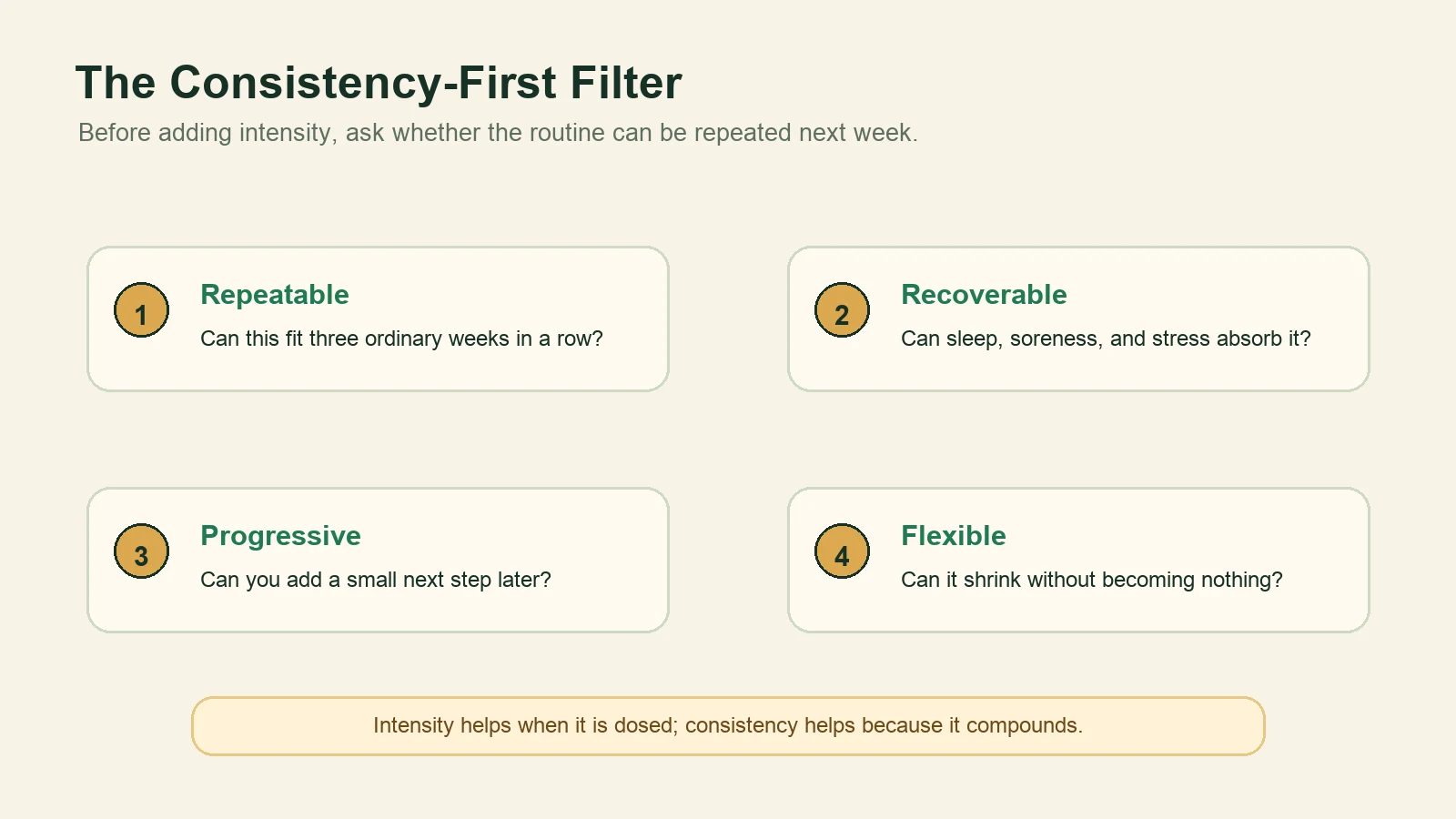
The repeatability test
Before adding more intensity, ask whether the current plan passes the repeatability test:
- Can I do this for three ordinary weeks in a row?
- Can I recover enough to train again?
- Does the plan fit my actual schedule?
- Do I know what to do when time is short?
- Can I progress gradually without changing everything?
If the answer is no, more intensity may make the problem worse. You may need fewer exercises, fewer hard sets, a shorter session, a clearer progression, or more rest between demanding days.
This is not lowering ambition. It is protecting the conditions that let ambition compound. Training that can repeat has more opportunities to create progress.
Showing up does not mean doing everything
Consistency is often misunderstood as never missing and never adjusting. A better definition is maintaining the thread. On good days, you may complete the full plan. On average days, you complete the useful work. On difficult days, you use the minimum version and return.
The Move Your Way campaign is useful because it frames physical activity as something that can fit different lives and schedules. That flexibility matters. If the only version of training that counts is long, hard, and perfectly timed, most real people will eventually fail it.
Showing up might mean:
- two good full-body sessions per week;
- one gym session and one home session;
- a shorter workout during a deadline week;
- a walk when lifting would be a poor recovery choice;
- restarting without trying to make up every missed set.
The consistent person is not the person with no interruptions. It is the person with a return path.
Consistency reduces the emotional cost of training
When training happens regularly, it becomes less dramatic. You do not need to rebuild identity every Monday. You do not need to confess every missed session. You do not need to search for a perfect program every time life gets messy.
Habit research helps explain this. In a study on habit formation in daily life, repeated behavior in a consistent context was associated with increasing automaticity. Training will always require more judgment than a tiny daily habit, but the direction is useful: repetition can make the start less psychologically expensive.
That is especially important on flat days. How to Train When You Don’t Feel Like Training offers a practical way to choose a useful version of the session without turning motivation into a pass-fail test.
That is one reason consistency beats intensity. A routine that starts easily is more likely to happen. A routine that requires a huge emotional lift every time is more likely to be postponed.
Make the normal version productive, the minimum version easy to start, and the restart version free of punishment.
When intensity should increase
Once the routine is stable, intensity can rise. Add load, reps, sets, speed, density, or difficulty gradually. Keep enough information to know what changed. If everything gets harder at once, you will not know what worked or what caused fatigue.
A simple progression might be:
- keep two weekly sessions consistent;
- add a small amount of load or one rep where technique is solid;
- hold the change for a week or two;
- reduce volume briefly if soreness or stress accumulates;
- continue.
This is not flashy. It is effective because it respects the relationship between stress and recovery. Hard work matters more when it is recoverable.
The cost of the heroic week
The heroic week feels productive because it produces strong feedback. You train hard, you feel sore, and the effort is obvious. The hidden cost is what happens afterward. If the week leaves you exhausted, resentful, or unable to repeat the plan, it may have borrowed progress from the future.
This pattern is common after long breaks. Someone returns with maximum enthusiasm, tries to recover lost time, then gets so sore or overwhelmed that the next week collapses. The problem was not a lack of effort. It was too much effort in a format that could not repeat.
A consistency-first approach asks for a less dramatic start. Choose sessions you could repeat even if the week is normal rather than perfect. Leave the gym feeling like you could come back, not like you need to disappear for five days.
Make consistency measurable
Consistency becomes more useful when it is visible. Track the simplest numbers: sessions completed, main lifts practiced, walking or conditioning days, and one note about recovery. Avoid turning the log into a punishment diary.
At the end of the week, look for patterns. If you completed two of three sessions, which two survived and why? If the same session keeps failing, move it, shrink it, or change it. The goal is not a perfect streak. The goal is a plan that keeps teaching you how to continue.
Continue with a related guide
For the next practical step, read Discipline vs Motivation: What Builds Long-Term Progress?. For a second perspective from the same topic cluster, continue with How to Build a Training Habit That Actually Lasts.
Conclusion
Consistency beats intensity because it gives training time to work. It creates more practice, more feedback, more confidence, and fewer stop-start cycles. Intensity still matters, but it should be placed inside a routine that can survive ordinary life.
Show up. Do the useful work. Progress gradually. Save the heroic sessions for moments when they serve the plan, not when they are trying to replace it.
FAQ
Does consistency mean I should never train hard?
No. Hard training can be useful. The point is to make hard work recoverable and repeatable instead of letting it break the routine.
What counts as showing up?
Showing up means completing the best safe version of the session available that day: full, reduced, swapped, or minimum.