If the goal is to improve a maximal lift, heavy loads still matter. That statement can sound old-fashioned in a fitness culture that often treats every rep range as equally useful for every goal. The better version is more precise: several loading ranges can build muscle and general capacity, but strength is a specific performance. To get better at producing high force in a squat, press, pull, or machine movement, you need regular practice under sufficiently heavy, relevant conditions.
That does not mean every session needs a maximum attempt. It does not mean lighter work is useless. It does not mean a beginner should load a bar before learning the movement. It means the load has a job. When the test is a heavy repetition, training needs some exposure to the coordination, bracing, force, and confidence that a heavy repetition requires.
- What researchers mean by heavy loading
- What systematic reviews found for strength
- Why the result is about specificity
- What lighter work still contributes
- How to use heavy work without testing constantly
Heavy is relative, not a number on the bar
“Heavy” is relative to the lifter and the movement. A load that requires focused bracing and low repetitions for one person may be a warm-up for another. In research, high-load training is commonly defined using a percentage of a recent one-repetition maximum or a low repetition maximum. Those definitions are useful for comparing programs, but they are not a command to calculate a perfect percentage before every workout.
The practical meaning is simpler: the resistance is heavy enough that the movement has to be organized under meaningful force. You must stabilize the position, follow a reliable bar path, and produce force without the repetition becoming a slow, improvised rescue. Those demands are closer to a maximal-strength test than a long set with a much lighter load.
This is why load selection cannot be separated from the task. A heavy leg press can make your legs work hard, but it is not identical practice for a barbell squat. It may support the squat, but it does not replace the balance, trunk stiffness, and timing of the target lift. How Muscle Actually Gets Stronger explains why force expression depends on neural coordination and movement practice as well as muscle tissue.
What the strongest comparisons show
The useful evidence is not one gym anecdote. It is the pattern across controlled comparisons. A 2021 systematic review and network meta-analysis by Lopez and colleagues included 28 studies with 747 healthy adults. In those studies, sets were performed to volitional failure and programs were grouped as low load, moderate load, or high load. The review found similar hypertrophy across those loading ranges, but strength improvements were greater with high and moderate loads than with low loads. Read the Lopez network meta-analysis for the methods and exact comparisons.
A larger 2021 systematic review and meta-analysis reached a similar practical conclusion from 45 studies. Higher-load training produced superior improvements in one-repetition-maximum and isometric strength, while hypertrophy outcomes were broadly similar across high and low loads in the pooled results. The authors used thresholds above or below roughly 60% of one-repetition maximum or 15 repetitions maximum to distinguish higher and lower loads. The full review by Schoenfeld and colleagues matters because it shows the result is not limited to one study design.
More recently, a 2023 Bayesian network meta-analysis compared combinations of load, sets, and frequency across 178 randomized trials involving 5,097 healthy adults, 45% of whom were women. All resistance-training prescriptions beat no training for strength and hypertrophy, but the higher-load prescriptions ranked highest for strength outcomes. That is a strong summary of the direction of evidence, not a universal template. See the Currier and colleagues network meta-analysis for its ranking method, effect estimates, and limitations.
Why high load helps: specificity, not magic
Heavy loads do not contain a special ingredient that lighter loads lack. They ask the body to solve a more similar problem to a maximal-strength test. A hard single or low-repetition set demands high force, bracing, stable positions, and a coordinated movement path while fatigue is relatively low. Repeating those conditions teaches the system how to express force when the goal is a heavy lift.
This is the principle of specificity. Training adaptations tend to transfer best when the exercise, range of motion, contraction type, and loading conditions resemble the performance you want to improve. Strength gains from lighter work can still transfer, especially for beginners or when the movements are close, but the transfer is usually less complete when the target is a heavy one-repetition maximum.
Specificity also explains why heavy practice is not the same as testing. The job is to rehearse a demanding but controlled task, not to discover the most weight you can survive today. A sound strength session can include confident heavy repetitions that leave enough control for the planned work afterward. The Difference Between Training Hard and Making Every Session a Test covers how to keep effort purposeful instead of turning every workout into proof-seeking.
Lighter work still has a job
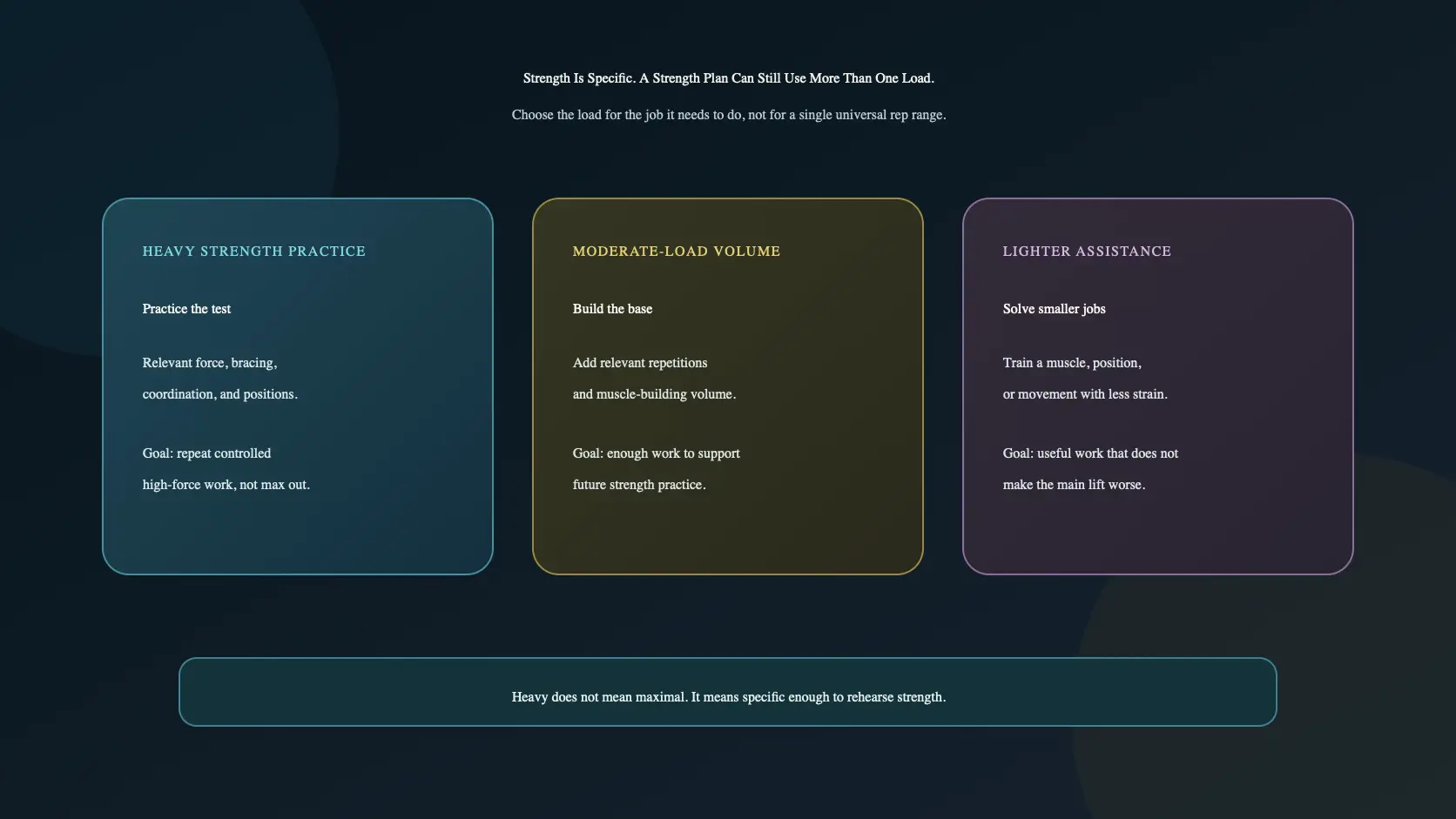
The evidence does not say that every exercise should be heavy. Lower and moderate loads can build muscle, practice positions, accumulate volume, and train around equipment or joint-tolerance constraints. They can also be more practical for accessory movements where the risk and setup costs of very heavy loading outweigh the benefit.
That is important because more muscle and more relevant volume can support future strength. A lifter may use heavier work in the main movement, moderate-load sets to build the muscles that support it, and lighter work for accessories or a lower-stress day. These are different tools, not opposing teams.
The line gets blurry when a program contains only easy, high-repetition work while claiming to target maximal strength. It may still improve general fitness and muscle size, but it leaves less practice for the exact performance being evaluated. The reverse mistake is also common: using only heavy sets, then having too little volume or too much fatigue to build a sustainable base. The Volume Sweet Spot explains why strength volume must be relevant and recoverable rather than simply high.
What the reviews cannot tell you
These reviews offer a useful direction, but they do not create a personal prescription. The included trials varied in training age, exercise selection, duration, how volume was matched, and the strength tests used. The Lopez review focused on sets taken to failure, which does not mirror every sensible strength program. A result ranked highest across many trials does not tell one individual exactly how many sets, repetitions, or heavy exposures they need.
The research also does not mean heavy loading is appropriate when technique is unstable, equipment is unavailable, or pain changes the movement. Nor does it prove that a lighter load has no value for a person returning after time away or building confidence in a new exercise. Program design still needs to account for skill, recovery, access, and the actual goal.
This is why “heavy loads rule” should be read as a statement about a specific outcome. If maximal strength is the goal, higher loads deserve a regular place. If the goal is general activity, muscle growth, rehabilitation under qualified guidance, or a short home workout, another loading strategy may be more appropriate.
A practical strength-focused structure
For an everyday lifter, the translation can remain simple. Keep a main lift or close variation in the program long enough to practice it. Include some work that feels meaningfully heavy while technique remains repeatable. Then use other sets and movements to add muscle-building volume, address weak positions, or make the week sustainable.
Progress does not require dramatic jumps. Add a small amount of load after repeated successful sessions, add a repetition within the plan, or improve the quality of the same work. If heavy sets repeatedly turn into grinders, miss the intended standard, or make the rest of the week worse, the answer is usually not more aggression. Reduce the demand, review recovery, or alter the plan.
Use appropriate safeties, a competent spotter where needed, and a setup you understand. Stop if you have sharp pain, unusual symptoms, or a movement that becomes unsafe. General science content can explain a training principle, but it cannot diagnose an injury or decide what an individual symptom means.
Conclusion
Heavy loads still rule when strength is the goal because strength is not only about muscle size. It is about expressing high force in a specific task. Higher-load training gives more practice with the coordination and confidence that task requires, and systematic reviews consistently find stronger maximal-strength outcomes than with lower loads alone.
That does not make other loading ranges inferior. Moderate and lighter work can build muscle, add useful volume, and keep a program practical. The best strength plan uses each tool for its job: heavy work for specific force practice, other work for the tissue and capacity that let that practice keep improving.
FAQ
Does heavy mean training to failure?
No. A heavy set can be challenging and controlled without reaching failure. For strength practice, preserving a repeatable movement standard is often more useful than turning every set into an all-out test.
Can light weights build strength?
They can improve strength, especially in beginners or when the task is similar, but the research reviewed here generally finds better maximal-strength gains with higher-load training. Light work remains useful for volume, muscle growth, and accessories.
Do I need to know my exact one-repetition maximum?
No. An estimated training maximum, recent performance, repetitions in reserve, and consistent logging can all help you choose a challenging but controlled load. Exact percentages are tools, not requirements.
Continue with a related guide
For the mechanism behind force production, read How Muscle Actually Gets Stronger. For the next programming decision, continue with The Volume Sweet Spot: How Much Work Does Strength Really Require?.