It is easy to assume that stronger muscle is simply bigger muscle. Size matters, but people often gain strength before they look different, and lifters with similar muscle mass can perform very differently in the same lift.
Strength is an output. The nervous system must recruit and coordinate muscle in a practiced movement, while repeated loading gradually adds contractile tissue and raises force potential. This guide explains how those neural, technical, and muscular changes work together for healthy adults.
- Why strength is not the same thing as muscle size
- What the nervous system changes first
- How hypertrophy raises force potential
- Why mechanical tension and recovery matter
- Why heavier training often improves strength faster
- What to do with this in practice
Strength is not the same thing as muscle size
Separate muscle size from strength performance. Size describes the available tissue; performance describes the force expressed in a specific squat, press, pull, or machine movement. Neural drive, coordination, motor learning, muscle architecture, and contractile growth connect the two.
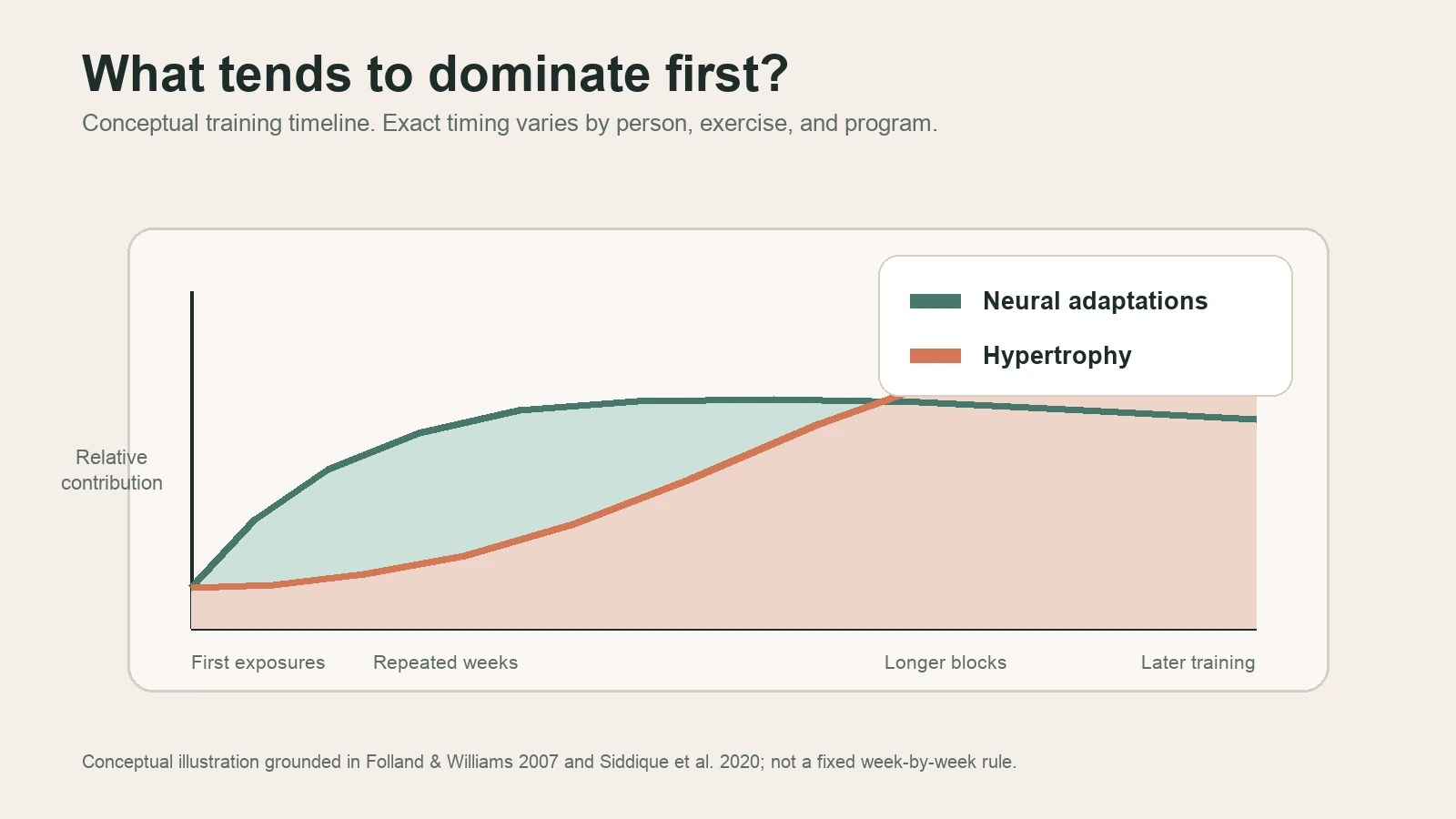
The review by Folland and Williams describes strength gains as a combination of neurological and morphological changes. This explains why a beginner can improve rapidly through better bracing, timing, and movement consistency before visible hypertrophy appears. It also explains why added muscle does not guarantee a better one-repetition maximum without practice under relevant loads.
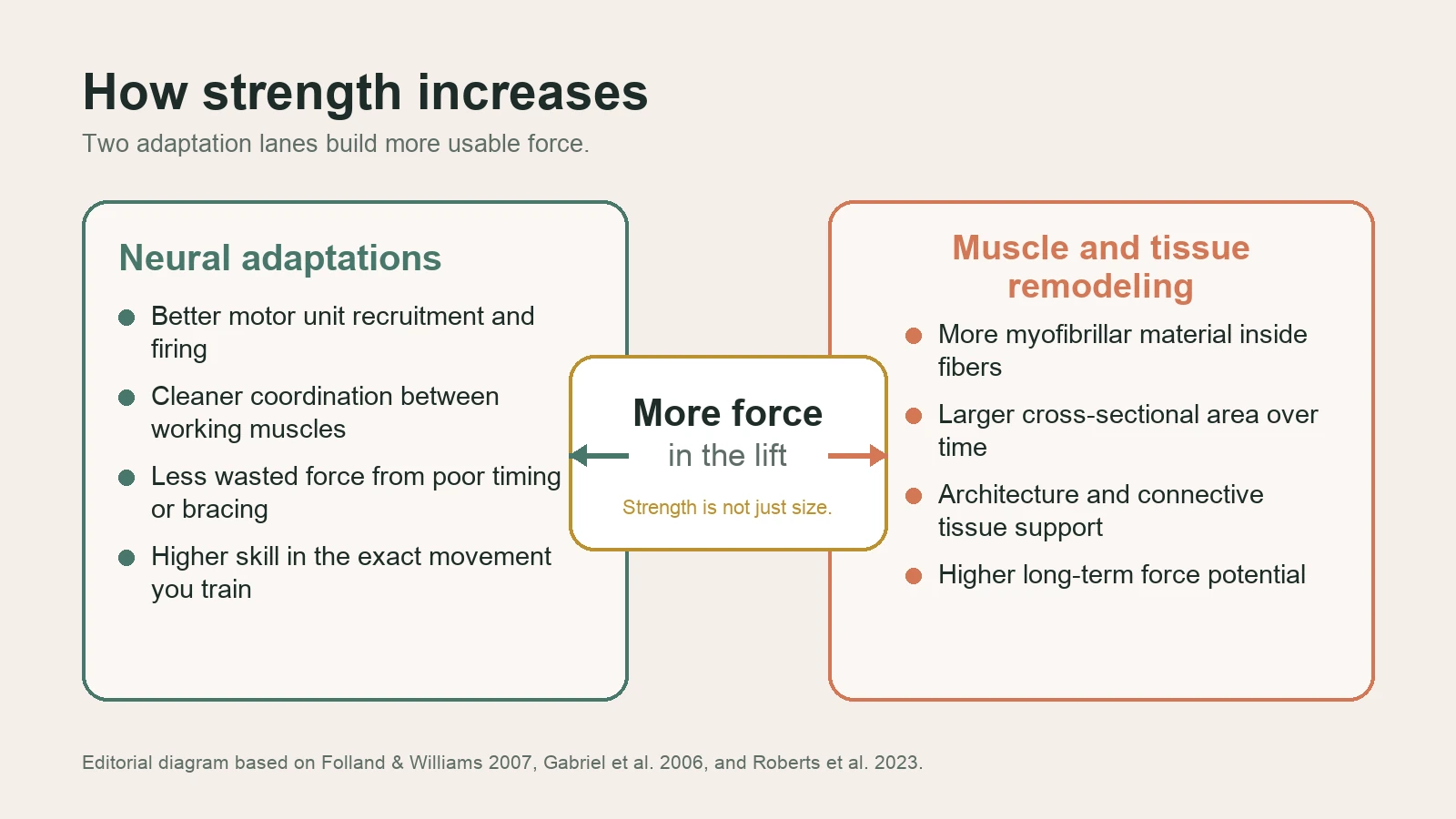
Muscle size therefore raises capacity, while neural and technical changes determine how effectively that capacity appears in the task being tested.
Think of the difference as capacity versus expression. A larger muscle may have more potential to produce force, but a strength test also asks whether the lifter can stabilize the joints, follow an efficient path, tolerate the load, and coordinate the relevant muscles at the right moment. The test itself matters: strength gained in one movement transfers best to tasks that share similar positions, ranges of motion, and loading demands.
The nervous system usually changes first
The nervous system adapts quickly. The review by Gabriel, Kamen, and Frost describes early strength gains without noticeable hypertrophy, alongside changes in neural drive, motor-unit behavior, and force organization.
In practical terms, the brain and spinal cord become better at recruiting available muscle and coordinating the movement. Bracing, timing, balance, and the reversal of a repetition become less wasteful with practice. A systematic review and meta-analysis by Siddique and colleagues reinforces that resistance training changes the nervous system as well as muscle, although the exact location and magnitude of each adaptation vary.
This is why strength is specific. Leg press may contribute to a squat, but squat practice develops the exact pattern more directly. Higher-repetition work can build tissue and work capacity, while heavier practice remains useful for expressing maximal force.
Specificity is not an argument for doing only one exercise or testing maximums every week. It means keeping enough exposure to the movement and loading style that define the goal. Assistance exercises can address weak positions or add volume with less fatigue, while the main lift preserves the technical reference point. Beginners often benefit from repeating a small exercise menu long enough for coordination to stabilize before changing variations.
Early strength gains do not mean “the muscle did nothing.” They mean the nervous system can improve force expression faster than visible tissue growth usually appears.
Hypertrophy raises the long-term force potential
Muscle size remains important. The Folland and Williams review describes increased muscle and fiber cross-sectional area through greater myofibrillar size and number. More contractile material gives the system a larger engine.
A 2023 Physiological Reviews paper on overload-induced hypertrophy identifies repeated mechanical overload as a major route to growth, while acknowledging that downstream biology remains complex. Hypertrophy expands force potential; skill, intent, stability, and exercise specificity determine how much of it appears in a lift. Long-term programs can therefore combine muscle-building work with phases that sharpen force expression.
This combination does not require rigid bodybuilding and strength phases. A program can keep one or two heavier exposures while using moderate-load sets to accumulate muscle-building volume. The balance changes with the goal, training age, and recovery capacity. What matters is that enough work builds tissue without removing the practice needed to express force in the chosen lifts.
Mechanical tension starts the remodeling, but recovery lets it stick
Training supplies a mechanical and molecular signal; adaptation accumulates afterward. The Damas review explains that resistance exercise and protein intake stimulate muscle protein synthesis, but acute spikes do not predict long-term hypertrophy by themselves.
Pump, soreness, and a dramatic session are therefore weak scorecards. Useful remodeling comes from repeated mechanical tension that can be recovered from, supported by adequate food and enough time to repeat quality work.
Productive tension is not simply the heaviest weight available. A controlled repetition with an appropriate range of motion can load the target muscles meaningfully, while a heavier but poorly controlled attempt may shift work elsewhere or end the set before enough useful volume accumulates. Progress can come from adding load, repetitions, sets, or a harder variation, provided technique remains acceptable and the added work is recoverable.
Sleep, calories, and protein do not create strength independently, but they support adaptation and the ability to repeat productive training.
Heavier training often improves maximal strength faster
Hypertrophy can occur across several loading ranges, so why does heavier training often improve a one-repetition maximum faster? A network meta-analysis by Lopez and colleagues found broadly similar hypertrophy across loads when sets reached volitional failure, but better strength gains with moderate and high loads than with low loads.
Low-load work is still useful, but maximal strength requires practice producing force under relevant conditions. The ACSM progression model likewise distinguishes strength-oriented loading from local-endurance work while treating moderate loads and higher volume as useful hypertrophy tools. Everyday lifters do not need constant max attempts, but a specific strength goal usually benefits from regular heavier work in the target lift or a close variation.
A practical week can therefore mix purposes. Heavier sets provide specific practice, moderate-load work supplies additional volume, and lighter accessories train muscles or positions without demanding another maximal effort. The exact split is less important than maintaining a clear progression method and enough recovery to perform the next session well.
What this means in practice
Translate the science into five decisions:
- Repeat the movement patterns that matter to your goal.
- Progress tension through load, repetitions, total work, or a harder variation.
- Judge training by repeatable progress, not soreness or exhaustion.
- Use volume to build tissue and specific heavier work to express strength.
- Treat sleep, food, and schedule as part of the training system.
For a beginner, this can remain simple. Keep the main movement stable for several weeks, record load and repetitions, and change one variable only when the log shows a pattern. A technically cleaner repetition at the same load is progress even before the weight increases. When several sessions are consistently successful, add a small amount of load or another repetition rather than redesigning the whole program.
When progress stalls, identify the limiting layer before adding work. Technique may need more practice, the target muscles may need additional volume, or accumulated fatigue may be hiding current strength. These problems can look identical on a single bad day, which is why trends across several comparable sessions are more useful than one test. The goal is not to label every plateau, but to make the smallest change that produces clearer feedback.
If you are dealing with injury, neurological symptoms, unexplained weakness, or pain that changes how you move, a general science article cannot replace individual assessment. Use qualified medical or rehab guidance where appropriate.
Continue with a related guide
For the next practical step, read Mechanical Tension Explained. Continue with Metabolic Stress and Hypertrophy: Does It Matter?, then see what changes first in The Beginner Strength Explosion.
Conclusion
Muscle does not get stronger only because it gets bigger. It gets stronger because repeated resistance training teaches the nervous system to express force better, teaches the body the exact movement demands you repeat, and over time remodels muscle and related tissues so the system can produce more force.
That is why early gains often feel faster than the mirror changes, why heavier lifting usually improves maximal strength better than very light loading, and why the best programs usually combine enough overload, enough specificity, and enough recovery to let the adaptation accumulate.
If you remember one sentence, make it this: strength is built by muscle, but also by the nervous system learning how to use that muscle under the demands you practice.
FAQ
Can you get stronger without getting much bigger?
Yes, especially early in training or when practice becomes more specific. Neural adaptation and better coordination can improve force expression before major visible hypertrophy appears.
Does soreness mean the muscle is getting stronger?
Not necessarily. Soreness can happen after novel or hard training, but it is not a reliable scorecard for strength adaptation. Consistent performance progress over time is a better signal.