

Metabolic stress is the scientific-sounding name behind a familiar gym feeling: the burn, the pump, the pressure in the muscle during higher-rep sets, short rests, drop sets, and other fatigue-heavy work. It feels productive because the feedback is immediate. The muscle swells, the set burns, and the session feels like it is doing something.
The question is whether that feeling actually matters for hypertrophy. The answer is nuanced. Metabolic stress may contribute to muscle growth through several possible pathways, but it is not a replacement for mechanical tension, useful volume, and progression. A pump can be part of good training. It is not proof by itself.
This article explains metabolic stress in practical terms. The short version: it can matter, but it should be used as a supporting tool rather than the foundation of the whole program.
- What metabolic stress means
- Why it may contribute to hypertrophy
- Why pump is not proof of growth
- How it interacts with load and effort
- How to use metabolic stress in a program
What metabolic stress means
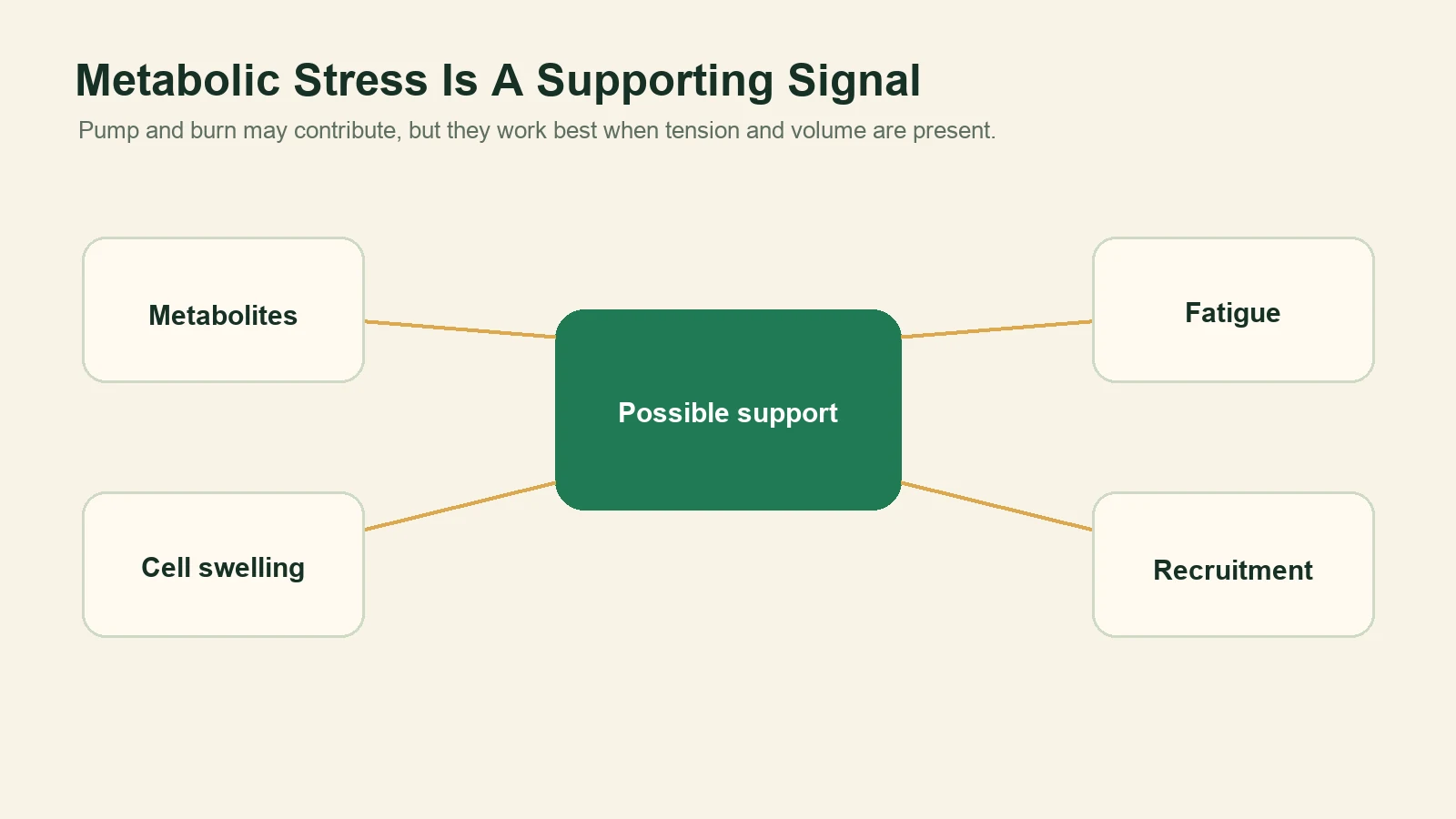
During hard sets, especially higher-rep sets or sets with short rests, metabolites accumulate. Lactate, hydrogen ions, inorganic phosphate, and other changes are part of the local fatigue environment. Blood flow, cell swelling, and the sensation of pressure can also change.
The Schoenfeld paper on metabolic stress and hypertrophy discusses several possible ways metabolic stress could contribute to growth, including cell swelling, hormonal environment, fiber recruitment, and other local mechanisms. The important word is possible. The mechanisms are plausible, but not every pump-heavy method automatically produces superior hypertrophy.
Metabolic stress is therefore best understood as a supporting signal. It can make sets harder, increase recruitment near fatigue, and add volume with lighter loads. But it does not remove the need for the muscle to experience meaningful tension.
Why pump feels so convincing
The pump is immediate feedback. Strength and hypertrophy take weeks or months to confirm. A pump appears in minutes. That makes it psychologically powerful.
A muscle that is pumped may look bigger temporarily because fluid has shifted into and around the working tissue. That can make a workout feel successful. But temporary swelling is not the same thing as stable growth of contractile tissue.
This does not mean the pump is useless. It can help a lifter feel the target muscle, tolerate lighter joint stress, and add work after heavier sets. It simply means the pump is a sensation, not an outcome measurement.
Metabolic stress is difficult to isolate
One reason this topic stays messy is that metabolic stress rarely appears alone. A hard high-rep set also includes mechanical tension, fatigue, effort, and volume. A heavy set may involve less burn but still create high tension. A drop set changes several variables at once.
That makes research interpretation difficult. If a pump-heavy method works, was it because of metabolic stress specifically, because the set was close to failure, because total volume increased, or because the lifter simply trained harder? Often the answer is some mixture.
This is why the safest practical interpretation is modest: metabolic stress may contribute, but it should not be separated from the rest of the training context.
Metabolic stress can increase recruitment near fatigue
One practical reason metabolic stress may matter is fatigue-related recruitment. With lighter loads, the early reps may not require high-threshold motor units. As fatigue builds, the body recruits more fibers to keep producing force. If the set is taken close enough to failure, many fibers can be challenged.
The Lopez network meta-analysis on load and hypertrophy is useful here because it reported broadly similar hypertrophy across loading zones when sets were taken to failure, while maximal strength favored heavier loading. That supports a practical idea: lighter, metabolically stressful sets can build muscle when effort is high enough, but they are not identical to heavy strength work.
This is why a set of 20 hard leg extensions can be useful, while 20 easy reps far from failure are mostly practice or warm-up. The burn alone is not the mechanism. The burn plus fatigue plus high recruitment plus enough tension is the better explanation.
Short rests can help or hurt
Short rest periods are one way to increase metabolic stress. They keep fatigue high and can make the muscle burn quickly. That can be useful for accessory work, time-efficient sessions, or exercises where very heavy loading is not necessary.
But short rests also reduce performance. If resting too little causes load or reps to fall sharply, total useful tension may drop. For big compound lifts, longer rests often allow better quality work. For safer isolation exercises, shorter rests may fit better.
The practical rule is simple: use rest periods that support the purpose of the exercise. Do not shorten rest only because suffering feels more scientific.
Mechanical tension is still the base
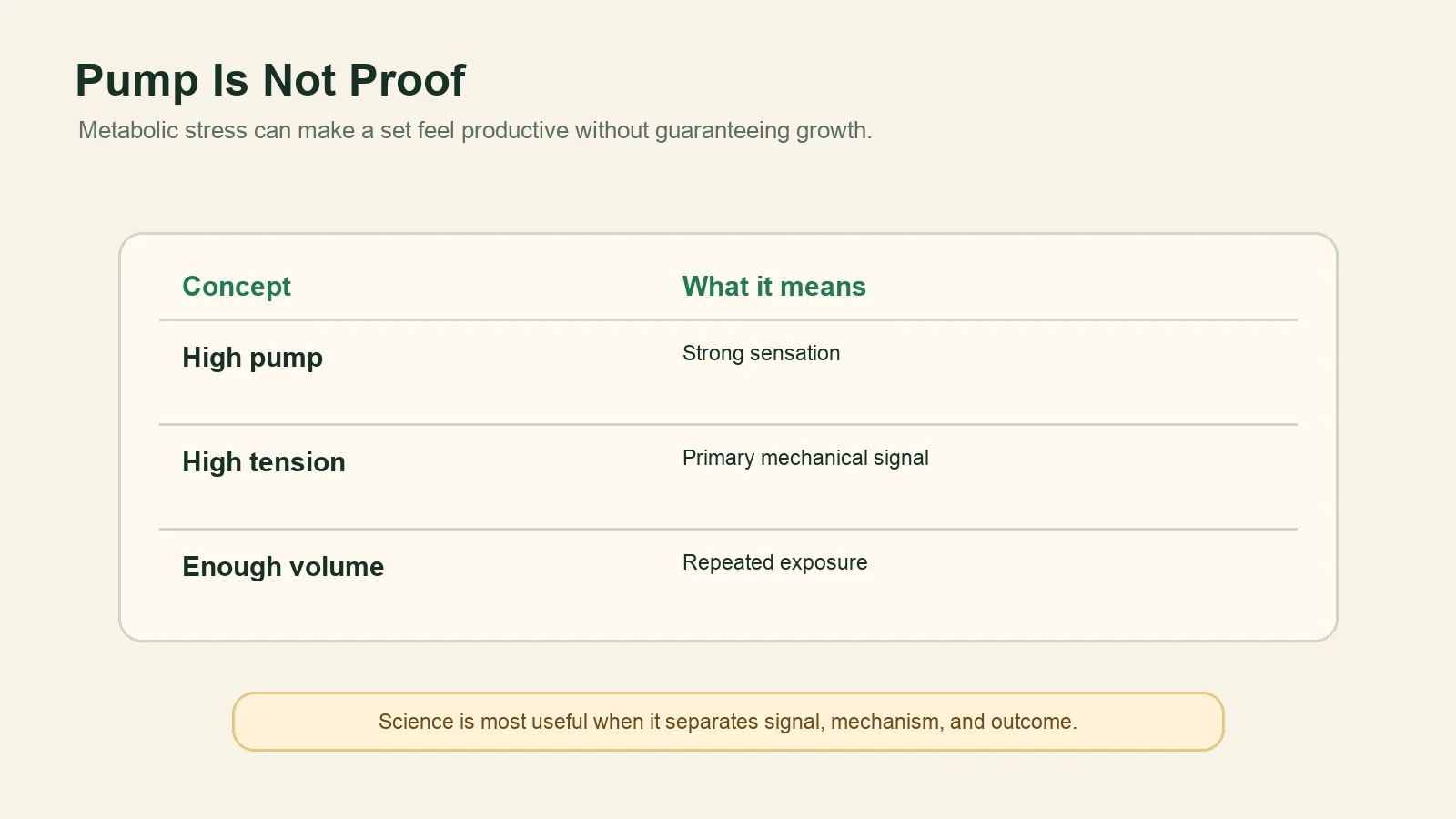
The Schoenfeld mechanisms review discusses metabolic stress as one proposed contributor to hypertrophy, but mechanical tension remains central. The more recent review on mechanical overload-induced hypertrophy reinforces the importance of mechanical overload in the growth process.
This is why pump-only training often disappoints. If the program is all light burn work, with no clear progression and no exercises that load the target muscle well, the stimulus may be too weak or too poorly organized.
A better model is layered:
- mechanical tension provides the primary stimulus;
- volume repeats the stimulus enough times;
- metabolic stress can add a useful fatigue and recruitment environment;
- recovery determines whether the work can be repeated.
Metabolic stress belongs in the system, not above it.
When metabolic stress is useful
Metabolic stress can be useful when heavier loading is not ideal for a specific exercise, joint, or training phase. Isolation work is a common example. Lateral raises, leg extensions, curls, triceps pressdowns, calf raises, and machine work often fit moderate-to-high rep ranges well.
It can also be useful near the end of a session. After heavier sets have provided a strong tension stimulus, pump-focused work can add volume without requiring another heavy compound lift.
Examples include:
- higher-rep isolation sets;
- short-rest accessory work;
- drop sets used sparingly;
- rest-pause sets on safer exercises;
- slower controlled reps where the target muscle stays loaded.
The key phrase is "used sparingly." Metabolic methods can accumulate fatigue quickly.
Blood-flow restriction is a special case
Blood-flow restriction training is often discussed in relation to metabolic stress because it can create a high-fatigue environment with relatively light loads. Research in this area is interesting, especially for situations where heavy loading is difficult.
But it is also more specialized than most readers need. It requires appropriate cuffs, pressure decisions, safety screening, and careful programming. For a general lifter, the main lesson is not "use blood-flow restriction." The lesson is that lighter loads can sometimes be effective when the local effort is high and the context is controlled.
If someone has cardiovascular, clotting, neurological, or medical concerns, blood-flow restriction should not be treated as a casual internet technique.
When it becomes a distraction
Metabolic stress becomes a distraction when the session is judged only by burn. If technique falls apart, range of motion shrinks, load never progresses, and recovery worsens, the pump may be masking a weak program.
It can also become a distraction when every exercise becomes a finisher. Heavy compounds, skill practice, and progressive overload may get pushed aside because pump work is more immediately rewarding.
For lifters with limited time, this matters. A short session should prioritize the work with the highest return. Pump work can be added, but it should not crowd out the movements and loading patterns that drive most of the progress.
How much should you use?
Most lifters can think of metabolic stress work as the final layer of a hypertrophy session. The main lifts and stable accessories provide the base. Then one or two pump-oriented exercises can add local work without requiring another heavy lift.
For example, a chest session might use pressing first, then cable flyes or push-up variations for higher reps. A leg session might use squats or presses first, then leg extensions or hamstring curls with shorter rests. Arms and delts often tolerate this style well because the exercises are less systemically demanding.
If the extra pump work improves the session and you recover well, keep it. If it crowds out progression, reduce it.
Use pump work to add useful volume after the main tension work, not to replace the main tension work.
How to program metabolic stress
Start with the main work: compound or stable machine exercises that load the target muscles well. Then add metabolic stress where it fits.
For example, an upper-body session might include presses and rows first, then higher-rep lateral raises, curls, or triceps work. A lower-body session might include squats or leg presses first, then leg extensions, hamstring curls, calves, or sled work.
Keep most metabolic work technically clean. Stop when the target muscle is challenged but before the set becomes random movement. If soreness or joint irritation climbs, reduce intensity methods before cutting the whole program.
What to watch over time
The useful question is not "Did I get a pump today?" The useful question is "Is the program producing progress across weeks?"
Track performance in your main lifts and accessories. Track body measurements or photos if hypertrophy is the goal. Notice recovery. If pump work improves the session and progress continues, it probably fits. If it makes you sore, tired, and less able to progress, it may be too much.
Metabolic stress is a dial, not a switch. More is not automatically better.
Continue with a related guide
For the next practical step, read Strength vs Muscle Size: What’s the Relationship?. For a second perspective from the same topic cluster, continue with What Actually Causes Muscle Growth?.
Conclusion
Metabolic stress can matter for hypertrophy, but it is not the main character. It may support growth through fatigue, recruitment, cell swelling, and local signaling, but those effects are most useful when combined with mechanical tension, enough volume, progression, and recovery.
Use the pump intelligently. Let it add useful work, improve target-muscle challenge, and make training engaging. Do not treat it as proof that growth is happening. The scoreboard is still long-term progress.
FAQ
Is the pump necessary for muscle growth?
No. A pump can be useful and motivating, but it is not required for hypertrophy and does not guarantee growth.
Are drop sets good for hypertrophy?
They can be useful on safer exercises when used sparingly, but they should not replace progressive tension and recoverable weekly volume.