

Muscle growth is often explained with one favorite cause. Some people say it is mechanical tension. Others say volume, soreness, metabolic stress, progressive overload, protein synthesis, or training to failure. Each of those ideas can matter, but none of them is a complete explanation by itself.
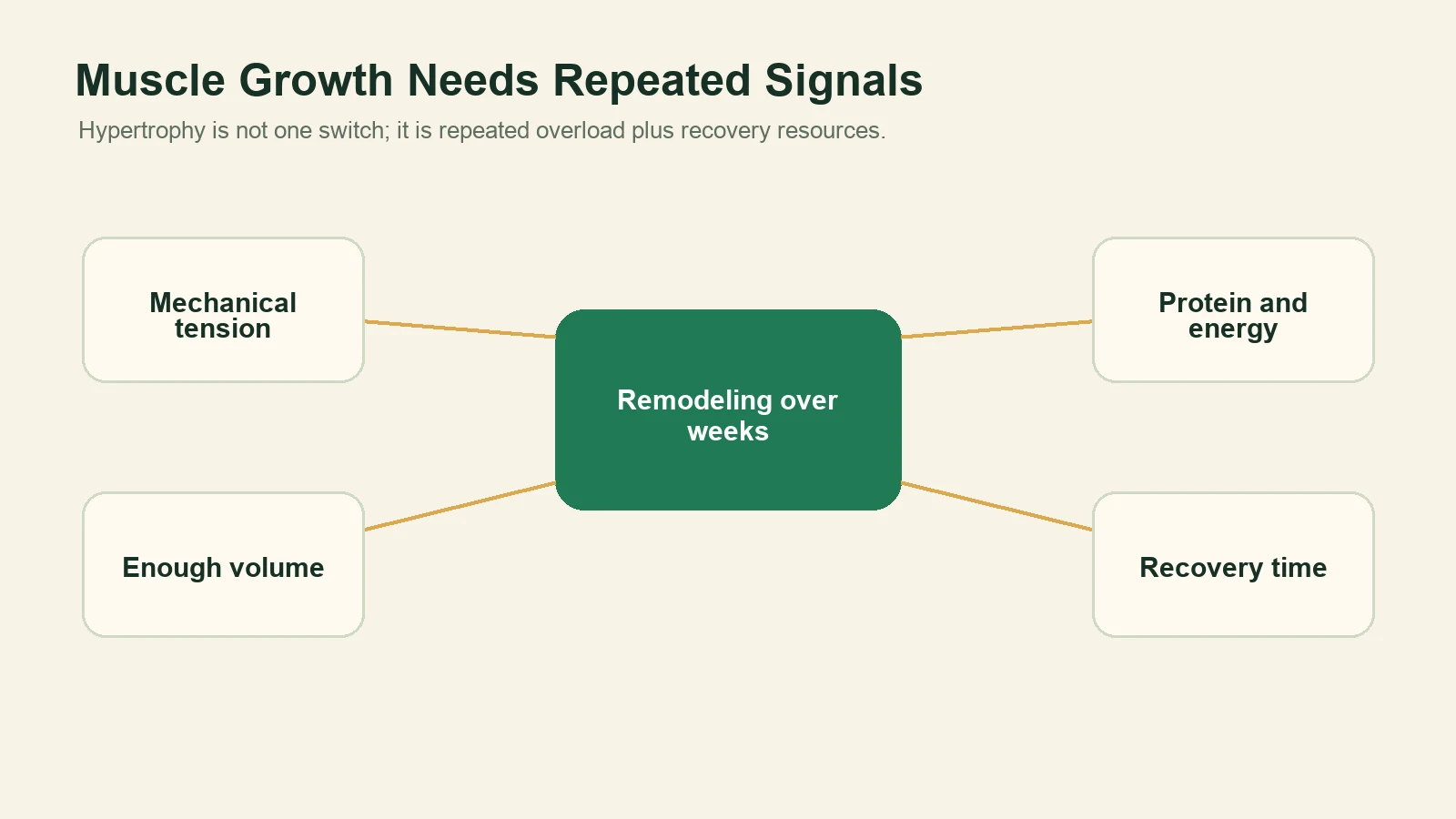
Muscle growth happens when resistance training gives muscle tissue a repeated reason to remodel, and the body has enough recovery resources to make that remodeling stick. The strongest practical signal is mechanical tension, but the program also needs enough volume, enough effort, enough food and protein, and enough time.
This article is for healthy adults who want the science without turning every workout into a lab report. The short version: growth is not one magic feeling. It is accumulated adaptation from repeated, recoverable overload.
- The main signal for growth
- Why volume and effort matter
- What protein synthesis does and does not prove
- Why soreness and pump are incomplete signals
- How to apply the science in training
Mechanical tension is the central signal
The best starting point is mechanical tension. When muscle fibers contract against resistance, they experience force. That mechanical challenge is a major trigger for the cellular and molecular events that can eventually lead to hypertrophy.
The classic Schoenfeld review on mechanisms of muscle hypertrophy discusses mechanical tension, muscle damage, and metabolic stress as proposed mechanisms. Since then, the field has continued to refine the model, but mechanical tension remains the most important practical anchor.
The broader Physiological Reviews paper on mechanical overload-induced hypertrophy also supports the central role of mechanical overload while making the biology look more complex than a simple gym slogan. The muscle has to sense mechanical demand, translate it into cellular signaling, and adapt across repeated exposures.
That is why a good hypertrophy program needs more than "feeling the burn." The target muscle needs to do meaningful work against resistance.
Volume gives the signal enough repetitions
One hard set can stimulate muscle. But long-term growth usually depends on repeated hard-enough work across weeks and months. This is where volume matters.
Volume is not only a number to chase. It is the amount of useful work the muscle receives. Too little volume may not provide enough stimulus. Too much volume can reduce performance, extend soreness, and make recovery harder. The useful amount depends on training age, exercise selection, effort level, sleep, nutrition, and the muscle being trained.
For most lifters, volume should be increased only when the current amount is recoverable and no longer producing progress. More work is not automatically better. More useful work is better.
That distinction keeps hypertrophy training sane. The goal is not to collect sets. The goal is to apply enough repeated tension to encourage remodeling while still being able to train well again.
Progression tells you the signal is still challenging
Progressive overload is not a separate magic cause of growth. It is the practical way you keep the training signal relevant as the body adapts. If the same load, reps, range, and effort become easy, the stimulus has changed even though the workout looks identical on paper.
Progression can happen in several ways. You can add load. You can add reps. You can add a set. You can improve control through a longer range. You can make the exercise more stable or less stable depending on the goal. You can reduce assistance. The common thread is that the muscle is asked to do slightly more useful work over time.
This is why good hypertrophy programs track something. The log does not have to become an obsession, but without some record it is easy to confuse tiredness with progress. A workout can feel hard because life was stressful, not because the muscle received a better growth stimulus.
Effort changes which fibers are recruited
Effort matters because a set that stops too early may not recruit and challenge enough high-threshold motor units. This is one reason low-load training can still build muscle when taken close enough to failure: fatigue forces the body to recruit more fibers as the set continues.
The Lopez network meta-analysis on training loads found broadly similar hypertrophy outcomes across loading zones when sets were taken to volitional failure, while strength gains favored heavier loading. For hypertrophy, the lesson is not that load is irrelevant. The lesson is that effort and recruitment help explain why several rep ranges can work.
In practice, most people do not need to take every set to absolute failure. They need enough honest effort. Stopping with one to three good reps in reserve is often a useful range for hard working sets, especially on compound lifts where technical breakdown has a cost.
Protein synthesis is part of the process, not the scoreboard
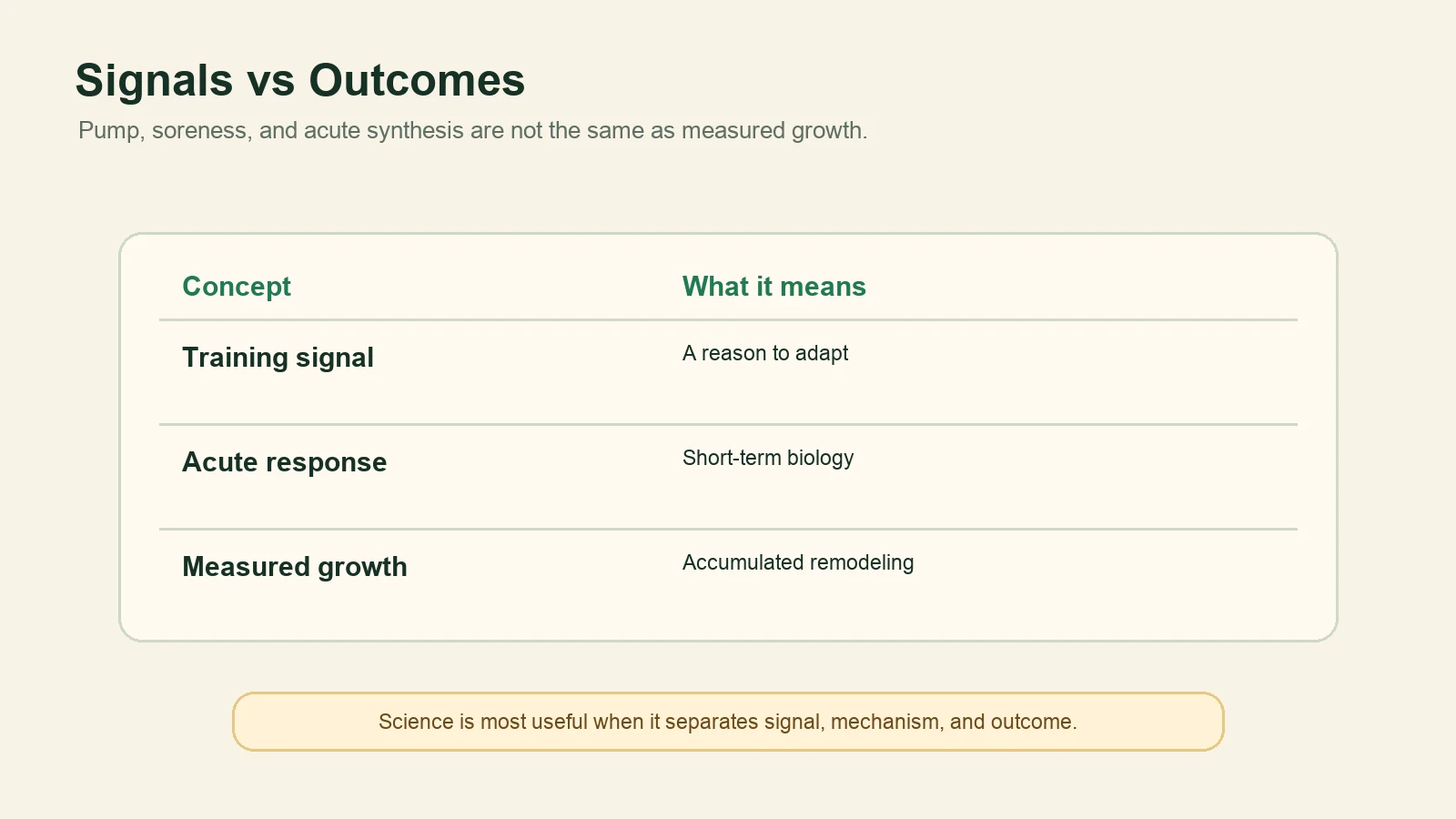
Muscle protein synthesis is often treated as if it directly equals growth. It is more accurate to say that it is part of the remodeling process.
The Damas review on resistance training, muscle protein synthesis, and hypertrophy is useful because it cautions against reading early acute protein synthesis responses as a simple prediction of later hypertrophy. Early in training, some of the response may relate to repair and remodeling after novel stress, not only net new muscle growth.
This is why the timeline matters. A single workout can raise signaling. A training block determines whether that signaling accumulates into measurable growth. Protein intake supports the process, but protein without progressive training does not create the same adaptation.
Soreness is not the target
Soreness can happen after hard training, new exercises, long muscle lengths, high eccentric stress, or more volume than usual. It is a common experience, but it is not a reliable growth meter.
A session can produce soreness because it was novel or damaging, not because it was an ideal hypertrophy stimulus. A session can also stimulate growth with little soreness, especially when the exercises are familiar and the lifter is well adapted.
This is important because chasing soreness often leads to poor programming. If every workout is designed to make you sore, you may reduce performance in the next session and lose the repeated high-quality work that growth actually needs.
Pump and metabolic stress can contribute, but they are not enough
The pump is not meaningless. Metabolic stress, cell swelling, and fatigue-related recruitment may contribute to hypertrophy under some conditions. But a pump without sufficient mechanical tension and progression is not a complete growth plan.
Think of pump work as a possible tool. It can add volume with lighter loads, make training feel engaging, and challenge fibers near fatigue. But the base of the program still needs hard, progressive work that the target muscle actually performs.
This is why a program made only of light burn sets often stalls. It may feel productive, but the progression is unclear and the tension may be too low for continued adaptation.
Exercise selection changes the stimulus
Muscle growth is not only about effort; it is also about where the effort goes. A movement that loads the target muscle through a useful range, feels stable enough to push, and can be progressed safely will usually be easier to use for hypertrophy than a movement that mostly challenges balance or joint tolerance.
This is why machine and cable exercises can be valuable. They are not automatically inferior to free weights. If they let a lifter train the target muscle hard with less setup fatigue, they can provide a strong hypertrophy stimulus. Free weights remain excellent tools, but the best exercise is the one that matches the muscle, goal, and person.
For example, a squat may build quads well for one lifter and mostly become a hip/back-limited movement for another. A leg press or hack squat may target the quads more directly. That does not make one exercise universally best. It means the cause of growth is the muscle’s actual work, not the exercise name.
Recovery lets the signal become adaptation
Training is the stimulus. Recovery is when the body deals with that stimulus. Sleep, total energy intake, protein intake, stress, and session spacing all influence how well the body can repeat and adapt.
Recovery is not passive laziness. It is part of the mechanism. If you create a large training signal but cannot recover, the result may be fatigue rather than growth.
The practical sign of appropriate recovery is not that you always feel perfect. It is that performance trends upward or stays productive across the training block. If loads, reps, motivation, sleep, and soreness are all moving in the wrong direction, the program may be exceeding your current recovery capacity.
Muscle growth requires a repeated training signal, enough effort, enough recovery resources, and enough time for remodeling to accumulate.
How to apply this
Use exercises that train the target muscle through a useful range of motion. Progress slowly. Work hard enough that the target muscle is challenged. Add volume only when you can recover from it. Eat enough protein and total food to support your goal.
Then judge the trend. Are measurements, photos, performance, and training logs moving in the right direction over months? That matters more than whether one workout created a huge pump or made stairs painful for three days.
What not to overread
Do not overread one study, one workout, or one biomarker. Muscle growth research is difficult because studies use different populations, exercises, measurement tools, training durations, and definitions of failure. A beginner’s response to a new program is not the same as an advanced lifter’s response to a carefully controlled block.
That uncertainty does not make the topic useless. It simply means the best recommendations are pattern-based: apply mechanical tension, use enough recoverable volume, train close enough to failure, eat and sleep enough to adapt, and evaluate the trend over time.
Continue with a related guide
For the next practical step, read Does Muscle Damage Cause Muscle Growth?. For a second perspective from the same topic cluster, continue with How Muscle Actually Gets Stronger.
Conclusion
Muscle growth is caused by repeated, recoverable overload. Mechanical tension is the central signal, but the result depends on useful volume, sufficient effort, nutrition, recovery, and time. Soreness, pump, and acute protein synthesis can provide clues, but none of them is the scoreboard by itself.
The best practical plan is boring in the right way: train muscles hard through useful ranges, progress gradually, recover well enough to repeat, and judge outcomes across blocks rather than single sessions.
FAQ
Do you need to train to failure for muscle growth?
Not always. Training close enough to failure can help recruit fibers, but many productive sets stop with a few good reps in reserve.
Is soreness required for hypertrophy?
No. Soreness can occur after training, especially novel training, but it is not required and is not a reliable measure of growth.