

“How many sets does a muscle need to grow?” sounds like it should have a clean answer. It does not, because the question combines several moving parts: which muscle, which exercises, how close the sets are to real effort, what other exercises train that muscle, and whether the work can be repeated next week.
Research supports the broad idea that muscles generally need more than a token amount of resistance training to grow. It also shows that higher weekly volume can help on average. What it does not give you is a number that guarantees a result for every biceps, chest, quadriceps or back program. The useful job of a set count is to make training easier to observe and adjust, not to replace judgment.
This explainer is for healthy adults. It is not a diagnosis of stalled progress, pain, unusual fatigue or a medical condition. If symptoms are changing how you move, seek individual advice from an appropriately qualified clinician or coach instead of trying to solve the problem by adding more work.
- What a weekly set count can tell you
- Why direct and indirect sets are different
- Why a hard set is not just a line in a log
- How to read research ranges without copying them blindly
- How to make a cautious adjustment
A set count is a map, not a growth guarantee
Weekly sets are popular because they are easy to record. If you perform several sets of presses, rows, squats and curls, you can look back at the week and see where the work went. That is useful information, especially when a program has become complicated enough that “I train hard” no longer describes it clearly.
The problem begins when the count is treated as a score. A set is not a universal unit of stimulus. A controlled set of a stable exercise taken close to a challenging effort is different from a rushed set after a long session. Two people can report the same number for chest work while using different ranges of motion, loads, rests, exercise choices and technical standards.
The 2025 ACSM overview of resistance-training reviews found that progressive resistance training improves muscle size in healthy adults and that higher weekly volume was associated with greater hypertrophy in the evidence it synthesized. That is a useful direction, not a personal minimum. Group-level findings cannot tell you where your own productive range begins or ends.
Direct work is easiest to count
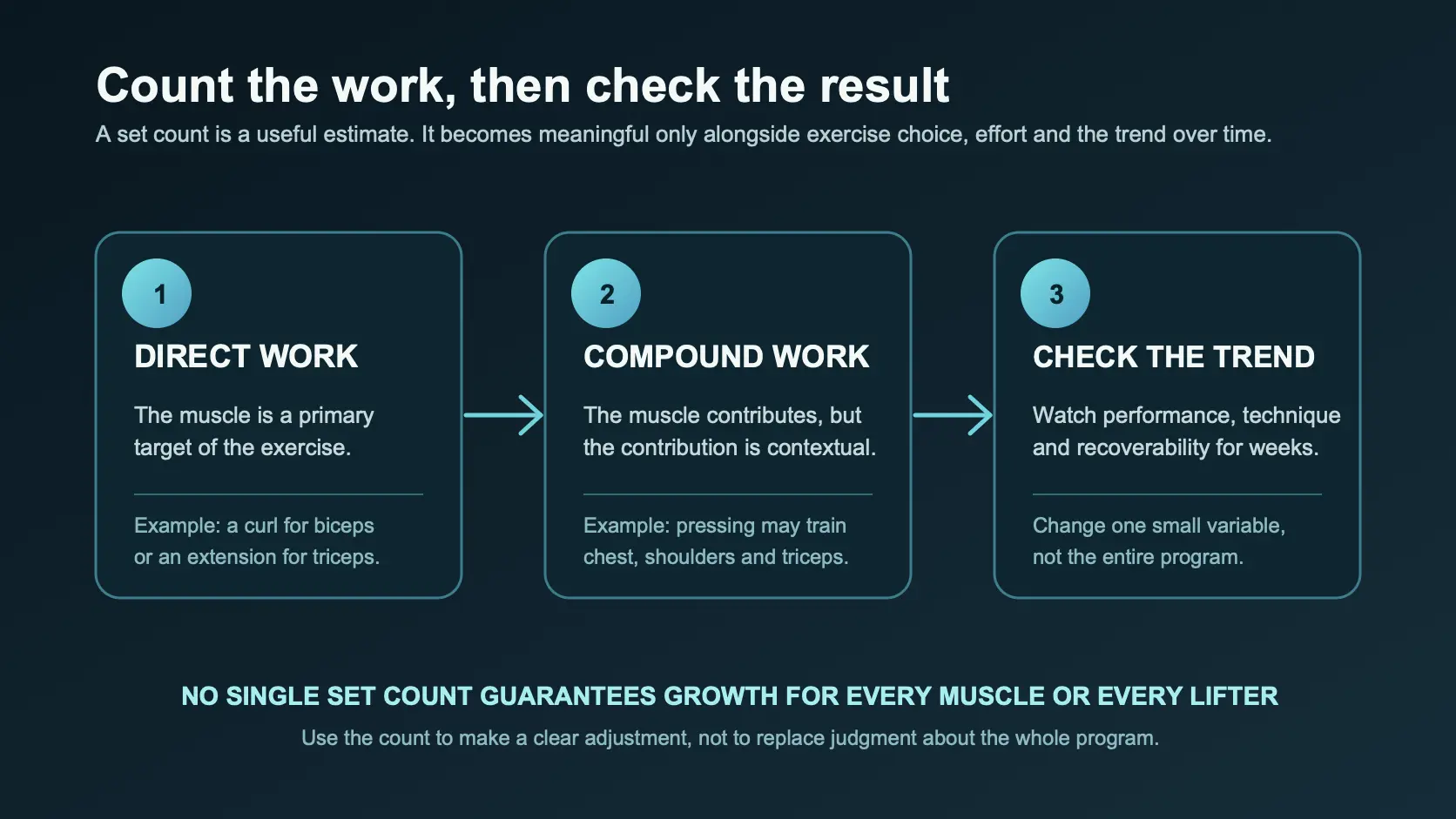
Direct sets are the straightforward part of the picture. If the target muscle is the primary purpose of an exercise, count it as direct work. A curl is direct work for the biceps. A knee extension is direct work for the quadriceps. A triceps extension is direct work for the triceps.
Those examples are not meant to imply that isolation exercises are mandatory. They simply make the accounting cleaner. When the target muscle is clearly the point of the set, you can compare one week with the next without inventing complicated math.
Direct work can be especially useful when a muscle is not receiving enough attention from the rest of a program. If your pressing is built around chest-focused movements but your triceps are a stated priority, a small amount of direct triceps work can make the plan more specific. The question is not whether isolation is superior. It is whether it solves a clear programming problem.
Compound sets contribute, but they are not identical
Compound movements spread work across several muscles. A press can involve the chest, shoulders and triceps. A row or pulldown can involve the back and elbow flexors. A squat pattern can challenge the quadriceps, glutes and other tissues depending on technique and exercise choice.
That makes compound sets valuable, but it makes simple counting less precise. The 2025 meta-regression on resistance-training dose response specifically classified contributing sets as direct or indirect and found the strongest support for a fractional way of representing indirect work. The practical lesson is not that you need to calculate half-points for every set. It is that a press should not automatically be logged as a full direct set for every muscle involved.
Ask three ordinary questions instead. Was the muscle a main limiter in the exercise? Was the set performed with enough control and effort to challenge that muscle? Does the program also contain direct work for it? Your answers will be more useful than a spreadsheet that looks exact but hides the exercise context.
Set quality changes what the count means
Counting every warm-up set as a growth set makes a log look busy without improving the estimate. Warm-ups have a job: preparation, technique rehearsal and gradual loading. They may matter to a session, but they are not automatically equivalent to the harder work sets that follow.
The same applies to sets that are cut short by a poor setup, a distracted rest period or a load that is far below the intended challenge. A 2021 systematic review of set counting for hypertrophy concluded that total sets taken to failure, or near it, can be a practical way to quantify volume when key variables are held reasonably constant. The qualifier is important. Set counts become more meaningful when you compare like with like.
This is where the article Mechanical Tension: The Signal Behind Muscle Growth fits in. The number of sets alone cannot tell you whether the target muscle was actually doing useful work. Exercise setup, range of motion and effort change the local challenge.
Research ranges are reference points, not requirements
Readers often encounter a weekly range online and assume they should immediately train every muscle at that level. That skips the context of the studies and the person. Training age, previous volume, exercise selection, session length, sleep, other sport and simple preference all influence what a lifter can use productively.
The evidence supports a positive relationship between weekly work and hypertrophy on average, but the return from additional work can shrink. The article Training Volume Has a Dose — and More Isn’t Always Better explains that broader relationship. This guide adds the muscle-specific question: before deciding that a muscle needs more sets, make sure you know which existing sets already contribute to it.
That check often prevents two common mistakes. The first is undercounting compound work and adding direct exercises that only lengthen the session. The second is assuming a compound movement covers every involved muscle equally, then wondering why a stated priority is not changing. Neither mistake is fixed by copying a number from another person’s split.
Test a small change and keep the evidence readable
If you want to give one muscle more attention, change one clear thing. Add a small amount of direct work, replace an exercise with a more targeted option, or distribute existing work across another day. Keep the rest of the program stable long enough to see whether the intended outcome improves.
Track a few signals: whether the target exercise is progressing, whether technique stays consistent, whether the added work fits the session, and whether you can repeat it without the rest of the program deteriorating. Do not use soreness as the only verdict. Less soreness can coexist with productive training, and more soreness is not proof that a muscle received a better dose.
For the programming side of that experiment, Progressive Overload Is More Than Adding Weight to the Bar is the next useful read. It covers why one small, trackable adjustment is usually better evidence than changing every variable at once.
The answer is a process, not a number
A muscle needs enough relevant, challenging work to adapt, repeated over time. That statement is less satisfying than a single weekly target, but it is closer to the actual decision.
Count direct work clearly. Treat compound work as a contribution with context. Compare sets that are performed under similar conditions. Then adjust only when the trend gives you a reason. That process turns “how many sets?” from an internet argument into a manageable training question.
FAQ
Do compound exercises count toward muscle growth?
Yes, they can contribute meaningful work to several muscles. The contribution depends on the movement, setup and the muscle’s role in the exercise, so it should not automatically be treated as identical to a direct isolation set.
Should I count warm-up sets for hypertrophy?
Warm-ups matter for preparation and technique, but they are not automatically equivalent to challenging work sets. Keep your log clear about which sets were intended to provide the main training stimulus.
Does every muscle need the same number of weekly sets?
No. Muscles can receive different amounts of direct and indirect work, and people respond differently to the same program. Use a count to understand your current plan, then make cautious changes based on the trend.