

Ronnie Coleman’s bodybuilding record is easy to state: eight consecutive Mr. Olympia titles from 1998 through 2005. The reason the story travels beyond contest history is the workday detail beside it. While he was building a competitive career, Coleman worked in law enforcement in Arlington, Texas. That contrast gave the public a simple way into an otherwise specialized sport: a person with an ordinary professional role also became the athlete to beat on bodybuilding’s biggest stage.
The contrast should not be romanticized into a rule about sleep, workload, or what a reader ought to copy. Professional bodybuilding has demands, resources, and tradeoffs that do not belong in a normal training plan. The useful point is historical. Coleman’s career shows how a record becomes a recognizable story when sustained competitive results meet a background people can understand.
- The working-life detail behind the legend
- The early wins that established the path
- Why eight Olympia titles matter
- What an everyday lifter should not copy
- The smaller, useful lesson from the story
The police officer detail is context, not a gimmick
Coleman graduated from Grambling State University with an accounting degree, then worked in law enforcement in Arlington. The Louisiana Sports Hall of Fame profile places that job alongside his move into bodybuilding, rather than treating it as a separate prelude. The Hall of Fame’s longer account says he served as an Arlington police officer from 1989 to 2000 and later as a reserve officer.
That timeline explains why the “police officer to bodybuilding icon” line has lasted. It is not an invented origin story added after the titles. It describes two overlapping parts of his life. At a time when elite bodybuilding could seem remote from ordinary gym culture, the job gave his progress a grounded detail that audiences remembered.
It also gives the story a useful boundary. A demanding job does not automatically make a training method more admirable or more sustainable. Work schedules, sleep, family, commute, and recovery capacity differ too much for that. Coleman’s career is notable because of what he achieved in a professional sport, not because every reader should try to stack more demands onto an already busy week.
The record had an amateur foundation
The Olympia titles did not arrive as a surprise from nowhere. The Louisiana Sports Hall of Fame records a Mr. Texas title in 1990 and a heavyweight title at the 1991 World Amateur Championships, which earned him the Mr. Universe designation. Those results established a competitive foundation before the long professional reign began.
The early years matter because they restore time to a story often reduced to famous training clips and catchphrases. A major title run is usually the visible part of a much longer sequence: learning the sport, showing up at smaller contests, building a record, then becoming a professional athlete capable of winning against an international field. The eventual result can look inevitable only after it has happened.
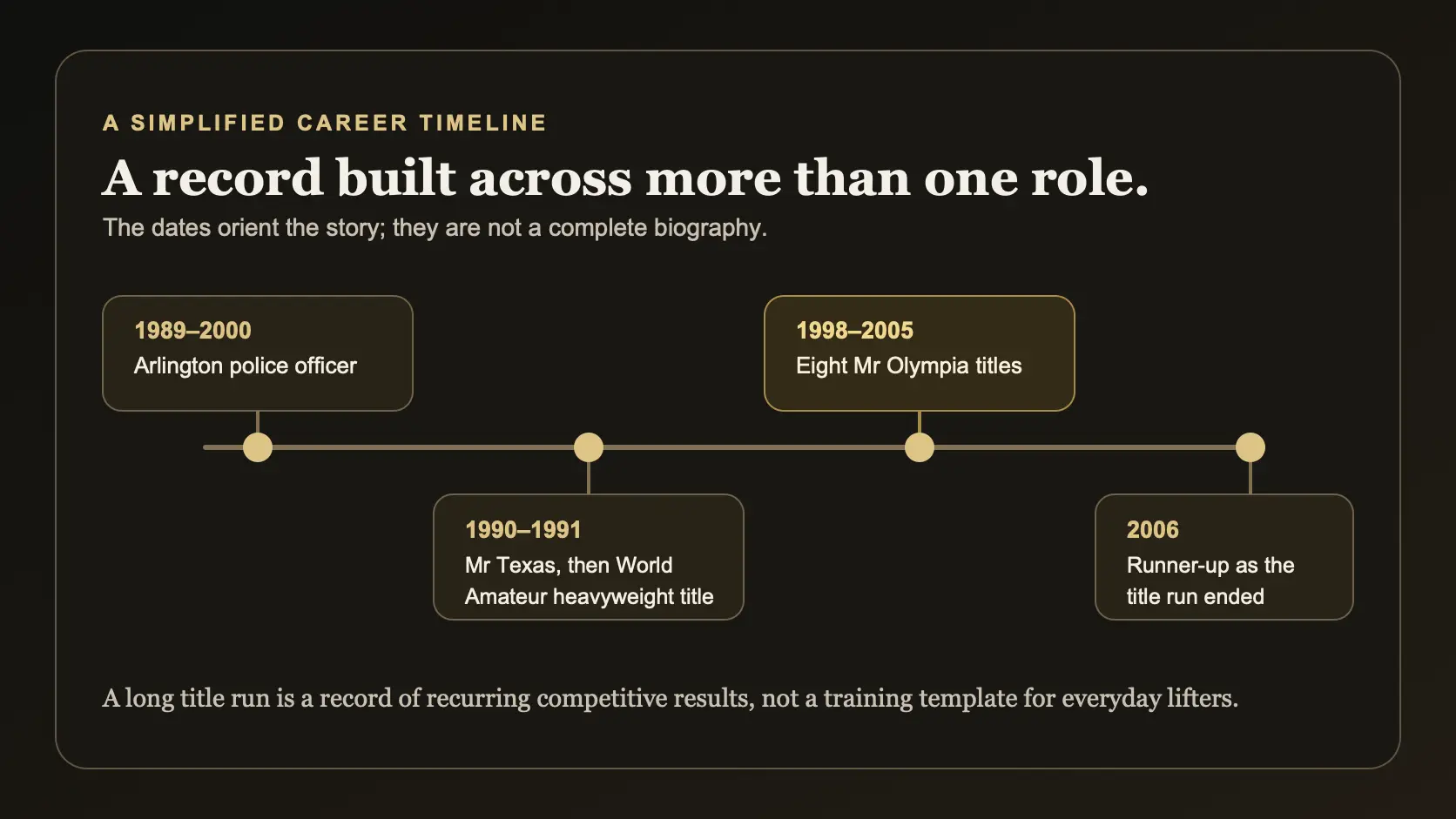
The same Hall of Fame profile credits Coleman with 26 professional victories. Numbers alone do not tell us how a physique should look, what a person should weigh, or how anyone ought to train. They do make one thing clear: the Olympia streak was part of a larger competitive career, not a single exceptional weekend.
Eight titles made an era visible
The Mr. Olympia winners archive lists Coleman as the winner in every year from 1998 through 2005. Eight consecutive wins tie the record held by Lee Haney, whose own sequence ran from 1984 through 1991. One title identifies a peak. Eight annual wins mean an athlete repeatedly met the same visible test while fields, expectations, and competitive pressure changed.
Coleman’s run also followed Dorian Yates’ six-title era and ended before Jay Cutler won in 2006. That placement is important because it keeps history from becoming a list of isolated champions. A new title holder arrives in a sport already shaped by what the previous champion made familiar. Coleman’s wins became a reference point for the early 2000s because the result recurred long enough to define a period, not because a single image settled the sport forever.
Terms such as “icon” can flatten that history. The factual center remains the contest record. The cultural interpretation is that the combination of a memorable background, a distinctive competitive presence, and a long sequence of wins gave bodybuilding media an easy story to tell. Those are different claims, and keeping them separate makes the achievement clearer rather than smaller.
A famous training clip is not a personal program
Coleman is often remembered through unusually heavy training footage. It is tempting to turn that footage into a prescription: work at the most extreme end, copy the exercise choices, and assume effort is proven only when it looks dramatic. That is a poor lesson for most readers.
Professional contest preparation is not a practical template for a beginner or intermediate lifter. It sits inside a different training history, competitive goal, support system, and level of risk. Heavy work can be meaningful when it is technically appropriate, programmed, and recoverable. It is not meaningful merely because it resembles a famous athlete’s highlight reel.
The more useful question is whether your own plan has a clear purpose and can be repeated. The Anatomy of a Great Strength Program starts there: movement selection, a manageable dose, progression, and room to adapt. That framework is less cinematic than a viral lift, but it gives everyday trainees something they can actually use.
Coleman’s titles establish his place in the sport. They do not establish a universal set-and-rep plan, body standard, or level of risk for someone else.
Why the story still works
The best version of the Ronnie Coleman story is not “an ordinary person discovered a secret.” It is that a long process can contain roles that do not look like a fitness-influencer biography. He had a job, a competitive path that developed over years, and then an eight-title run that became one of bodybuilding’s clearest records.
For readers outside professional bodybuilding, that is enough. Ambition does not need to be loud to be real. A normal schedule does not make progress impossible, and a famous athlete’s result does not set the scale for a worthwhile goal. Build a training week that fits the life you actually have, then give it enough time to become a record of your own consistency.
Continue with a related story
For the other eight-title Olympia era, read Lee Haney: The Era of Size, Shape and Eight Olympia Titles. For the champion who directly preceded Coleman’s run, continue with Dorian Yates: How Blood and Guts Changed the Bodybuilding Standard.