

Dorian Yates did not merely win the Mr. Olympia once and leave behind a famous training video. He won it six consecutive times, from 1992 through 1997. That sequence made a particular kind of competitive package hard to ignore: dense muscle, a highly prepared stage look, and a private, work-first identity that contrasted with the more public bodybuilding culture around it.
“Blood and Guts” became the shorthand for that identity. It was not a scientific training term or a program that every lifter can copy safely. It was a recognizable way of presenting effort, focus, and a low-volume, high-intensity approach to bodybuilding. The phrase lasted because it attached an idea about training to an athlete who kept returning to the sport’s biggest stage and winning.
This is a historical profile, not a routine to imitate. Professional bodybuilding requires a context that everyday lifters do not share: a long training history, contest-specific preparation, resources, and tradeoffs that do not belong in a normal week at the gym.
- The six-title run behind the reputation
- Why the Blood and Guts identity landed
- How a title streak changes a competitive standard
- What the story does not ask modern lifters to copy
- The useful lesson for ordinary training
Six titles gave the story a factual center
The core record is clear. The Mr. Olympia winners archive lists Dorian Yates as champion in 1992, 1993, 1994, 1995, 1996, and 1997. Guinness World Records likewise identifies the 1992-1997 stretch as six consecutive wins in its entry on Yates’ 1993 Olympia result.
That matters because a title defense tells a different story from a first win. One contest can capture a peak. Six annual results show that the athlete repeatedly met a specific competitive test against changing lineups and expectations. The run is the evidence. Everything else about “changing the standard” is an interpretation of what that repeated success made visible to audiences, competitors, and gyms.
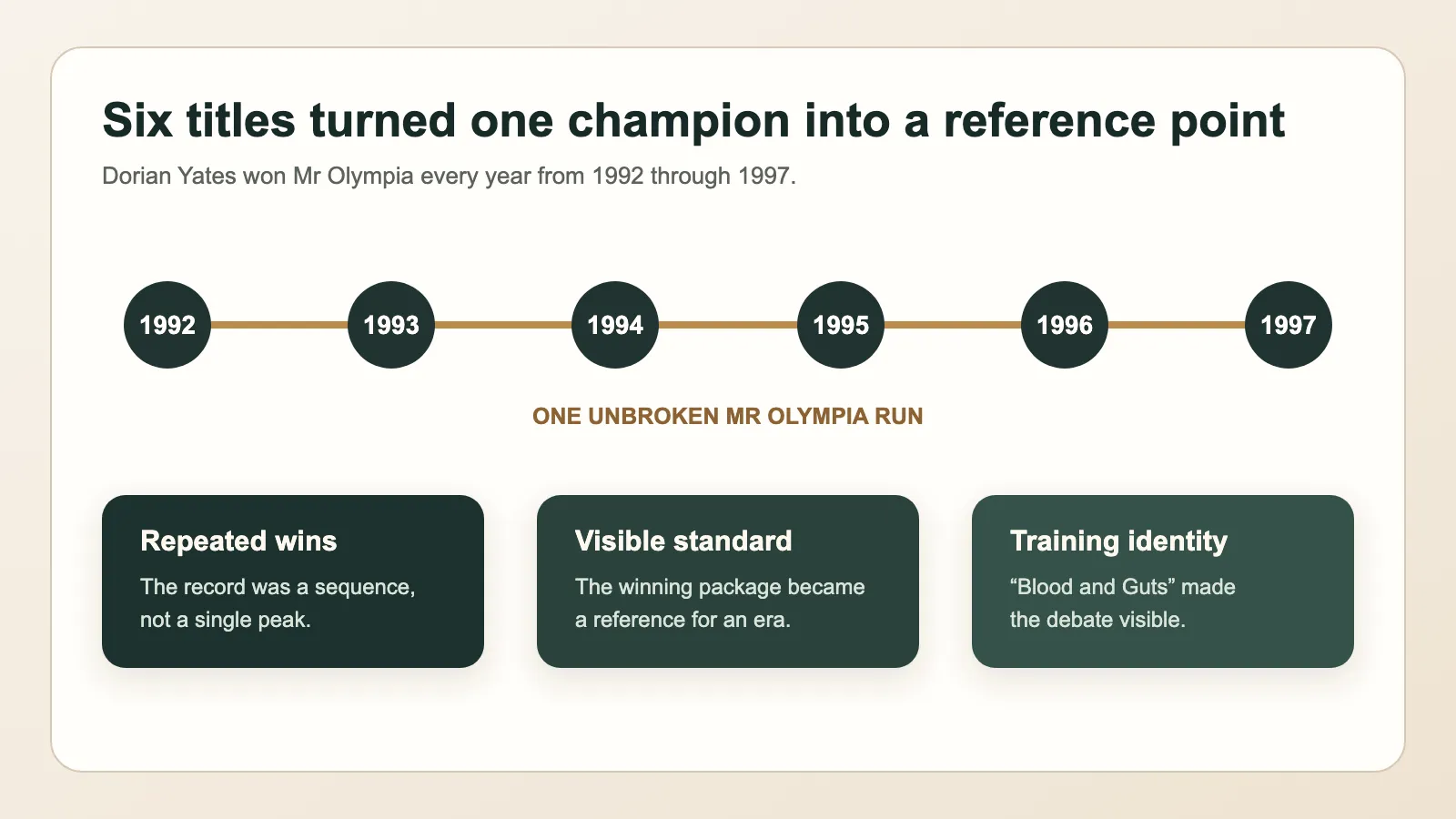
The sequence also sits between two other long Olympia eras. Lee Haney’s eight-title run ended in 1991; Yates won the next six contests; Ronnie Coleman began his own eight-title sequence in 1998. Those records do not make one era objectively superior. They show why the 1990s could be remembered through Yates’ recurring presence at its center.
Blood and Guts was an identity before it was a checklist
The image most people recall is not a spreadsheet of sets and repetitions. It is the atmosphere: an intense, focused session in a hard-edged gym, stripped of ceremony. That image connected with lifters because it offered an alternative to a crowded, performative version of gym culture. Work mattered; unnecessary activity did not.
Yates’ own training material describes the method as a version of high-intensity training shaped by earlier influences, including Arthur Jones and Mike Mentzer. The DYHIT Academy description calls it the “Blood n’ Guts” method and emphasizes that goals, health, and schedule change the way training should be applied. That is a useful correction to the myth that the name itself is a complete program.
In a first-person retrospective for Muscle & Fitness, Yates wrote that he moved to one main working set per exercise only after winning his first Olympia in 1992. Read his account of the one-set strategy as the athlete’s description of how his workload evolved, not as a universal readiness test. His career is one source of context, not a substitute for a reader’s own training log.
That distinction separates the useful idea from the cult version. The useful idea is that a session should have a purpose and a cost you can justify. The cult version is that every lifter should push every set as hard as a famous professional did, regardless of experience, exercise choice, or recovery.
A new reference point is not a universal body standard
When a champion wins repeatedly, the winning physique becomes a reference point. Other competitors prepare against what the stage has rewarded, magazines frame the champion as the athlete to beat, and audiences learn to recognize a new competitive language. Yates’ run made a dense, heavily developed look central to the era’s conversation because it was repeatedly successful, not because one photograph settled what bodybuilding should be forever.
That is why the phrase “mass monster” is too simple on its own. It can describe how later audiences remember an era, but it leaves out conditioning, proportion, posing, the field, judging, and the reality that physique competition is a visual sport with changing standards. A historical profile should make the achievement clear without turning an elite contest result into a target for someone training for strength, health, or enjoyment.
The same caution applies to the stories around Yates’ intensity. High effort can be useful. It can also be technically demanding, fatiguing, and poorly matched to an unfamiliar movement. The history gives a reader a question, not a command: is the work in this program actually earning its place?
The conversation with Mentzer mattered
Yates is often discussed beside Mike Mentzer because both became associated with low-volume, high-effort ideas. The connection is real enough to examine, but it should not erase the differences between an influence, an athlete’s evolving practice, and the later mythology built around both men.
Mike Mentzer and Heavy Duty covers why Mentzer’s argument about effort, volume, and recovery divided bodybuilding. Yates made a related conversation more visible in the 1990s because the question now had a six-time Olympia winner attached to it. That did not prove that one low-volume formula beats every other approach. It gave lifters a prominent example of a program being organized around hard work, careful selection, and recovery rather than sheer session length.
The sensible modern takeaway is smaller. Before adding more sets, exercises, or days, be able to say what they are supposed to improve. Before reducing work aggressively, be sure that the remaining work is technically sound, specific to the goal, and recoverable. The Anatomy of a Great Strength Program offers that practical framework without asking anyone to recreate a 1990s contest preparation.
The legacy is a standard of intent
Dorian Yates changed bodybuilding’s reference point because six consecutive wins gave his style of preparation a visible stage and a durable name. Blood and Guts became memorable not because it supplied a magic number of sets, but because it made training intent easy to see: do enough meaningful work, do not confuse duration with quality, and take the recovery cost seriously.
For everyday lifters, that legacy works best as a filter. Keep the exercises that serve a clear goal. Record the work well enough to compare it. Build a dose you can recover from. The point is not to train like Dorian Yates. It is to make your own program more deliberate than a collection of things that merely feel hard.
Continue with a related guide
For another story about low-volume, high-effort training, read Mike Mentzer and Heavy Duty: The Training Philosophy That Divided Bodybuilding. For the broader culture around competitive bodybuilding, continue with Pumping Iron: The Film That Took Bodybuilding Out of the Gym and Into Pop Culture.