In powerlifting, a benchmark is not simply the person with the loudest reputation or the biggest single lift on video. It is a lifter whose platform results give other competitors a stable point of reference over time. Ed Coan occupies that place in the sport because his record was not built around one spectacular day or one lift. It was built around elite totals across several weight classes, repeated over a long competitive span.
That distinction matters. Powerlifting records live inside rulebooks, equipment rules, bodyweight classes, judging standards and federations. A number from one era cannot be dropped into another without context. Coan’s legacy is stronger than the usual internet slogan because the public competition record shows why lifters kept returning to it: he produced unusually high totals while the sport’s conditions, classes and equipment categories changed around him.
This is a historical profile, not a claim that any one lifter represents a universal standard of strength or a program for readers to copy.
- What makes a powerlifting benchmark
- The public competition record
- Why the total matters more than a highlight lift
- Why comparisons need context
- The useful lesson for ordinary lifters
The reputation begins with the total
Powerlifting asks an athlete to bring together a squat, bench press and deadlift on one day. A remarkable deadlift can become famous, but a competitive total shows how the three lifts held together under the same meet conditions. That is the first reason Coan became a reference point: the public record is not a collection of unrelated gym claims.
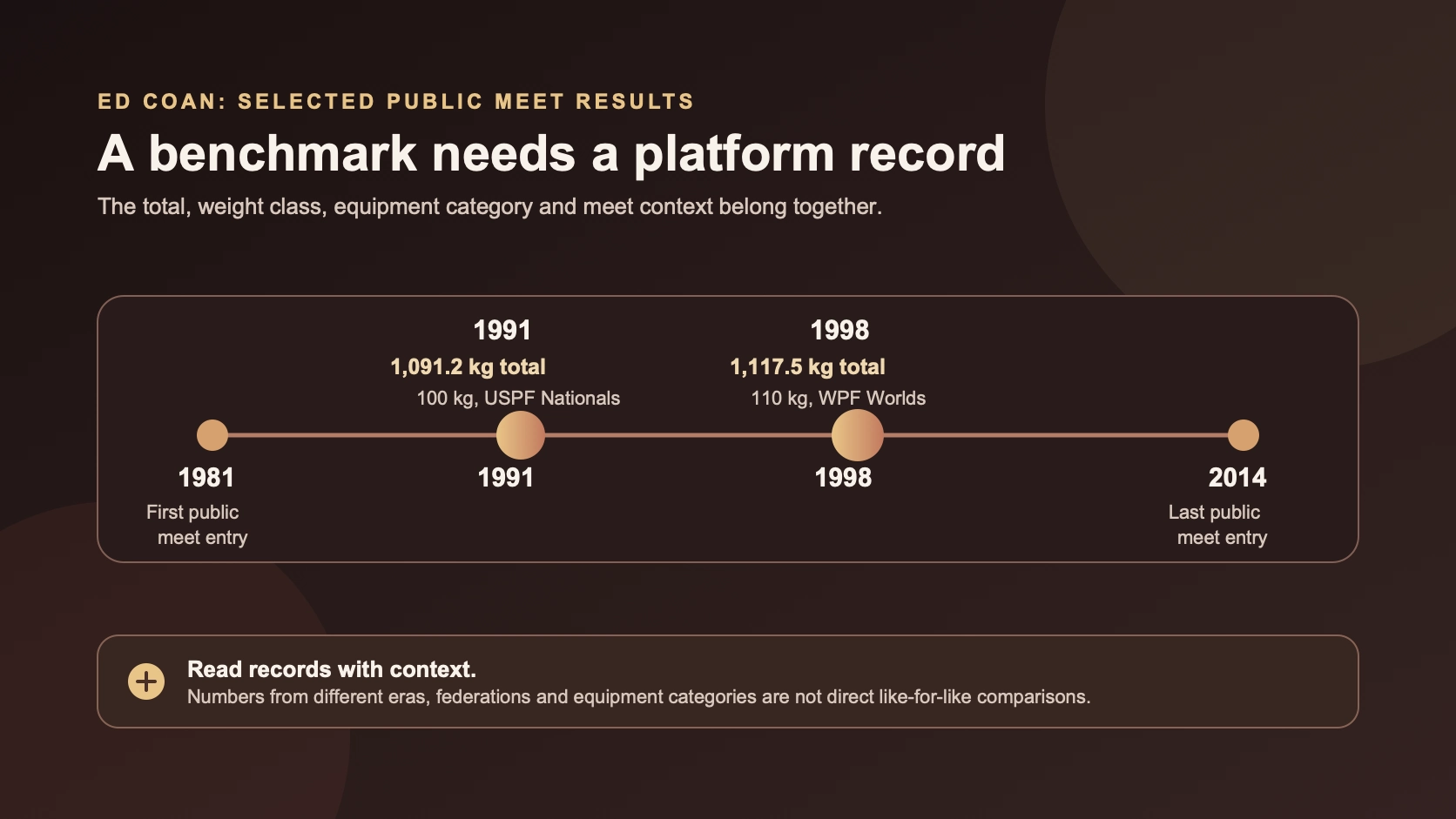
The OpenPowerlifting competition profile for Ed Coan lists 46 meet entries from 1981 to 2014. It records personal bests of 471 kg in the squat, 262.5 kg in the bench press, 408.6 kg in the deadlift and a 1,117.5 kg total in single-ply competition. These are results-database figures, not a single federation’s current record book, so they should be read as a documented competition history rather than a permanent all-time ranking.
Two totals help show the scale of that history. The public results list a 1,091.2 kg total at 100 kg at the 1991 USPF Senior Nationals, and a 1,117.5 kg total at 110 kg at the 1998 WPF World Championships. The later figure is 2,464 pounds. The point is not that these numbers settle every cross-era argument. It is that high-level performance appeared repeatedly in the record instead of only once.
Consistency made the numbers meaningful
A benchmark needs more than a peak. It needs enough range for people to see a pattern. The Powerlifting Records profile, which organizes public meet data into a career summary, tracks Coan’s appearances across the 82.5, 90, 100, 110 and 125 kg classes. It lists 12 equipped world records set across the squat, deadlift and total categories in its underlying dataset. Read its career record summary alongside the individual meet results rather than treating any aggregated website as a replacement for a federation archive.
This is where the word "benchmark" becomes more useful than "greatest." It does not require a claim that all conditions were identical or that later lifters cannot exceed a number. It means the performance created a durable reference for what a balanced, high-level total could look like at several bodyweights.
The sport also remembers Coan because all three lifts mattered. Some lifters become closely associated with a particular event. Coan’s totals made the whole meet the story. That is the central logic of powerlifting itself, explained in The Big Three: Why the Squat, Bench and Deadlift Still Rule Strength Training: the three movements test related but distinct qualities, and the total asks for all of them on the same platform.
Equipment and federation context are not footnotes
Historical comparisons in powerlifting can become misleading very quickly. Coan competed in multiple federations and in equipped categories. Rules, equipment allowances, weight classes, judging practice and the depth of the competitive field all affect what a result means. A lift listed as single-ply equipped should not be casually compared with a raw lift or with a performance recorded under a different federation’s standards.
That context is not an attempt to shrink the achievement. It is what lets the achievement be described accurately. A belt, supportive suit, wraps and other approved equipment can have a defined role under a rulebook, while the competition total remains the result of three judged lifts. What ‘IPF Approved’ Really Means provides a modern example of why approved equipment, technical rules and federation labels need to be read as part of the result rather than decoration around it.
It also explains why record counts vary between sources. One database may track all-time records in a category, another may record a federation-specific standard, and a historical list may be updated when rules or categories change. The reliable approach is to name the meet, class, equipment category and source instead of repeating a bare number as if it travels without context.
The lesson is not to copy a legend’s load
It is tempting to turn a famous powerlifter into a ready-made program. Look at the heaviest lifts, copy the exercise order or chase numbers that make sense only inside someone else’s bodyweight, experience, equipment and competitive setting. That misses what makes the story useful.
The durable lesson is that a total rewards development across the whole platform. A lifter who wants a stronger squat, bench and deadlift needs a plan that gives each movement a job, tracks progress over time and leaves enough room to recover. The benchmark is not a load you must chase. It is a reminder that results become meaningful when they are documented, repeatable and understood in their setting.
Coan’s place in powerlifting history comes from that combination: long-term competition, high totals, several weight classes and a reputation built from platform results rather than a single viral moment. The numbers deserve context. With that context, they explain why the reference point has lasted.
Continue with a related guide
For the three lifts that make up a powerlifting total, read The Big Three: Why the Squat, Bench and Deadlift Still Rule Strength Training. For equipment-rule context, continue with What ‘IPF Approved’ Really Means.