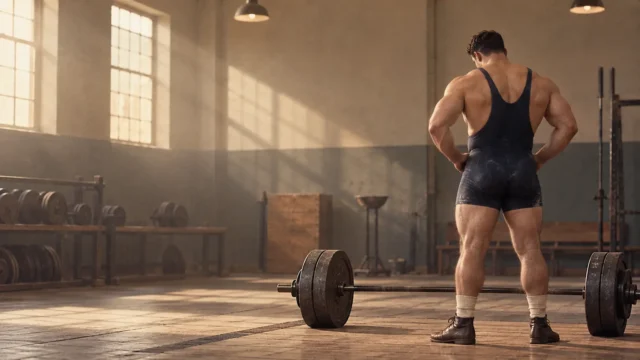
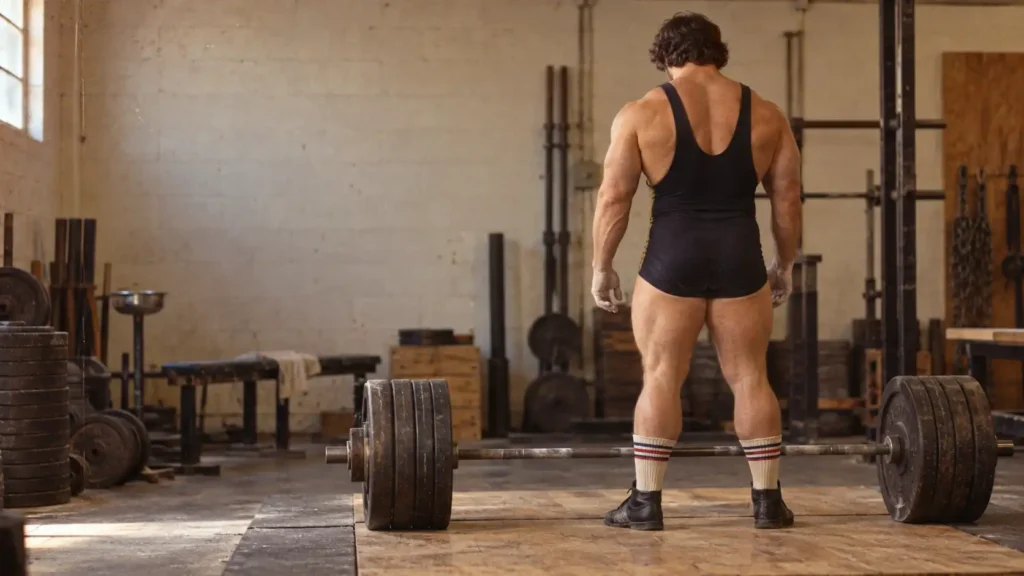
Lamar Gant is often introduced with a single extraordinary claim: a deadlift of five times bodyweight. The number deserves attention, but it is only part of the story. Gant’s career also included repeated success in the lighter weight classes, a long run of world-level results and lifts that still make readers stop to check the units.
That is what makes his career worth studying. It is not a template for how another person should train, and it is not proof that a famous number can be judged outside its rules, bodyweight class and era. It is a reminder that the best sporting stories get stronger when the result is placed back on the platform where it happened.
This profile uses public competition records and hall-of-fame material. It does not present an AI illustration as a photograph of Gant, and it does not turn historical results into a prescription for readers.
- A young lifter from Flint
- Why the deadlift became the headline
- What the meet record adds to the story
- How to read an old result responsibly
A young lifter who reached the world stage early
The Greater Flint Area Sports Hall of Fame records that Gant grew up in Flint, Michigan, and began powerlifting after a student teacher encouraged him to try the sport in junior high. Its biography places him second in the 123-pound class at the 1973 World Powerlifting Championship in Harrisburg, Pennsylvania, when he was 16. The same account lists a 524.5-pound deadlift in the 123-pound class as his first world record in 1974.
Those details explain why his later achievements did not emerge from nowhere. He arrived in the sport young, competed in a clearly defined weight class and kept returning to the platform. The hall-of-fame record lists world titles from 1975 through 1990 across the 123- and 132-pound divisions. Such lists are historical summaries, not training evidence, but they establish the scale and duration of the competitive record.
Powerlifting was already a sport of three lifts: squat, bench press and deadlift. The big three remain the sport’s basic language because a total asks a lifter to perform across all three, not merely excel at a single movement. Gant became especially known for the deadlift, but the broader career was built in meets where all three lifts were recorded.
The deadlift number needs its full context
Gant’s reputation rests partly on a remarkable power-to-bodyweight relationship. The public IPF chronology held by AllPowerlifting lists his 289.5-kilogram deadlift in the 56-kilogram class on 10 July 1982 in Dayton, Ohio. That is an exceptional number in any discussion of lighter-class deadlifting. It is also more informative than a floating social-media claim because it ties the lift to a class, date, federation record sequence and unit of measurement.
The famous “five times bodyweight” description is best read as a way to convey scale, not as a comparison tool. Bodyweight class, weigh-in weight, equipment, judging, rulebook and the record source all affect what a ratio means. A lighter person does not need to chase a multiplier to train well; a heavier person is not less accomplished because the ratio is smaller. Historical greatness is not a challenge for the reader to reproduce.
What the ratio does show is how unusual the lift was for its class. It is one reason Gant remains part of the sport’s shared reference points. A useful way to appreciate it is to look at the records as records: evidence of a performance under a named set of conditions, rather than fuel for a dramatic comparison across every lifter and era.
The record is larger than one pull
The OpenPowerlifting profile for Lamar Gant collects meet results spanning his competitive history. Its entry records, for example, a 675-kilogram total at the 1988 IPF Men’s World Powerlifting Championships in the 60-kilogram class, with a 310-kilogram deadlift. Database entries are not the whole biography: historical data can be incomplete, federation names and equipment labels can change, and a database cannot explain the conditions of every attempt. They do give the reader a way to see that the deadlift was part of repeated full-meet performance.
That distinction matters in a sport that often celebrates one viral lift. A large deadlift can be memorable, but a powerlifting total also requires a lifter to manage attempts, make weight, meet the rules of the day and produce three judged lifts. The hall-of-fame profile credits Gant with 15 world championships. Taken together with the meet record, that makes the fairer description of his career: an outstanding deadlifter who repeatedly delivered in competition.
For a modern reader, the lesson is not to hunt for the most extreme single rep. It is to respect the discipline of repeatable performance. Building a deadlift that continues to move forward usually comes from controlled practice, appropriate workload and enough recovery to return for another useful session. Our guide to building a deadlift that does not stall focuses on those ordinary decisions. For a wider historical reference, the profile of Ed Coan shows another way a long record across all three lifts became meaningful.
What Gant’s career can and cannot teach
The safe lesson from a great lifter’s history is not that every feature of that lifter should be copied. Gant competed in a specific era, at specific bodyweights and under specific federations. His deadlift record tells us he was exceptional; it does not identify a perfect technique, loading plan or bodyweight target for someone else.
It can, however, sharpen how we watch the sport. Ask where a result happened, what class and rules applied, whether it came from a full meet, and whether the source documents it. Then separate admiration from imitation. These questions make a historic lift more interesting because they reveal the competitive setting rather than reducing it to a number.
Conclusion
Lamar Gant’s career remains remarkable because the deadlift headline sits inside a deeper competitive record: early entry into the sport, success across years, world titles in the lighter classes and documented meet results that support the reputation. The numbers are striking, but the context is what makes them durable.
Read a famous lift as a record from a real platform, under real rules, at a real bodyweight. That keeps the achievement impressive without turning another athlete’s career into a standard that every lifter must chase.