A deadlift plateau rarely arrives with a neat explanation. One week the bar moves normally, the next it feels slow from the floor, and soon every warm-up becomes a question about whether the program has stopped working. The temptation is to add a new variation, more sets, a heavier single or all three at once.
That response usually creates more noise than progress. A deadlift is demanding enough that small changes in setup, sleep, loading, grip, prior training and attention can change how a session feels. A useful plan does not prevent every difficult day. It makes the lift comparable enough that you can tell the difference between a normal rough session and a pattern worth changing.
- Define the deadlift you want to improve
- Build a recoverable weekly dose
- Use the log to identify a real signal
- Change one variable at a time
Define one version of the lift
"Deadlift" can mean a conventional pull, sumo pull, trap-bar deadlift, paused deadlift, block pull or Romanian deadlift. All may be useful training tools. They are not one interchangeable test.
Write down the version you want to improve: bar, stance, grip, start height, footwear, pause or no pause, and the effort you intend to use. This is not obsessive bookkeeping. It gives your log enough context to make a ten-kilogram change, a bad sleep week or a new pair of shoes visible instead of mysterious.
The Big Three: Why the Squat, Bench and Deadlift Still Rule Strength Training covers why the deadlift is more than a hip-and-back strength test. It is a coordinated skill: setup, bracing, grip, position and force have to meet at the same time. If those details change every week, the number on the bar is not answering one clear question.
Start with a dose you can recover from
Many lifters stall because the deadlift is treated as either a weekly max-out or an exercise to avoid completely until a test day. A more useful middle ground is direct practice at a load and repetition range you can repeat with controlled positions.
One lifter may use a heavier main exposure plus a lighter technique exposure later in the week. Another may pull once, then use a hinge variation and rows to support the pattern. The right structure depends on experience, schedule, other lower-body work and how well the sessions are recovered from. The rule is not "pull twice a week." The rule is to give the lift enough clear practice to learn from without making the next session worse by default.
This is where The Volume Sweet Spot: How Much Work Does Strength Really Require? is useful. Count the direct, comparable deadlift work first. Then look at the squats, hinges, posterior-chain accessories and hard conditioning that may affect it. A large training week can still have very little quality deadlift practice.
Do not label every hard rep a weak point
The deadlift has positions where the demand changes, but a slow rep does not automatically reveal one faulty muscle or one magic assistance exercise. A review of sticking points in the squat, bench press and deadlift describes why the hard portion of a lift can emerge from several biomechanical and physiological factors. The useful response is observation before intervention.
Ask a smaller question. Does the bar drift away from you at the start? Does a familiar load become slow only after hard squats? Does the grip become the first limiter? Does the position change when the session gets late? A phone video from one consistent side angle, a simple log and an honest effort estimate are often enough to spot a repeatable pattern.
The distinction matters because strength is task-specific. A 2025 systematic review of resistance-training specificity found that dynamic resistance training produces greater gains in the trained task than in non-trained isometric strength. Assistance work can help, but it does not replace practising the movement you care about.
Make one change that answers the question
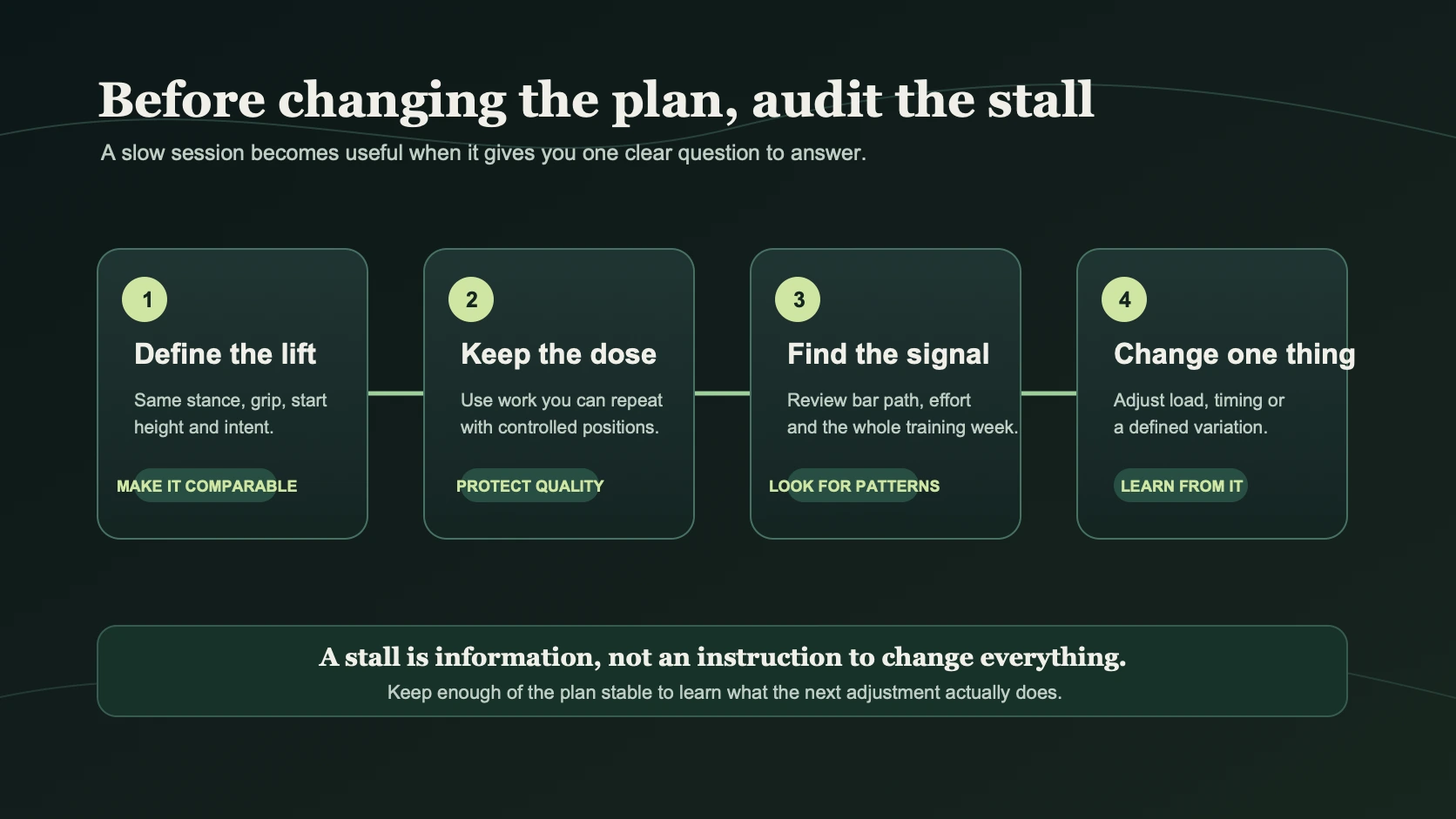
Once you have a pattern, choose the smallest useful change. If positions are getting loose at a load you have rushed toward, hold the load and rebuild clean repetitions. If the main work is consistently tired after other lower-body training, move it earlier or reduce the competing work for a few weeks. If a technical variation helps you repeat a specific position, use it for a defined block and keep the main lift in the plan.
Avoid changing load, volume, variation and effort target in the same week. If the next session improves, you will not know what helped. If it gets worse, you will not know what to remove. A deadlift plan needs enough stability for the result to teach you something.
Use RPE and RIR: Measuring the Same Problem From Different Angles to record how close a set was to your limit. It does not need to be perfect. A consistent estimate is more useful than pretending every work set felt identical.
Protect the work from unnecessary fatigue
Deadlifts are not improved by treating every set as a test. A 2025 systematic review on effort, intensity, volume and fatigue summarizes why those variables interact with voluntary performance and fatigue symptoms. That does not produce a personal prescription, but it supports a sensible training habit: reserve hard, high-effort pulling for the occasions when it has a clear job.
For most of the work, aim to leave the platform knowing what happened and able to train again. If sleep, stress, travel or a physically demanding week changes the session, adjust the load or number of sets rather than forcing the planned number because it is written down. The article Recovery Is Part of the Program explains why this is not softness. It is how hard work stays available over months instead of being spent in one dramatic day.
Build momentum, not a perfect week
A deadlift that keeps moving is built from weeks that resemble each other enough to compare. Set up the same lift, practise it with a recoverable dose, record what happened and make one response when the evidence is clear.
Some sessions will still be slow. That is normal. The goal is not to eliminate difficult reps. It is to stop treating every difficult rep as a reason to abandon the plan.
FAQ
How often should I deadlift to get stronger?
There is no fixed answer. One direct exposure can work for some schedules, while others benefit from a second lighter or more technical exposure. Start with the smallest amount you can perform well and review over several weeks.
Should I add more deadlift volume when I stall?
Not automatically. First check whether the lift is comparable, whether the current work is recovered from, and whether the problem appears across several sessions. Add work only when it answers a clear need.
Are deadlift variations necessary?
No. They can be useful when they give you a specific practice opportunity, but they should support rather than replace the main deadlift if that is the lift you want to improve.
Continue with a related guide
For the movement context behind this plan, read The Big Three: Why the Squat, Bench and Deadlift Still Rule Strength Training. For a practical way to choose a recoverable weekly dose, continue with The Volume Sweet Spot: How Much Work Does Strength Really Require?.