

A gym membership can look like a simple equipment purchase. In practice, it changes the route you take after work, the time you leave home, whether you can find a rack, how comfortable you feel asking a question and how likely you are to go back on a tired Tuesday.
That is why the right gym changes more than the exercises you perform. It changes the friction around the exercise. A room with every machine in the catalogue cannot help if it is too far away, too crowded at your only training hour or so uncomfortable that you keep finding reasons to skip it. A smaller gym can be a better choice if it makes your ordinary week easier to repeat.
This guide is for adults choosing a place to train, not a label to adopt. It does not rank gyms by seriousness. It gives you a short trial that helps you choose the space that supports your own routine.
- Why access is part of the program
- What equipment you actually need
- Why comfort and culture matter
- How to run a normal-week trial
Start with the trip you will make repeatedly
Before comparing equipment, map the journey. Can you reach the gym from home or work without adding a complicated detour? Does it open when you are genuinely free? What happens when traffic, weather, family plans or a late meeting shrink the available window?
There is no universal acceptable commute. The useful question is whether the trip still feels possible on an average day. If you plan three sessions a week, try to picture all three trips, including the one when energy is low. A membership that only works on your ideal day is less useful than a less glamorous option you can reach consistently.
Research on resistance-training participation also points beyond equipment. A systematic review of factors associated with resistance-training participation identified influences such as self-efficacy, self-regulation, social norms and program leadership. A gym cannot create all of those for you, but it can make them easier or harder to use. Clear opening hours, simple access and a predictable route are not small details when the goal is repeated attendance.
Make an equipment list for your actual program
Write down the four or five things you need for a normal session. For a general strength plan, that might be adjustable dumbbells, a bench, a cable station and one way to squat or hinge. For barbell training, it may be a rack with safeties, an appropriate bench, plates and enough floor space to set up. If your plan includes cardio, add the machine or outdoor route you will realistically use.
Then distinguish “must have” from “nice to have.” A sauna, a smoothie bar and a wall of machines may improve a visit; they do not replace the one piece of equipment that makes your main lift possible. If a single rack is always occupied when you arrive, that is not a theoretical inconvenience. It is a constraint on the program you can run.
The choice between a broad commercial facility and a powerlifting-focused room is a separate question. Our comparison of a commercial gym and a powerlifting gym explains when barbell specificity is worth prioritizing. Here, focus first on whether this individual location has the tools available at the time you will use them.
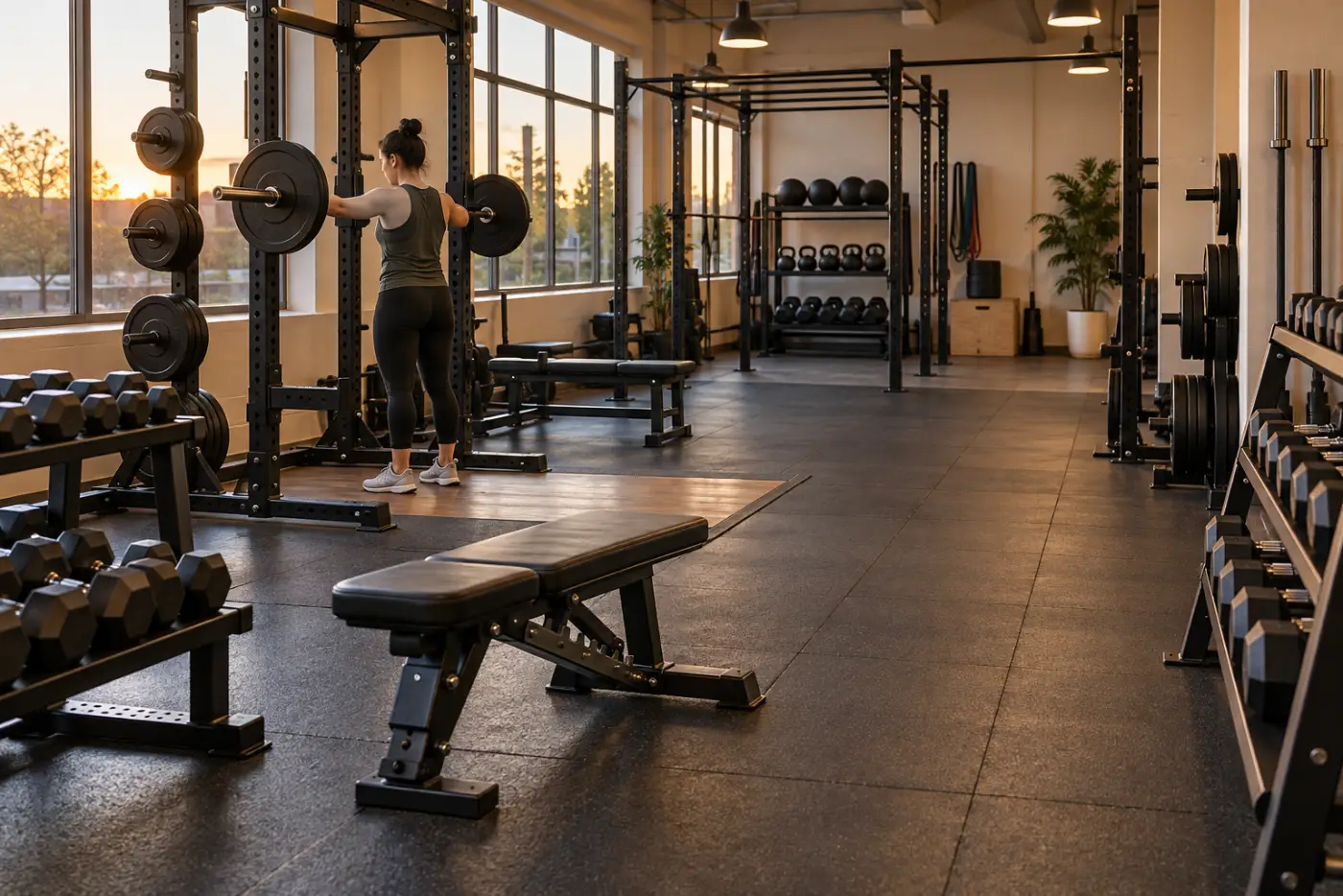
Treat comfort as a practical condition
“Good atmosphere” can sound vague, so make it observable. During a visit, notice whether people share equipment, return weights, respect personal space and leave room for someone learning. Watch how staff respond to a basic question. You should be able to set up, take normal rest periods and use a light load without being treated as entertainment or a problem to solve.
Comfort does not require making friends on the first day. Some people want conversation and a training partner; others want to put on headphones and work quietly. Both are legitimate. The important part is that the setting does not make either choice unusually difficult. If you do want a shared session, the qualities of a helpful partner are covered in our guide to training with the right person.
The evidence on exercise maintenance is appropriately broad here. A 2024 qualitative synthesis of adults maintaining physical activity found recurring themes of access, cost, habits, enjoyment, flexibility and support from others. It does not prove that one gym design causes lasting attendance. It does reinforce the common-sense choice: select a space that removes your own known barriers instead of adding new ones.
Check the contract before you fall for the tour
Ask about the monthly price, joining fee, cancellation terms, freezes, guest passes, parking, towel policies and whether your preferred hours have separate access limits. These are not boring administrative details. They determine what the membership costs in money and effort over the next several months.
Also ask when the gym is busiest. A tidy midday tour says little about the 6 p.m. crowd. If staff cannot offer a trial, visit at the time you expect to train and watch the flow for ten minutes. You can learn a great deal by seeing whether the equipment you need is available and whether the room feels workable at its busiest.
Run a two-visit, normal-week trial
Use one visit to inspect and one to train. On the training visit, arrive at the usual hour, change as you normally would and perform a scaled version of a real session. Time the journey, see how long the warm-up takes and notice what you have to improvise. Do not judge the gym because one dumbbell is temporarily out of place; look for the repeated pattern.
Afterward, answer five questions:
- Can I get here often enough for my intended schedule?
- Can I reliably do the main work in my program?
- Do I feel comfortable enough to return and learn here?
- Does the full cost fit my budget without strain?
- What is my minimum version on a rushed day?
The last question protects the decision from all-or-nothing thinking. Your minimum version might be a 35-minute session, a nearby location or a short walk from work. A one-year study of new fitness-club members found that enjoyment and challenge were rated more highly by people who exercised regularly, while priority was a major barrier for those who dropped out. The study cannot predict your membership outcome, but it is a useful prompt: make the gym easy enough to prioritize and useful enough to want to return to.
Conclusion
The right gym is not the place with the most impressive equipment list. It is the place that fits your route, your actual hours, your necessary equipment and your ability to feel at ease while learning. Choose it after a normal-week trial, read the contract and give the ordinary details as much weight as the tour.
When the setting removes friction, your program has a better chance of becoming a routine instead of a plan that only exists on paper.