

Creatine is one of the few supplements that deserves its boring reputation. It is not flashy. It does not need a complicated stack. It has decades of research behind it, and its strongest use case is clear: supporting high-intensity performance, strength training capacity, and gains in lean mass when paired with training.
But “creatine and recovery” is a trickier phrase. Some people use it to mean less soreness. Others mean faster repair. Others mean better readiness because they can maintain training quality. Those are related ideas, but they are not identical.
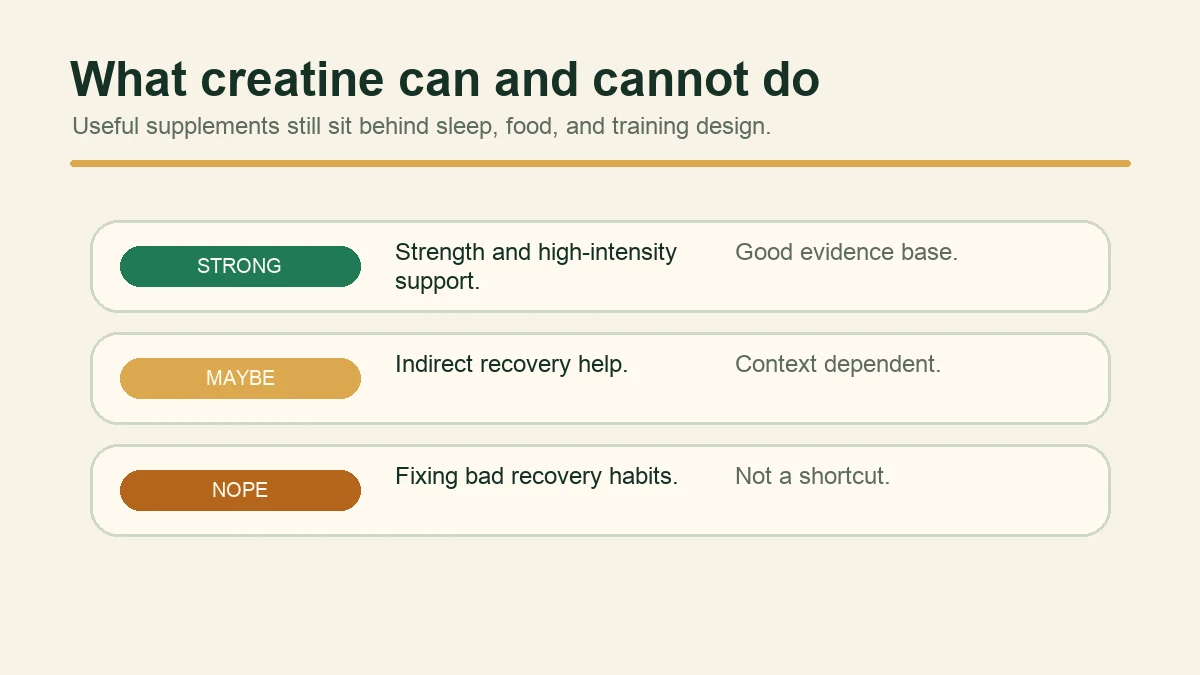
The most honest answer is this: creatine may support recovery indirectly by helping you train better and maintain high-intensity output, but it does not replace sleep, calories, protein, hydration, deloads, or sensible programming. Some recovery-specific findings are promising, but the evidence is more nuanced than supplement marketing suggests.
That makes creatine useful, not magical. A very respectable category.
- What creatine does best
- How it may relate to recovery
- What claims need caution
- How lifters can use it sensibly
- Who should ask a professional first
Creatine supports short, hard efforts
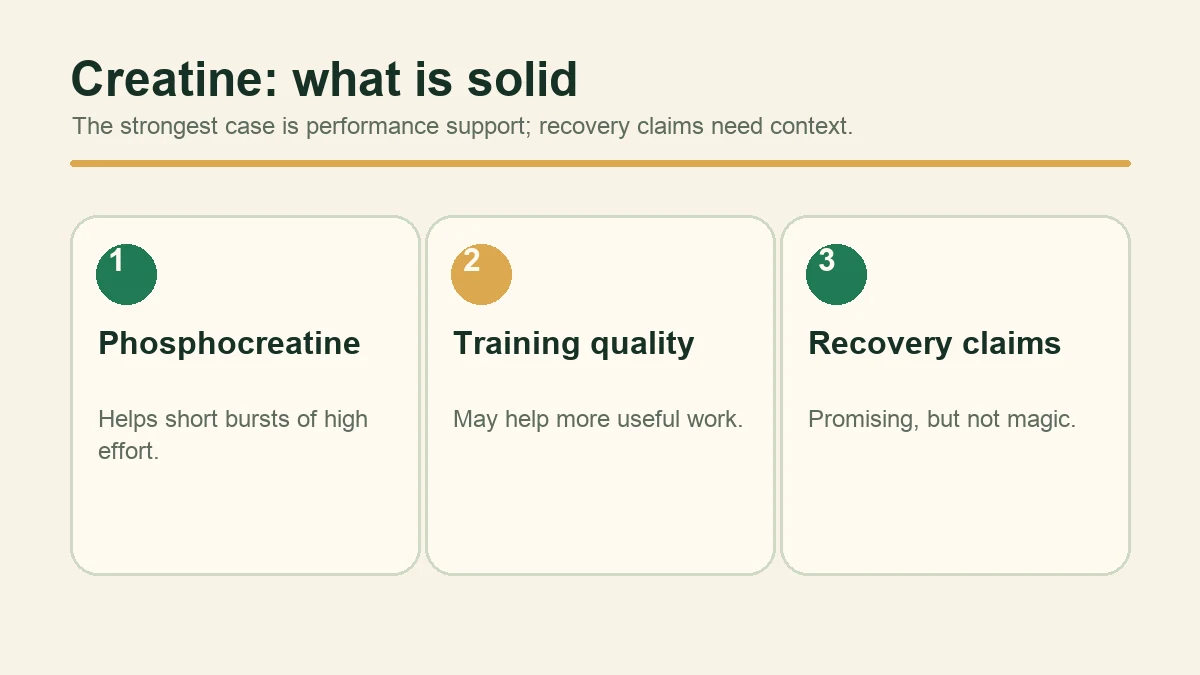
Creatine is stored in muscle as creatine and phosphocreatine. During short, intense efforts, the phosphocreatine system helps rapidly regenerate ATP, the immediate energy currency used by muscle cells.
For lifters, that matters because sets of heavy squats, presses, deadlifts, sprints, jumps, and repeated hard efforts rely partly on that energy system. More available creatine can help support repeated high-intensity work.
The International Society of Sports Nutrition position stand on creatine summarizes a strong evidence base for creatine monohydrate as an effective ergogenic aid for high-intensity exercise and training adaptations. That is the foundation. Not “instant recovery.” Not “no soreness ever.” Better support for the kind of work that strength athletes care about.
Better training quality can look like better recovery
If creatine helps you complete more quality reps, maintain output across sets, or tolerate a training block better, it can indirectly support progress. In that sense, recovery and performance overlap.
Imagine two lifters doing the same program. One can keep bar speed, rep quality, and total work slightly higher across weeks. That lifter may accumulate a better training signal. Recovery is not only about feeling fresh the next morning. It is also about returning to useful performance often enough to build momentum.
This is the strongest practical argument for creatine in a strength program: it may help support the work that creates adaptation. The recovery benefit is not that creatine erases fatigue. It is that it can improve the energetic side of repeated high-intensity training.
Less soreness is not guaranteed
Some studies have investigated creatine in relation to muscle damage, inflammation markers, soreness, and recovery of performance. Results can vary depending on the exercise protocol, training status, dosing, timing, and what recovery marker is measured.
That is why it is better to avoid the claim “creatine prevents soreness.” It may help in some contexts, but soreness is influenced by novelty, eccentric stress, volume, sleep, genetics, and prior exposure. A supplement cannot override all of that.
The broader creatine literature continues to examine health, performance, and recovery-related outcomes, but the safest editorial stance is still conservative: creatine is well supported for performance; recovery-specific effects should be described carefully.
Creatine does not fix a bad program
This is where supplement thinking gets silly. If your training volume is too high, sleep is poor, calories are too low, and every set is taken to failure, creatine will not rescue the plan. It might help performance at the margins, but the larger recovery debt remains.
Supplements sit downstream of the big inputs. For recovery, those are sleep, enough total food, adequate protein, reasonable training volume, stress management, and time. Creatine can be part of the system. It is not the system.
This is especially important during fat-loss phases. If you are dieting hard, training hard, sleeping little, and expecting creatine to keep recovery perfect, expectations need to come down. Creatine can support performance, but energy availability still matters.
How to use creatine without making it weird
For most healthy adults who choose to use it, creatine monohydrate is the default option. It is studied, available, and usually less expensive than fancy variations.
A common approach is 3–5 grams daily. Some people use a loading phase, but it is not mandatory. Daily consistency matters more than perfect timing. Taking it with a meal can be convenient. If it upsets your stomach, split the dose or take it with more food and fluid.
Creatine can increase body weight slightly because of water stored with muscle creatine. For strength athletes, that is usually not a problem. For weight-class athletes, it should be planned.
Hydration advice should stay normal, not mystical. Drink enough fluids for your body, climate, sweat, and training. Creatine does not require panic-level water rituals.
What to expect in the first month
Creatine is not a stimulant, so do not expect to “feel” it the way you might feel caffeine. The effect is usually subtler: an extra rep here, better repeat effort there, or slightly more stable performance across hard sets. Some lifters notice nothing dramatic but still benefit over time because training quality accumulates quietly.
If you skip the loading phase, muscle creatine stores rise gradually over several weeks. That is fine. A slower start does not mean it is not working. If you load, stores rise faster, but some people experience temporary stomach discomfort. Neither approach is morally superior; the best approach is the one you can follow consistently.
Keep expectations tied to the right outcomes. Creatine may help you train productively. It should not be judged by whether every sore muscle disappears overnight. Recovery is bigger than one supplement, and strength progress is built over months.
How to judge whether it is worth keeping
Give creatine a fair trial inside a stable routine. If your program, calories, sleep, and exercise selection change every week, you will not know what creatine contributed. Keep the major variables steady for a month or two and watch practical markers: repeated-set performance, ability to finish planned work, body weight, and how training feels across the week.
The decision does not need to be emotional. If creatine is affordable, tolerated well, and fits your goals, it is reasonable to keep. If it bothers your stomach, complicates weight-class planning, or you simply do not want to use supplements, you can still make excellent progress without it.
Creatine is useful because it is optional, simple, and evidence-supported. It should make the plan easier to execute, not turn recovery into a supplement spreadsheet.
Who should ask first
If you have kidney disease, are pregnant, take medications that affect kidney function, have a medical condition, or are unsure whether creatine fits your situation, ask a qualified clinician before using it. This article is general education, not medical advice.
Also be cautious with supplement quality. Choose products from reputable brands, and consider third-party testing if you compete in drug-tested sport. Contamination risk is a real supplement-world issue, even when the ingredient itself is well studied.
The real recovery hierarchy
Creatine belongs in the “useful if the basics are handled” category. It can support high-intensity training. It may help you maintain quality work. It may have recovery-related benefits in some contexts. But the basics still decide most of the outcome.
If you sleep badly, eat randomly, train chaotically, and never deload, creatine is a small umbrella in a thunderstorm. If your program is solid, creatine can be one of the few supplements that actually earns a place on the shelf.
Keep it boring. That is the compliment.
Continue with a related guide
Start with the cluster overview in Why More Training Isn’t Always More Progress. Continue with Recovery Is Part of the Program, then clarify the terminology in The Difference Between Fatigue and Overtraining.