

Mike Mentzer made bodybuilding training feel like an argument with consequences. In an era when many routines prized more exercises, more sets, and more days in the gym, his Heavy Duty philosophy insisted that a small amount of very hard work, followed by enough recovery, could be the more rational path. That did not make the system universally right. It made the variables impossible to ignore.
The lasting appeal of Mentzer’s story is not a promise that one set or one weekly schedule will work for everyone. It is the force of the question behind the program: if a set is genuinely demanding and training is supposed to be recoverable, how much extra work is actually earning its place?
This is a historical profile and a training-context article, not an individualized program. Sets taken to failure can be technically and mentally demanding. New lifters, people returning after time away, and anyone dealing with pain, injury, or a medical condition should not treat an old professional bodybuilding method as a substitute for individual coaching or clinical advice.
- The competition record behind the reputation
- What Heavy Duty actually argued
- Why the philosophy divided bodybuilding
- What current evidence can and cannot settle
- What a modern lifter can take from the debate
The athlete behind the argument
Mentzer was not simply a writer offering a contrarian routine. His competitive profile gave the argument an audience. The modern official Heavy Duty archive’s detailed timeline records a perfect score at the 1978 IFBB Mr. Universe and his 1979 IFBB Mr. Olympia heavyweight division win. Its biographical account presents those results as part of the foundation for the later Heavy Duty work.
Those pages are a legacy source, not an independent audit of every historical detail, but they establish the central sequence: a highly visible competitor became an advocate for a training philosophy that ran against much of the gym culture around him. That combination mattered. An abstract disagreement about volume becomes louder when it is attached to an athlete whose physique and contest record people can see.
Mentzer’s professional career also puts a limit on the usual internet version of the story. It is tempting to treat the later, most extreme versions of Heavy Duty as the exact program that created every earlier competitive result. Training philosophies evolve, and a champion’s career contains more than one phase. History is more useful when it keeps that distinction rather than retrofitting one neat routine onto an entire life.
Heavy Duty was more than low volume
Heavy Duty is often reduced to “one hard set.” That description misses the wider claim. Mentzer combined brief sessions, high effort, relatively little working volume, generous recovery, and a belief that the trainee should respond to evidence rather than to a crowded weekly ritual. The pieces were connected: if work sets were pushed very hard, he argued, the program should not also demand a large number of them or frequent repeats.
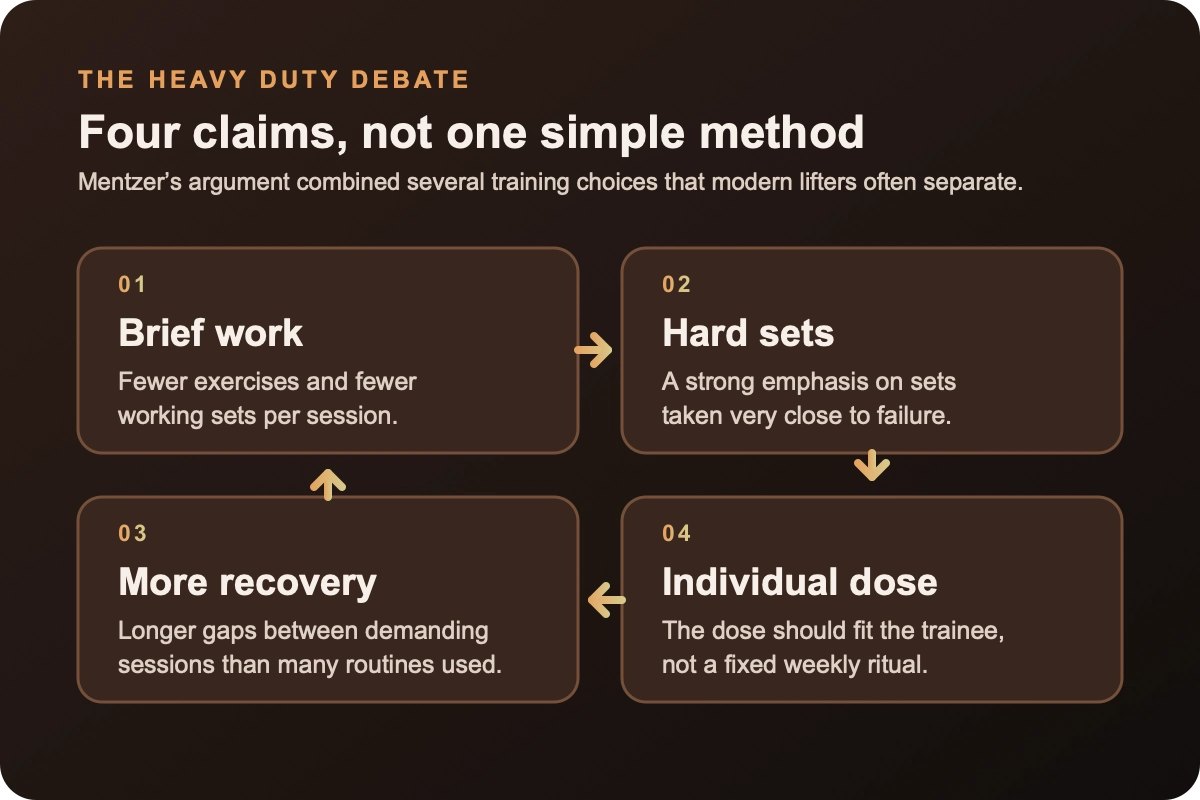
This was persuasive because it spoke to a real problem. More work is easy to prescribe and easy to confuse with better work. A short session with clear effort targets can be easier to complete, record, and recover from than a marathon workout built from loosely chosen extras. Mentzer gave lifters permission to ask whether fatigue was being mistaken for productive training.
It was divisive because the answer was not merely “train hard.” Heavy Duty challenged the social proof of busy gyms and high-volume routines. It also made strong claims about how little work was necessary. For some readers, that was a welcome correction to needless complexity. For others, it seemed to turn a useful principle into an unnecessarily narrow rule.
The question research does not settle with one verdict
Modern evidence can clarify parts of the debate without declaring a historical winner. A systematic review and meta-analysis comparing failure and non-failure training found no significant overall difference for strength or hypertrophy across the included studies. The authors concluded that training to muscle failure does not appear to be required for gains, even though it is not automatically harmful to adaptation either.
That matters because Heavy Duty treated very hard sets as central. Near-failure effort can be a legitimate tool, but it is not a universal entry requirement for progress. The same review also cautions against pretending that one outcome applies identically across training histories, exercises, and volumes.
The immediate cost matters too. A separate systematic review and meta-analysis on acute fatigue found that training to failure can produce greater acute fatigue in several measures, especially when volume is not equalized. That does not make failure training bad. It means a program that uses it needs a recovery plan and a reason, rather than an assumption that maximum effort is free.
This is where the debate becomes more useful than the slogan. Low volume, high effort, more recovery, and progress tracking can each be sensible choices. They do not have to arrive as one package. A lifter might use a hard final set on a stable machine exercise while keeping compound lift practice away from failure. Another might prefer more moderate sets because they enjoy the practice and can recover from it. Neither choice needs to be a betrayal of a training identity.
What Mentzer changed in the conversation
Mentzer’s lasting contribution was to make recovery and dose part of bodybuilding language. Before a lifter adds another exercise, set, or day, it is reasonable to ask what that addition is meant to accomplish. Before declaring a routine too easy, it is reasonable to check whether the log shows better repetitions, more load, a more consistent range, or a useful trend.
That is close to the practical logic in The Anatomy of a Great Strength Program: change the smallest useful variable and keep the result measurable. It also connects to Why More Training Isn’t Always More Progress, which explains why extra work only helps when the athlete can recover from and repeat it.
The useful modern reading of Heavy Duty is therefore not “do exactly what Mentzer did.” It is “make the program defend its cost.” If a long session is improving performance and fits the week, it may be worth keeping. If it only creates fatigue and uncertainty, less work may be the better experiment. The answer belongs to the goal, the movement, the training history, and the person doing the work.
A legacy that resists easy imitation
Mike Mentzer remains a central figure because Heavy Duty made a bold claim at the right time: more training is not automatically more adaptation. The claim divided bodybuilding because it touched identity as much as programming. It asked lifters to value precision, recovery, and proof over the visible busyness of a long workout.
The history is more interesting when we do not flatten it into a cult routine or a cautionary tale. Mentzer’s philosophy gave bodybuilding a durable disagreement. For modern readers, that disagreement is productive when it leads to better records, clearer goals, and a training dose that is difficult enough to matter but realistic enough to repeat.
Continue with a related guide
For another story about bodybuilding culture, read Pumping Iron: The Film That Took Bodybuilding Out of the Gym and Into Pop Culture. For the practical training context, continue with Why More Training Isn’t Always More Progress.