Every training session has self-talk, whether you plan it or not. It may be a useful reminder before a squat: "stay balanced." It may be a vague prediction halfway through a set: "this is going badly." Or it may be a judgment after one missed repetition that follows you through the rest of the workout.
The point is not to become relentlessly positive. A hard set is still hard, and pretending otherwise rarely helps. The useful question is whether the words in your head direct attention toward the next action or pull attention into a verdict about who you are as a lifter.
Self-talk is a small training tool. It cannot repair an unrealistic program, replace technical coaching, or make an unsafe rep safe. Used well, it can make a session calmer: one clear cue before the lift, one honest observation after it, then the next sensible decision.
- Why the words around a set matter
- Instructional cues versus motivational cues
- How to keep a cue short and believable
- How to review a difficult set without self-judgment
Self-talk directs attention before it changes anything else
The first benefit of useful self-talk is not magic confidence. It is direction. A short phrase can tell you where to put attention when the bar feels heavy or the session feels messy. "Brace, then stand" gives the next few seconds a job. "Do not mess this up" gives the mind a problem without an action.
A meta-analysis of self-talk interventions in sport found a moderate overall effect on task performance, with differences depending on the task and type of self-talk used. Read the self-talk and sport-performance meta-analysis as evidence that structured self-talk can be a useful performance skill, not as proof that one phrase works for every lift or every person.
In a strength session, the phrase needs to fit the task. If you are learning a movement, an instructional cue may be useful: "feet planted," "push the floor," or "stay tall." If the movement is familiar but effort is the issue, a motivational cue may be better: "one clean rep" or "finish the set." The cue does not need to be clever. It needs to be short enough to survive contact with a real working set.
Instruction is different from self-criticism
Instructional self-talk tells you what to do. Self-criticism tells you what you fear the set says about you. The first has a next action. The second often creates more noise.
Compare these two responses after a slow warm-up:
- "I am weak today" is a judgment with no useful instruction.
- "Use the planned warm-up, then see how the first work set moves" is a decision.
The second sentence is not fake optimism. It leaves room for the session to be adjusted if the evidence stays poor. It simply postpones the global conclusion until there is something real to review.
This matters most when a set does not go as planned. The Difference Between Failure and Feedback explains why a missed target can be information about load, setup, recovery or the plan rather than a character verdict. The words you choose can preserve that distinction. "The bar drifted forward" is an observation. "I always ruin heavy sets" is a story that makes the next attempt harder to assess.
Choose one cue, not a speech
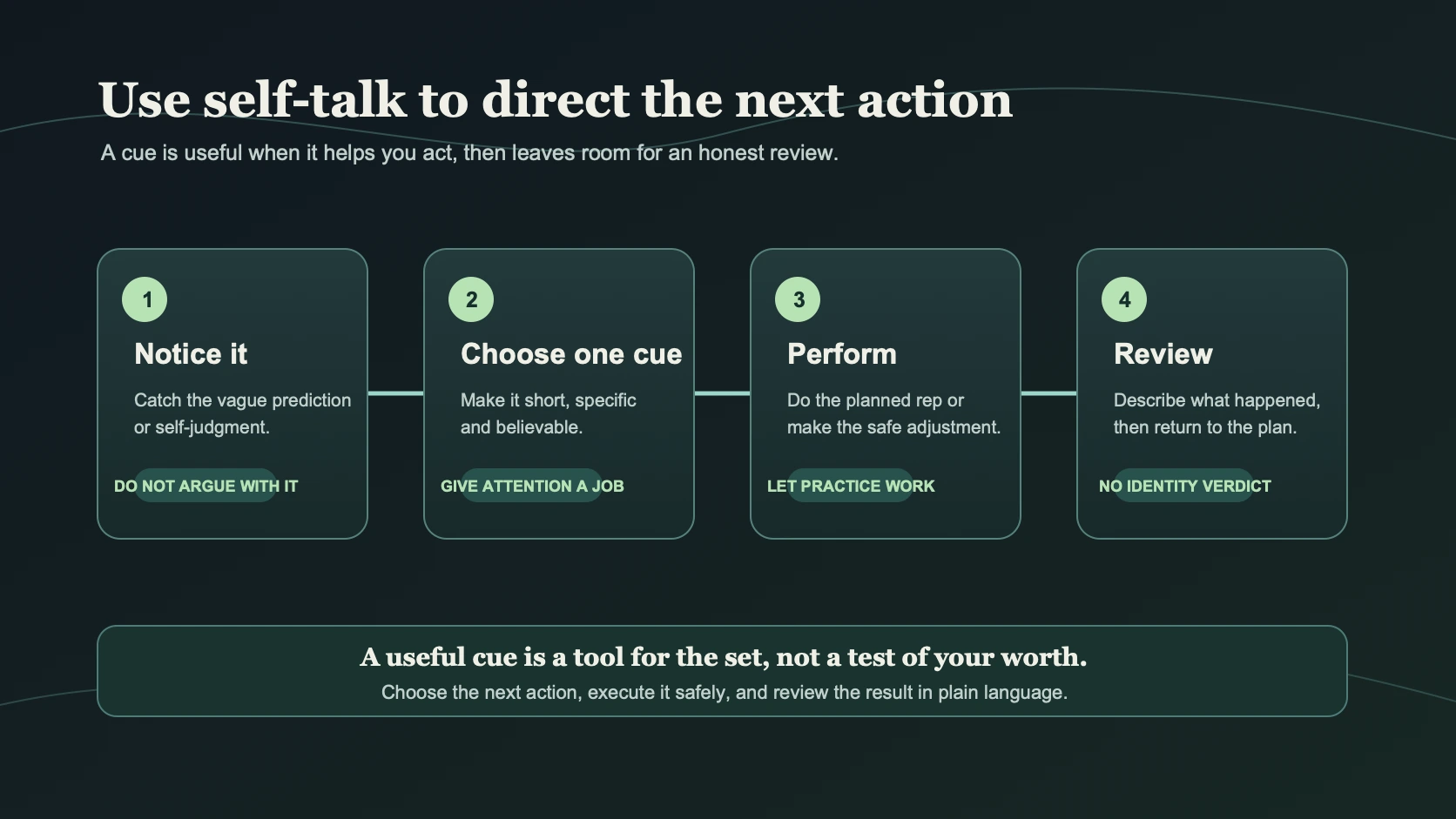
The worst time to hold a long internal meeting is under a loaded bar. Pick one cue that matches the movement and use it consistently for a few sessions. If you squat, it might be "stay over mid-foot." If you deadlift, it might be "push the floor away." If you are doing a difficult conditioning interval, it might be "settle the first minute."
Use the cue before the set, not as a constant stream of commentary. Once the repetition starts, let practice do its job. Adding five instructions to a movement you already know can make it feel less automatic, not more precise.
There is related evidence that feedback can improve resistance-training performance, although feedback and self-talk are not the same intervention. A systematic review and meta-analysis of feedback in resistance training found benefits for several acute performance measures, while also noting variation across study designs and feedback methods. The practical overlap is simple: concise information is more useful than a flood of commentary.
Try a cue for enough sessions to learn whether it helps. If it makes you rush, overthink or tense up, discard it. A cue is a tool, not a personal philosophy.
Keep the language honest enough to believe
Some people dislike motivational phrases because they sound artificial. That is often a sign that the phrase is too broad. "I am unstoppable" asks the mind to agree with something it may not believe. "I can do the next controlled repetition" is smaller and easier to test.
Honest self-talk can also include restraint. "This is not a max" can stop a normal work set becoming a test. "Reset and use the safeties" can be the right response when setup is not there. The Discipline to Stop a Set Early covers the same idea from a decision-making angle: ending or changing a set when the conditions are wrong can protect the work that follows.
Do not use self-talk to override sharp pain, dizziness, new weakness or a setup that is clearly unsafe. A cue can direct attention; it cannot turn a risk into a good idea. Stop, use appropriate safety equipment and seek individual guidance when a health concern needs it.
Review the action, not your identity
After the set, use a plain question: what happened? You may notice that the bar moved slower than expected, your rest was too short, the cue helped, or the load was not appropriate for the planned repetitions. Write a short note if it will help next time.
Then move on. There is no need to make a hard session prove that you are disciplined, weak, talented or behind. Why Slow Progress Is Still Progress is a useful reminder that a trend needs several comparable sessions. One phrase, one set and one day are all too small to carry a global conclusion.
The goal of self-talk is not to become your own hype person. It is to keep attention on the work: choose one cue, perform the rep, review honestly and return to the plan.
FAQ
What is a good self-talk cue for a heavy set?
Use one short cue that fits the movement you are performing, such as "brace and stand" for a squat or "push the floor" for a deadlift. Test it in lighter work before relying on it during a hard set.
Should self-talk be positive all the time?
No. It should be useful and believable. A calm instruction or an honest reminder to reduce the load can be more helpful than forced positivity.
Can self-talk replace coaching or a training plan?
No. It can help direct attention, but it does not replace technique instruction, sensible programming, sleep, recovery or safety decisions.
Continue with a related guide
For a practical way to separate a difficult session from a personal verdict, read The Difference Between Failure and Feedback. For the discipline of making a safe, useful call during a workout, continue with The Discipline to Stop a Set Early.