

Deloads have a way of becoming gym folklore. A new lifter hears that serious programs include a lighter week every four, six or eight weeks, then starts wondering whether skipping one means they are doing training wrong. The short answer is no: beginners do not automatically need a deload because a number on the calendar has arrived.
They do need a program they can repeat. That is the real job of a deload or any recovery adjustment. A lighter week is a tool for reducing training stress when the current dose no longer fits the person, the program or the rest of life. It is not a badge of advanced training and it is not an obligation you earn by feeling sore enough.
For many beginners, the first useful recovery skill is simpler: learn the difference between normal unfamiliar effort and a problem that is repeating. Early lifting comes with new movements, new soreness and a lot of information to process. None of that automatically calls for a week-long change.
- Why beginners often do not need a calendar deload
- What can look like a recovery problem
- How to make a smaller adjustment first
- When a lighter week may make sense
A beginner program should leave room to learn
Early progress is usually built on a relatively modest amount of well-practiced work. You are learning how to set up a squat, control a press, recover between sets and judge whether the next session is realistic. Adding more weight or repetitions too quickly is often a bigger issue than failing to insert a formal deload.
A sensible beginner plan already has some protection built in. It uses a manageable number of hard sets, leaves room to improve technique and does not require every set to be a test. When the plan fits, you may train for many weeks without needing a special low-stress week. Normal rest days, ordinary sleep and reasonable session length do much of the recovery work.
That does not mean beginners are immune to fatigue. It means the first question should be, “Is the program asking for more than I have prepared for?” A sudden jump from two sessions to five, a new batch of high-repetition accessories or a stretch of poor sleep can make training feel much more expensive. The answer may be a smaller correction, not a ritualized deload.
Do not confuse novelty with a warning sign
New exercises create unfamiliar soreness. Learning a hinge can make your hamstrings feel different for a few days. A first proper squat session can leave your legs tired in a way walking has never done. Those experiences are normal parts of learning a new demand, but they are not reliable evidence that your whole program has stopped working.
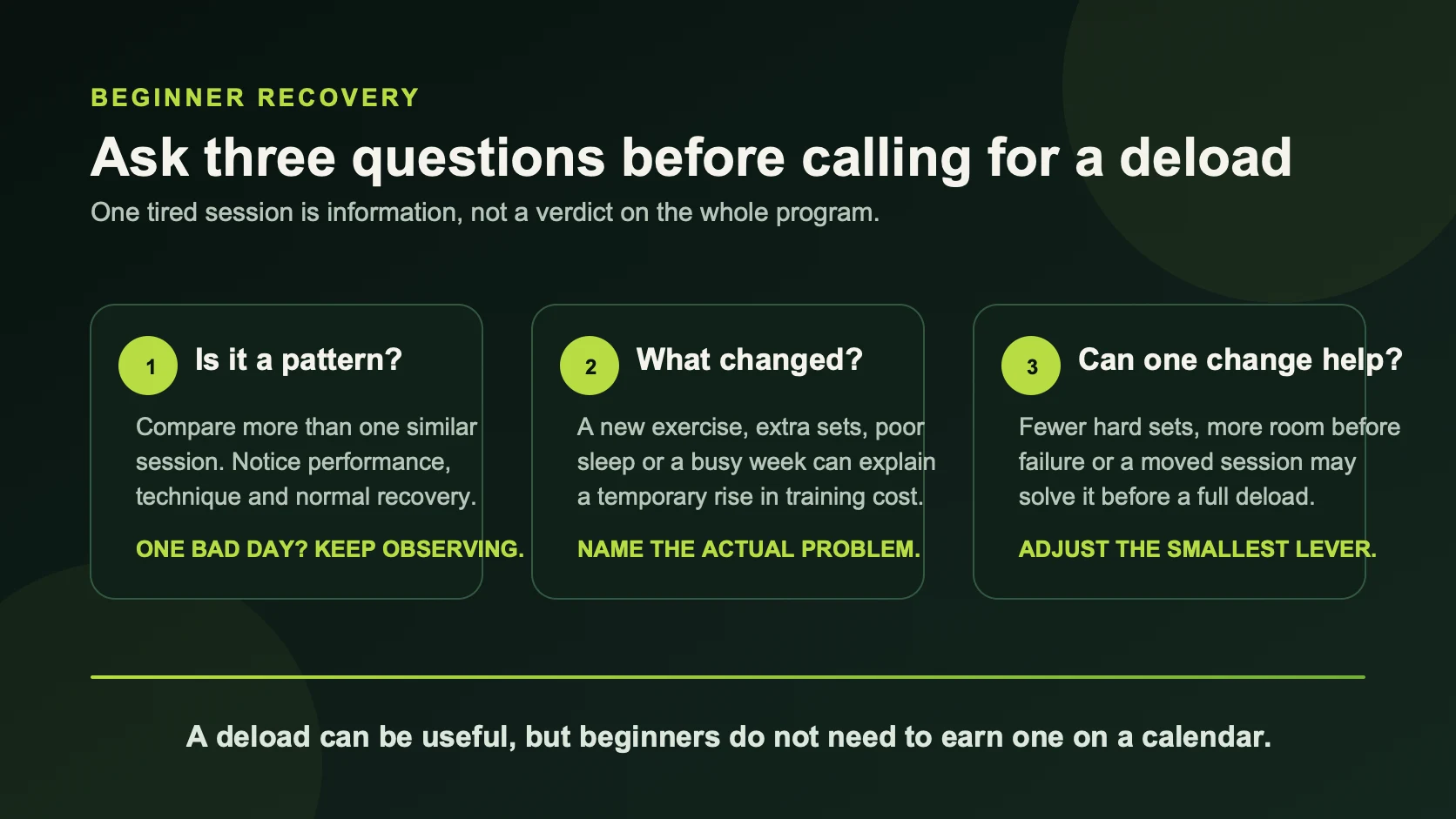
One disappointing session is also weak evidence. Maybe you arrived late, ate differently, slept badly or used a busier rack than usual. Instead of declaring a deload, compare the next similar session. Are the warm-ups still unusually hard? Is technique drifting on loads that were recently controlled? Are ordinary targets repeatedly costing much more effort? A pattern deserves attention; one rough day deserves context.
The language matters here. Fatigue, Overreaching and Overtraining Are Not the Same Thing separates normal short-term fatigue from more persistent performance and recovery problems. Do not give yourself a dramatic label because you are tired after a new workout. At the same time, do not ignore a decline that continues across comparable sessions.
Use the smallest useful adjustment first
When training has become harder to repeat, change the thing that is most likely causing the extra cost. A beginner who added three new accessories may remove one or two before changing the entire week. Someone who has been taking every set close to failure can leave a clearer margin on the next session. A person with a difficult work week may move one demanding workout rather than trying to force it into the same schedule.
The goal is not to find a perfect percentage. It is to make the plan manageable again while keeping enough of it familiar to learn from the result. Keep the main movements if they still feel controlled. Reduce optional work first. Record what changed, then see whether the next comparable session feels more normal.
This is where When Your Program Is Asking for a Deload becomes useful. That guide covers the broader signs of a lighter week: a repeated trend, a deliberate reduction in training cost and a clear return plan. A beginner may reach that point, especially after an ambitious block or a demanding period outside the gym. The point is not to avoid deloads. It is to use them for a reason.
A planned deload can still be a good tool
Some beginner programs include a lighter week for structure. There is nothing wrong with that. It can teach restraint, provide a predictable review point and make it easier to keep training through a busy period. If your coach or program has one built in, follow its logic instead of trying to prove that you are too new to need it.
But do not assume every formal deload produces a special reset. A 2024 study in trained lifters compared a complete one-week break in the middle of a resistance-training program with continuous training and did not find a clear advantage for the break. The participants were trained, not beginners, and a full week away is not the same as every lighter-week approach. The one-week deload study is useful mainly because it discourages simple promises: less training is not automatically a shortcut to more progress.
For a beginner, consistency usually matters more than finding the ideal deload date. If you can perform the planned work with stable technique, normal recovery and enough interest to return, keep building. If the same work becomes repeatedly difficult and a small change does not solve it, a lighter week may be the cleanest next step.
Keep a return plan
A deload is more useful when you know what happens after it. Before making the change, write down the last few sessions, the part of the program that became difficult and what you will return to. That protects you from a common beginner mistake: taking a lighter week, feeling fresh, then adding every missed set and several new exercises at once.
Return to the ordinary plan first. If it now feels manageable, you learned that the previous block or week needed less cost. If the same issue returns immediately, inspect the setup. Perhaps session length is unrealistic, the progression rule is too aggressive or the hard days are too close together. Volume or Intensity: What Should You Cut During a Deload? explains which lever may be worth reducing when a full lighter week is appropriate.
Keep the response proportional. A single hard session might only need an earlier night, a normal rest day or a smaller accessory list. A repeated problem may deserve a deliberate lighter week. New or worsening chest pain, fainting, severe shortness of breath, sudden weakness, significant swelling, or sharp and persistent pain are not problems to solve by changing sets and reps. Stop the activity and seek appropriate individual advice.
The simple answer
Beginners do not need to schedule a deload simply to look like advanced lifters. They need a plan that starts at a repeatable dose, progresses without dramatic jumps and leaves enough information to notice when it no longer fits.
Use a lighter week when it solves a real training-cost problem, not because a countdown ended. Start by checking the pattern, naming what changed and adjusting the smallest useful lever. That approach makes recovery part of learning the program rather than another rule to worry about.
Continue with a related guide
For the broader decision framework, read When Your Program Is Asking for a Deload. For a practical choice inside the lighter week, continue with Volume or Intensity: What Should You Cut During a Deload?.