The modern gym has not become a film set, but it no longer feels separate from one. Phones hold programs and timers. They record sets, carry clips into warm-ups, and make a platform feel public. That changes what people notice and need from one another in a shared room.
Social media makes training easier to discover, but it can also make ordinary sessions feel like background material for somebody else’s content. The useful question is whether a phone helps the session in front of you without reducing another person’s privacy, access or attention.
- What the phone added to the weight room
- Why visibility changes the atmosphere
- How to keep filming and learning proportionate
- Why local gym rules still come first
- How to protect a room where people can just train
The phone added useful tools, not just distraction
A phone can make a training session more practical. It can hold the next exercise, record a set for a coach, time rest periods, or make a newcomer feel less alone by connecting them with people who train in similar circumstances. The value is real when the device has a clear job.
A 2024 study of fitness self-presentations found that supportive responses were associated with higher physical-activity self-efficacy and motivation among the fitness-app users it surveyed. Read the study on fitness self-presentation and social support as a narrow observation, not proof that posting makes everyone more consistent. It does show why online connection can feel useful.
The problem starts when the tool loses its job: one video becomes five takes, rest becomes scrolling, and someone trying to use a rack becomes background material. The phone did not create all bad gym behavior, but it can amplify it by giving attention a second destination.
Visibility changes the room even when nobody posts
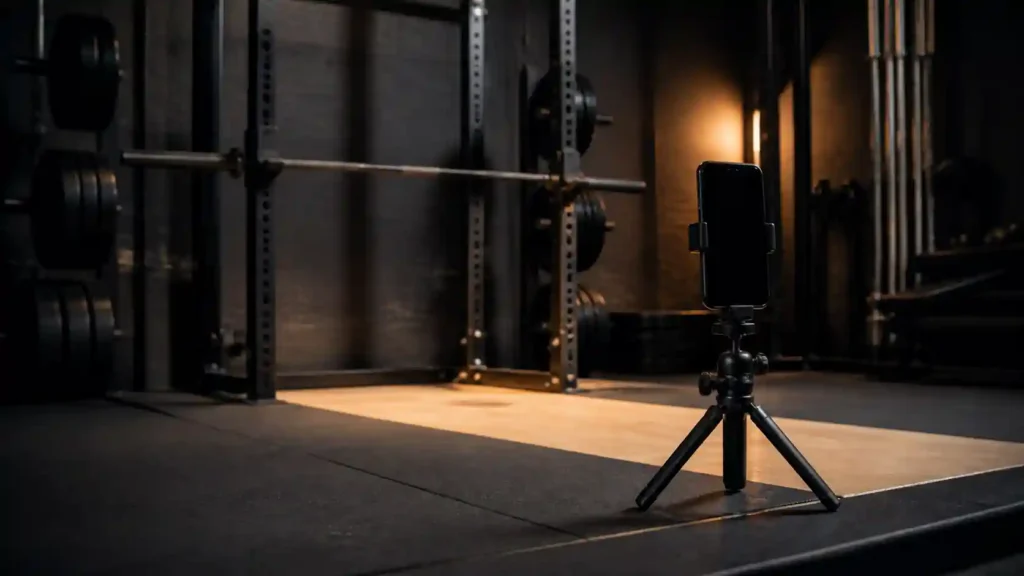
Most people do not need to be filmed to notice the possibility of being filmed. A phone on a tripod can change the temperature around a platform. Someone may wait to walk through the frame, avoid a useful station, or wonder whether they will appear in a stranger’s clip.
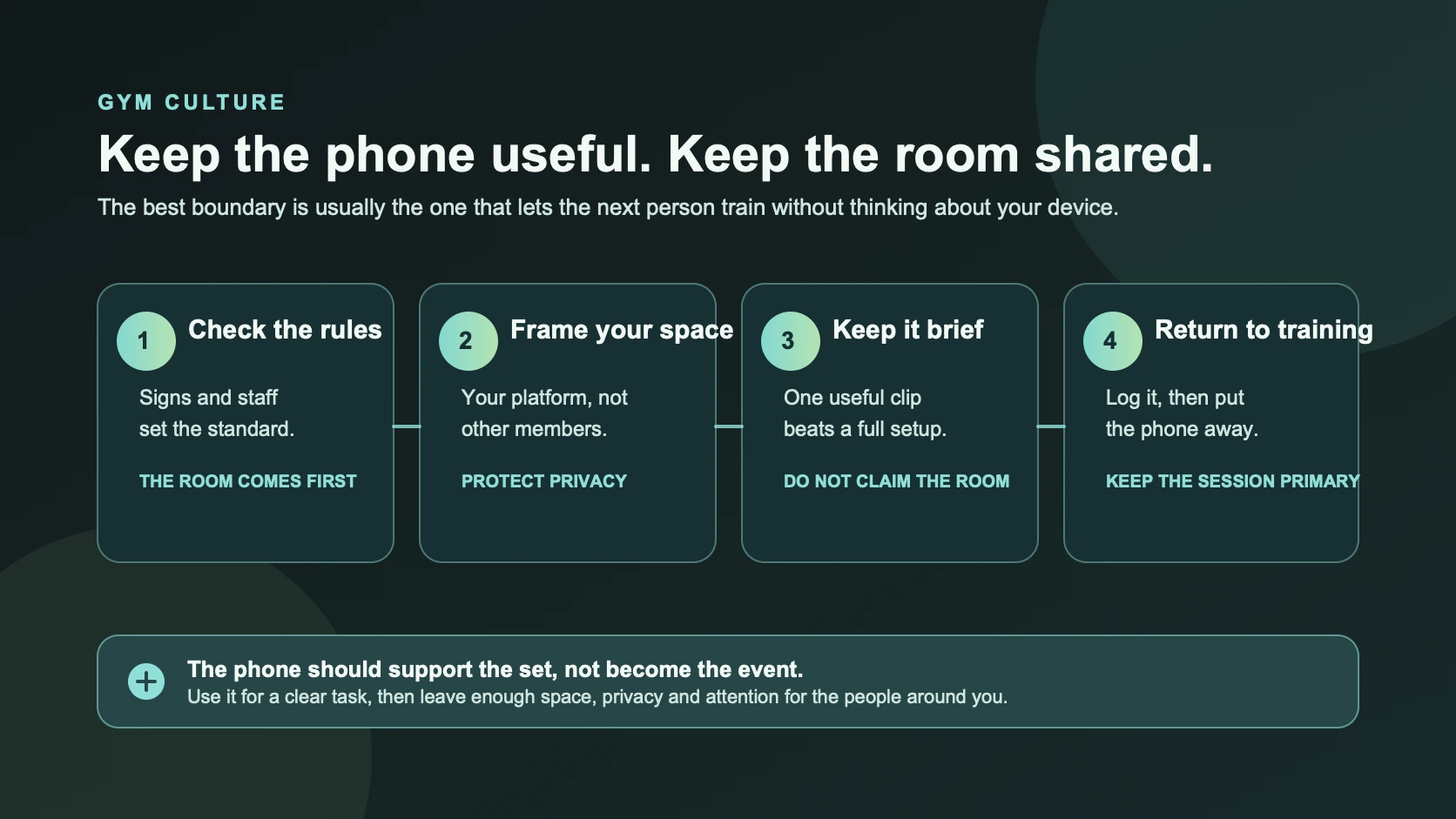
That does not mean recording a lift is automatically inconsiderate. A single side-angle video can be a sensible way to review a setup or send a coach a clear reference. The difference is whether the setup leaves room for everyone else. Is the camera placed out of the walkway? Is the frame limited to your platform? Is the session moving along normally? Are you following the facility’s policy?
The practical norms in Gym Etiquette Is Mostly About Not Being That Person apply here too. Shared equipment and shared attention work best when each person makes the next move obvious. A short recording that does not block anyone is one thing; claiming a popular station until the lighting, angle and audience feel right is another.
Comparison is now part of the background noise
Before social media, comparison was usually limited to the people in the room. Now every rest period can introduce a personal record or physique from somewhere else. That can be entertaining or instructive, but it can also make a normal working set feel less important.
The evidence does not support a simple rule that comparison always helps or harms. A 2020 meta-review of social-comparison features in physical-activity apps found that comparison was defined and used in widely different ways, making its effects difficult to generalize. A leaderboard, a lifting clip and a training group are not the same experience.
Use the feed for a question, not as the soundtrack to every set. You might save one setup cue to try during a planned review, or follow a coach whose explanations improve your understanding. You do not need to compare your ordinary session with a stranger’s selected moment while you are halfway through it. The article Why the Best Gyms Feel Like Communities, Not Businesses makes the wider point: a good room lets people train at different levels without turning every difference into a status contest.
Local rules are more useful than online certainty
There is no universal filming rule for every gym. A private strength club, a university facility and a busy commercial gym can set very different expectations. Read the signs, ask staff when the policy is unclear, and accept that the answer may be no in a particular room. An online creator’s routine is not permission to copy it in every facility.
The same applies to advice seen on a feed. A clip can give you an exercise idea, but it cannot tell you whether the equipment is free, whether the floor is suitable, or whether the technique suits your current experience. Keep the small lesson if it fits. Leave the performance pressure behind.
If someone else’s filming, comments or behavior makes the room difficult to use, you do not need to become the moderator. Use staff for repeated privacy, access or harassment problems. For ordinary sharing questions, direct and neutral language is enough: "Are you still using this?" or "Can I get through here?" A gym is better when members can solve small problems without turning the session into a confrontation.
The goal is a room where people can still be ordinary
Social media has widened the gym’s social world. It can bring useful instruction and community into a place that once felt closed off. It can also make strangers feel like accidental extras in a private post.
Keep the useful part: the log, timer, single technique clip and online connection. Then protect the older value that matters just as much: a room where people can do a normal session without being evaluated, interrupted or captured for somebody else’s audience.
FAQ
Is it rude to film a set in the gym?
Not automatically. Follow the facility policy, keep the frame on your own area, avoid blocking access, and treat other members’ privacy as more important than getting a perfect clip.
Can social media make the gym more welcoming?
It can. Online groups and clear educational content can help people find support or understand a new activity. The benefit depends on the content, the people involved and whether the online experience makes the real training space easier or harder to share.
What should I do if someone films me without asking?
Start with the gym’s staff and policy. You can state your concern directly if it feels safe to do so, but staff are better placed to handle repeated or escalating problems.
Continue with a related guide
For practical rules that keep shared equipment and attention manageable, read Gym Etiquette Is Mostly About Not Being That Person. For the culture that helps people train at different levels without unnecessary pressure, continue with Why the Best Gyms Feel Like Communities, Not Businesses.