

The hardest repetition in a set is not always the one you fail. Sometimes it is the one you could probably grind out, but choose not to attempt because it would turn a planned working set into a different kind of effort.
That decision can look unremarkable from across the gym. You re-rack the bar with one or two repetitions still possible, record the set, and move on. No dramatic collapse, no shouted final rep, no proof for anyone watching. But if the set had a defined purpose, stopping there can be more disciplined than chasing the last possible repetition.
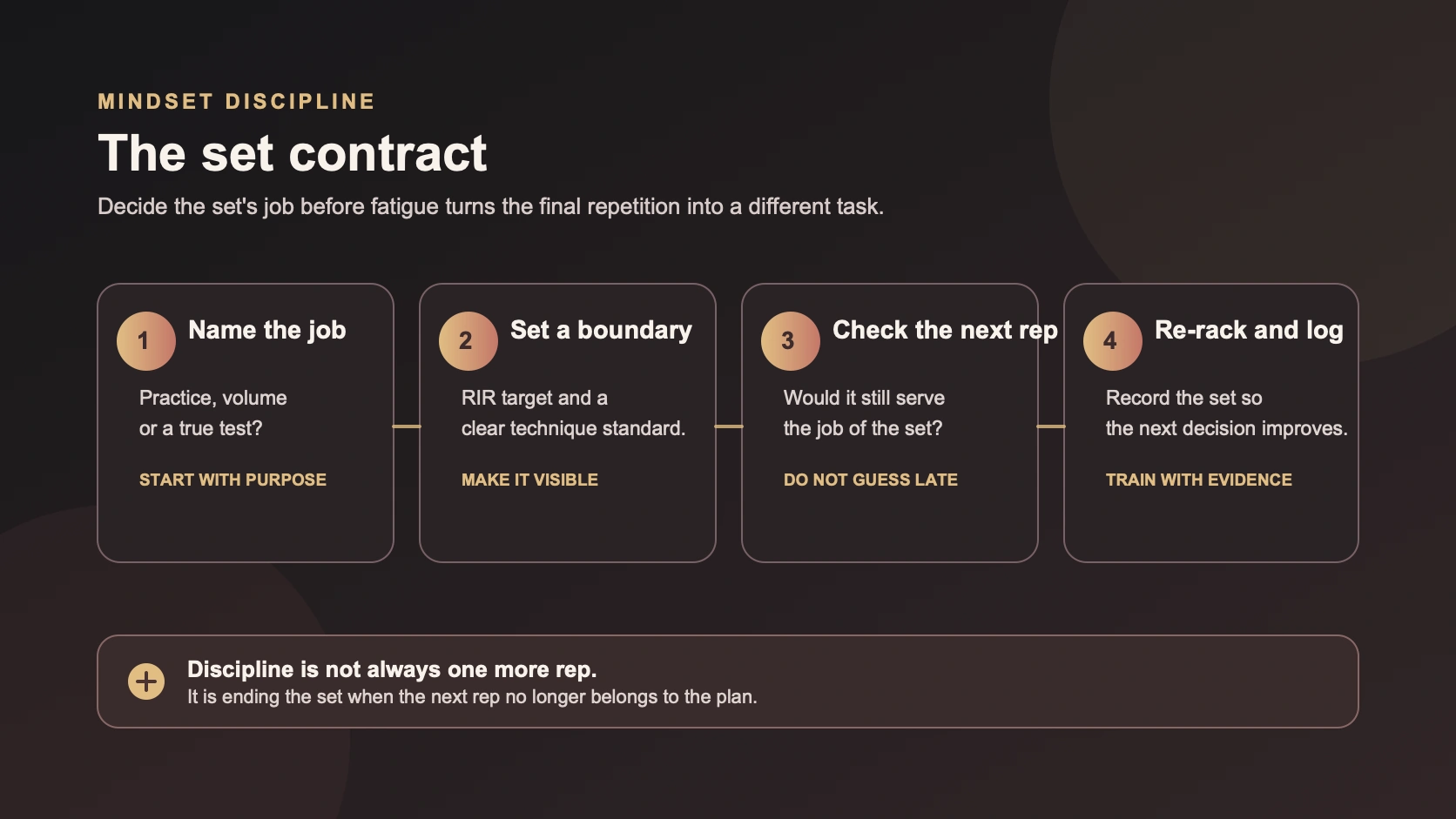
This is not an argument for stopping whenever training becomes difficult. It is an argument for deciding what a set is meant to do before fatigue makes the decision for you. A technical practice set, a volume set, an isolation exercise and a genuine test do not need the same ending. Discipline is matching the ending to the job.
- Why stopping early is not automatically quitting
- Give the set a job before you begin
- Use effort and technique as boundaries
- Know when the next repetition changes the set
- Log the decision without making excuses
A set does not have to end at failure to count
There is a persistent idea that a set only becomes meaningful at the point where another repetition is impossible. That can make every hard set feel like a character test: re-rack early and you were soft; grind until the bar stops and you were committed. It is a poor way to run most training.
Failure is one tool, not the definition of effort. A 2021 systematic review and meta-analysis of failure versus non-failure resistance training found that training to failure was not required for gains in strength or muscle size. Results varied by volume, training status and study design, which is exactly why a simple rule such as "always go to failure" does not fit every set.
Stopping before failure also gives you information. It tells you that you followed a target rather than waiting to discover the limit by accident. That can make the next set, next session and next week easier to compare. You are not trying to prove you could survive one more repetition. You are trying to perform the amount of work the plan asked for at a quality you can repeat.
Decide the job before the bar leaves the rack
The same load can have different jobs on different days. A squat set might be technical practice with a strict depth and bracing standard. It might be a moderate volume set where you want several consistent repetitions. It might be the final hard set of a block, where getting close to the limit is intentional. The load alone does not tell you when to stop.
Name the job in plain language before the set. For example: "five controlled reps with two reps in reserve," "three fast reps without a grind," or "a hard set while keeping the same setup." You do not need to announce it to the gym. You need a standard you can recognize when the set becomes difficult.
This is why The Difference Between Training Hard and Making Every Session a Test matters. A test set is designed to answer how much you can do today. A work set is designed to create a repeatable training stimulus. Both can be demanding, but confusing them leads to unnecessary fatigue and poor decision-making.
Effort targets are boundaries, not a performance of certainty
Repetitions in reserve, or RIR, is one useful way to describe proximity to failure. A target of two RIR means you finish when you judge that roughly two more repetitions could have been completed under the same standard. It is an estimate, not a lie detector.
The research literature is appropriately cautious. A 2022 review of proximity-to-failure methods notes that failure itself is defined differently across studies and that RIR, velocity loss and percentage-based prescriptions all have limitations. A more recent scoping review of RIR scales found that RIR can be useful for prescribing and adjusting intensity, while also noting that the estimate is individual and becomes more accurate closer to failure.
That uncertainty is not a reason to abandon the tool. It is a reason to use it honestly. If your program calls for two RIR and the fourth rep is already a slow grind with a changed setup, you do not have to force a fifth rep just to make the number look brave. Record what happened. Over several comparable sessions, your estimates will become more useful than a single perfect-looking set.
Technique is a boundary, not a beauty contest
No lift is mechanically identical on every repetition. A hard squat may be a little slower than the first repetition. A bench press may need more concentration as fatigue rises. The goal is not to stop at the first sign of effort or chase an imaginary perfect rep.
The useful question is whether the next repetition would require a change that breaks the standard you chose. Maybe the brace disappears, the range of motion shortens, the bar path becomes unpredictable, a spotter must take over, or a movement that was controlled becomes a gamble. When that happens, the set has changed jobs. It is no longer the practice or volume work you planned.
This boundary is individual. A beginner may stop as soon as the setup starts to unravel because every good repetition is valuable practice. An experienced lifter may intentionally use a harder final set in a safer exercise. The common rule is not a particular RIR number. It is that the standard is chosen before the fatigue arrives.
Re-rack, record, and use the result
Stopping early only becomes an excuse when it is disconnected from a reason and never reviewed. Re-racking because you felt uncomfortable, then changing the explanation every week, does not build confidence. Re-racking because you reached the planned RIR or technical boundary, then recording the result, does.
Keep the log short: load, repetitions, effort estimate and one relevant note. If you stopped after six reps with two RIR because the bar slowed more than expected, write that. If you stopped because your form changed, write that. The note lets you distinguish a sensible boundary from a repeated problem that needs a programming adjustment.
RPE and RIR Are Measuring the Same Problem From Different Angles explains how these tools can help make effort visible without pretending they are laboratory instruments. The useful outcome is a better next decision, not a more impressive description of how hard the set felt.
The same attitude appears in The Difference Between Failure and Feedback. If a stop happens earlier than planned, first describe it accurately. Then check the context before deciding whether you need to repeat the load, adjust the plan or simply accept that the day gave you a different but still useful result.
Keep the safety line obvious
Do not use a discipline article to talk yourself through sharp or worsening pain, dizziness, numbness, new weakness, a failed safety setup or a movement that suddenly feels unsafe. Stop the set. Get appropriate individual guidance when symptoms or circumstances call for it.
For ordinary training fatigue, the decision is simpler. Stopping a set with work left in reserve can be the disciplined option when it protects the purpose of the session. You are not avoiding effort. You are choosing where the effort belongs.
Conclusion
The discipline to stop a set early is the discipline to follow a plan when ego offers a louder alternative. Define the job, choose an effort and technique boundary, and re-rack when the next repetition would turn the set into something else.
Over time, that restraint builds a cleaner log, more repeatable sessions and better judgment about when a real test is worth taking. A set does not need to end in failure to be hard, useful or honest.
FAQ
Is stopping early the same as training too easily?
No. A set can be challenging and still end before failure. The question is whether it met the effort and technique target set for that exercise and day.
Should every exercise have the same RIR target?
No. The appropriate proximity to failure depends on the exercise, experience, goal, safety setup and place in the session. Use a target that makes the set’s job clear rather than applying one number everywhere.
Continue with a related guide
For a practical distinction between a work set and an unplanned test, read The Difference Between Training Hard and Making Every Session a Test. For a clearer way to interpret an uneven result afterward, continue with The Difference Between Failure and Feedback.