For a long time, fitness advertising sold a simple promise: change how you look. That promise still has a place. Wanting to feel more comfortable in your clothes or enjoy the way you look is not shallow, and no one needs to pretend otherwise.
But many people now want their training to do something they can use: a first pull-up, a calmer 5K, a stronger squat or the confidence to carry heavy things without making a ceremony of it. Those are performance goals. They give a session a job beyond waiting for the mirror to offer a verdict.
Appearance has not disappeared from fitness culture. Many lifters simply find becoming capable of something previously out of reach deeply satisfying.
- Why output is easier to work with than appearance alone
- What performance goals actually look like
- How feedback makes a routine easier to repeat
- Why aesthetics and performance do not need to compete
Performance gives training a job
Appearance is a slow and noisy score. Sleep, food, lighting, stress, hydration and plain old mood can all change how you think you look on a given day. None of that means visual goals are invalid. It means they are a difficult way to decide whether Tuesday’s session was worth doing.
Performance offers smaller signals: a steadier warm-up, better control, or a familiar weight needing less mental negotiation. That feedback can shape the next decision.
That matters because training works best when it fits into ordinary life. In Fitness for People With Actual Lives, the useful question is not whether a plan looks impressive on paper; it is whether you can repeat it through a normal week. A performance goal can make that repetition more concrete. Instead of vaguely trying to "get in shape," you are practising a lift, a pace, a skill or a capacity you can describe.
Research on exercise motivation does not say that everyone needs the same target. It does suggest that autonomous motivation and a sense of competence are meaningful parts of sustained activity. A 2025 review of self-determination theory research for physical activity describes how support for basic psychological needs, including competence, can help explain motivation. In plain gym language: people are more likely to return when the work feels like something they chose and can learn.
The goal does not need to be dramatic
"Perform" can sound like a word reserved for athletes, competitions or people who own more than one lifting belt. It is not. A performance target can be deliberately modest:
- Do three controlled push-ups from the floor.
- Add one clean rep to a set you have repeated for a month.
- Run or walk a familiar route at an easier effort.
- Learn to brace before a squat instead of treating every rep as a surprise.
The point is not to turn every person into a tracking project. The task can change with the season, available time and the rest of your life. Someone with a busy job may care more about leaving the gym with energy than chasing a personal record.
This is also why the phrase "functional training" is more useful when it is made specific. What Does Functional Training Actually Mean? argues that an exercise is functional when it helps with a real task you value, not because it comes with a fashionable label. The task is the anchor. The exercise is the tool.
Feedback makes the next session less mysterious
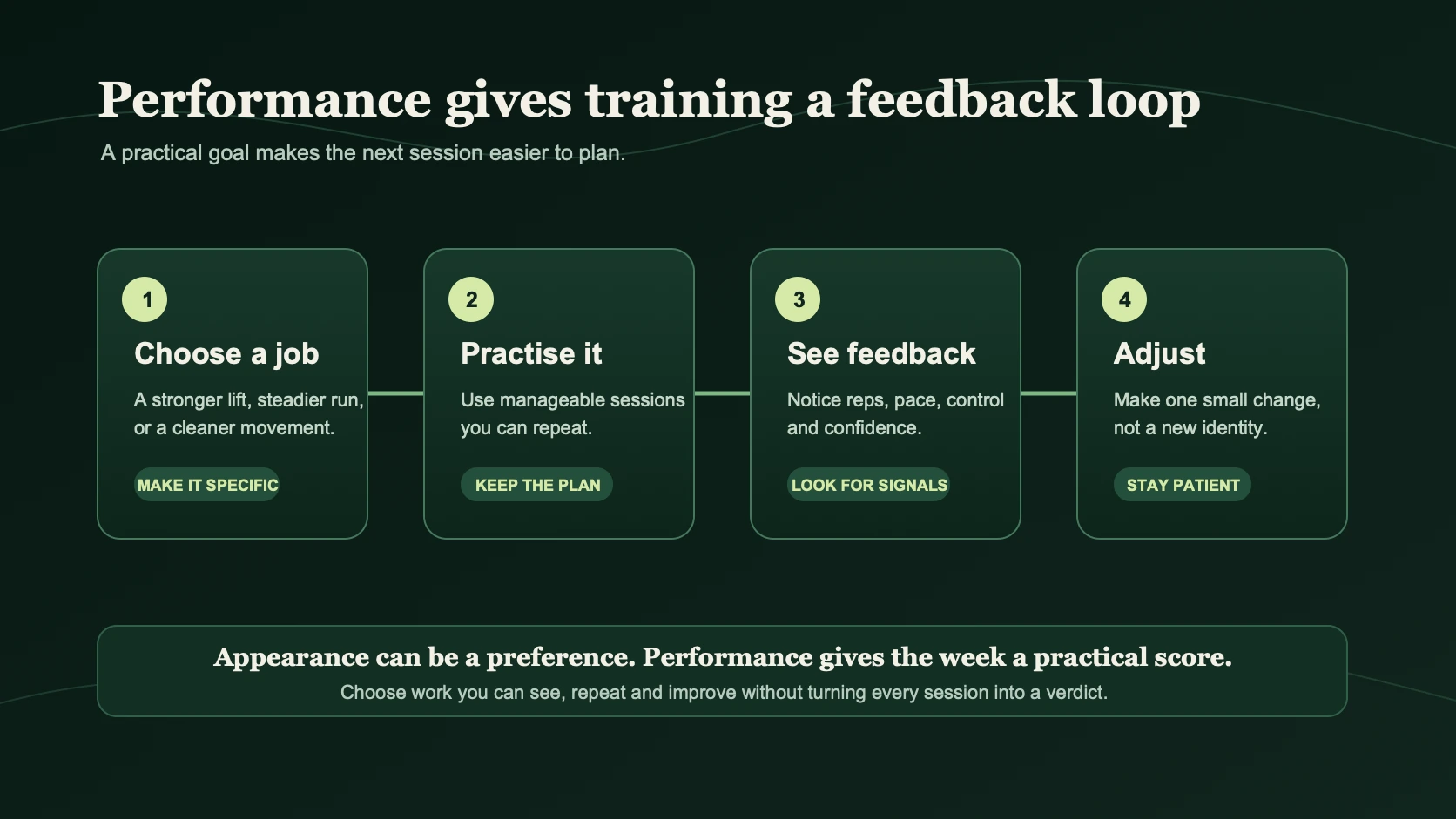
Good performance goals create a loop. You choose a job, practise it at a level you can recover from, notice what happened, then make a small adjustment. The adjustment might be another rep, a little more range of motion, a slower descent, an extra minute of easy cardio or simply the decision to keep the same setup for another week.
That is less exciting than a total reinvention. It is also more useful. A systematic review and meta-analysis found that goal setting, self-monitoring and behavioural practice were among approaches associated with helpful motivational changes. Read the review on motivation and physical activity as support for a simple feedback process, not a requirement to log every breath.
The loop protects you from a common mistake: mistaking novelty for progress. If the program changes every time motivation dips, you never learn whether the previous work was starting to pay off. The article Why Slow Progress Is Still Progress makes the case for giving ordinary improvements enough time to become visible. A cleaner rep and a more reliable week are not consolation prizes. They are the material progress is made from.
Aesthetic goals can stay, but they do not have to carry everything
There is no need to pick a side between performance and appearance. Strength training may improve dimensions of body image for some adults, though the research is not a guarantee; see this systematic review of resistance training and body image. Appearance is personal. You do not need to justify caring about it.
The problem is asking appearance to do every job: to prove that a workout counted, settle your confidence, provide daily motivation and determine whether you are "fit." That is a lot of weight for one changing signal to carry.
Performance distributes the score. Your body can be part of the story, but so can technique, consistency, strength, conditioning and coordination. That broader scorecard gives you more than one way to notice that the work is working.
Build a scorecard you can live with
Start with one or two targets that matter in your actual week. Make them observable but not obsessive. A useful goal should help you choose today’s work, not turn every workout into an exam.
You might want a stronger deadlift because you enjoy learning the lift, better walking fitness for weekends, or a first pull-up for upper-body direction. Leave room for the goals to evolve.
Looking fit can be part of why you train. Performing well gives that training a language of its own: what you can do, what you are practising and why you will return tomorrow.
FAQ
Does training for performance mean I should stop caring about aesthetics?
No. Aesthetic goals are personal and valid. Performance goals simply give you additional feedback that is often easier to use from session to session.
What is a good performance goal for a beginner?
Choose one clear task that fits your current ability, such as learning a controlled push-up, completing two consistent strength sessions a week or walking a route with less effort. Make it repeatable before making it ambitious.
Do I need to track every workout to train for performance?
No. A simple note, a remembered rep target or a familiar route can be enough. Track only what helps you make a calmer next decision.
Continue with a related guide
For a training framework that fits around work and normal responsibilities, read Fitness for People With Actual Lives. For a practical way to choose movements around real tasks, continue with What Does Functional Training Actually Mean?.