“Functional training” is one of the most common labels in fitness and one of the least precise. It can be used for a kettlebell circuit, a balance drill, a barbell squat, a sled push, a bootcamp class, or almost any exercise that does not look like a bodybuilding isolation movement. That makes the label sound useful while often saying very little.
The better question is not whether an exercise is functional in the abstract. It is functional for what? Carrying groceries, improving a five-kilometre run, getting stronger in a squat, moving through a long workday with more capacity, or returning to a hobby all make different demands. A movement earns its place when it helps a clearly named goal and fits the person, the program and the week.
That is less exciting than a new category of exercise, but it is much more useful. Functional training is not a collection of tricks. It is a way to judge whether the training you are doing has a job.
- Why the term became confusing
- What a useful definition looks like
- Why specificity matters more than novelty
- How ordinary exercises can be functional
- A practical filter for your own program
The label is broader than the promise
Functional training is often presented as an alternative to “traditional” strength training. The contrast usually implies that machines, barbells, or repeatable lifting patterns are somehow less useful for real life than unstable surfaces, mixed circuits, or exercises that look more athletic.
That contrast does not hold up well. A 2022 conceptual review of functional training found no universal agreement on its definition and argued that the programs and benefits commonly attributed to it overlap with established strength, power, mobility and aerobic training. The issue is not that kettlebells, carries, jumps or circuits are bad tools. It is that none becomes automatically better because the word “functional” is attached.
The term has become clearer, but not narrower. A 2025 international expert consensus defined functional training as an approach intended to improve human performance according to an individual goal in sport, daily life, rehabilitation or fitness, while considering task specificity and individual response. Read the consensus statement for its full scope and limitations. The practical part is simple: the goal comes first, then the exercise choice.
For a general trainee, that means you do not need to defend a squat, row, push-up or brisk walk as “real-world” enough. You need to know what ability you are trying to improve and whether the training can be performed, progressed and recovered from.
Specificity gives the word a real meaning
Training adaptations are not infinitely transferable. Practice improves the qualities and tasks you repeatedly ask the body to perform. That does not mean every exercise must copy an everyday movement exactly. It means the exercise should build a quality that has a credible connection to the task you care about.
For someone who wants to get up a hill with less effort, regular walking, uphill walking, cycling or another repeatable aerobic option may be more specific than an elaborate balance circuit. For someone who wants to be more capable with a suitcase or heavy shopping bag, carries and general strength work can be sensible. For someone whose goal is a stronger barbell squat, squatting and relevant supporting work deserve priority over endlessly changing the movement to look more “functional.”
A 2025 systematic review and meta-analysis of task specificity included 43 studies and 1,660 participants. Dynamic resistance training improved dynamic strength more than it transferred to untrained isometric tests. That result does not mean exercises never carry over to anything else. It is a reminder that the closer your goal is to a particular task, the more useful it is to practice the qualities of that task rather than hoping a vaguely athletic exercise will cover everything.
Ordinary training can be highly functional
An exercise does not need to be complicated to serve a real-life goal. A simple goblet squat can build leg strength through a controlled range. A row can train pulling strength and trunk control. A walk can build a repeatable aerobic habit. A deadlift variation can be useful when it is taught, loaded and progressed appropriately for the person doing it.
The reverse is also true. An unusual drill is not automatically functional because it requires coordination or uses several pieces of equipment. If a person cannot explain what it is meant to improve, cannot keep technique stable, and cannot tell whether it is progressing, the drill may be entertainment rather than a useful training choice.
This is where the basics deserve more respect. The Anatomy of a Great Strength Program starts with clear movements, enough practice and a manageable progression. Those are not “less functional” than a circuit. They are the structure that makes a circuit, a carry, or a sport-specific drill easier to judge.
Functional does not mean unstable
Balance work can have a specific role. So can single-leg exercises, loaded carries, medicine-ball throws, sled work and mixed conditioning. The problem starts when instability is treated as a universal upgrade. Making an exercise less stable usually changes the task and may reduce the load or technical quality you can use. Sometimes that trade is worth it. Sometimes it distracts from the quality you actually intended to train.
For example, a person who needs confidence stepping, changing direction or moving over uneven terrain may benefit from carefully chosen balance and single-leg work. A lifter who wants to improve a heavy squat may get more direct value from stable squatting, sensible accessory work and a program they can repeat. Both can be functional because their jobs are different.
Do not use the label to force an exercise through pain, poor control or a setup that feels unsafe. This article cannot assess an injury, condition or individual movement limitation. Persistent pain, swelling, dizziness, or symptoms that change normal movement call for appropriate professional guidance rather than a more creative circuit.
Build the smallest useful bridge to the goal
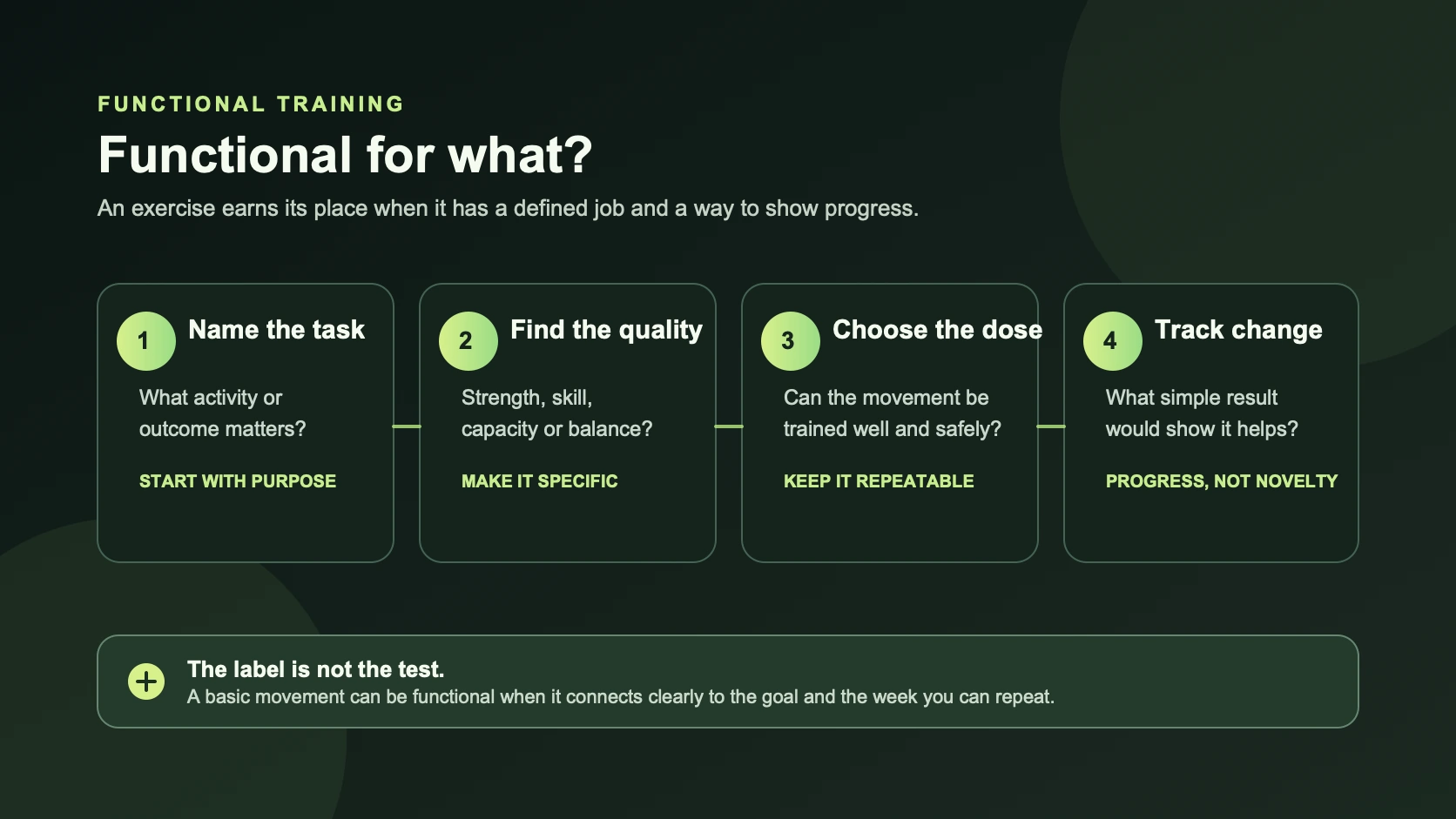
Start with the activity that matters. Then identify the quality that seems to limit it: general strength, aerobic capacity, repeated practice, balance, power, or simply the ability to do the activity consistently. Choose an exercise or session that plausibly trains that quality. Finally, decide how you will know whether it is working.
This process gives a program a bridge instead of a slogan. If you want to walk longer without your week falling apart, begin with walking often enough to learn what a sustainable amount looks like. Walking vs Running for General Fitness shows how the practical trade-off is time, demand and repeatability, not which identity looks more serious. If you want more strength for ordinary tasks, a basic strength plan with a few well-chosen carries may be a better bridge than a random circuit of new exercises every session.
The same rule applies to fitness classes. A class can be functional if it gives you consistent training that matches your goal and leaves room to recover. It does not need to include every physical quality in one hour. A program can be useful while remaining incomplete; you can add walking, strength work or a skill session elsewhere in the week.
Progress is the test, not the exercise name
Functional training still needs progression. You might add a little walking time, use a slightly more demanding route, complete more controlled repetitions, carry a manageable load farther, or improve the consistency of two weekly sessions. The progression should fit the task, not satisfy a need for constant novelty.
Keep the changes small enough to learn from them. If you replace every exercise, add intensity, shorten rest and increase weekly frequency at once, you cannot tell what improved or what created more cost. A stable plan is not boring in a bad way; it is how you notice whether the bridge to the goal is actually holding.
For most people, the functional choice is the one that remains visible during an ordinary week. That is why Fitness for People With Actual Lives emphasizes a plan built around work, family and available energy. An impressive session that cannot be repeated has less practical value than a modest one that becomes a habit.
Conclusion
Functional training is not a special category of equipment or a requirement to make every session look athletic. It is a practical question: does this training improve a quality that matters for the person and task in front of you?
Name the goal. Choose a movement or session that trains a relevant quality. Keep the dose manageable. Track a simple sign of progress. Under that definition, a barbell squat, a carry, a walk, a push-up or a circuit can all be functional. None earns the label by appearance alone.
FAQ
Is functional training better than regular strength training?
Not as a separate category. Regular strength training can be highly functional when it serves a defined goal. The useful comparison is between a well-matched program and one that has no clear purpose, not between fashionable equipment and basic exercises.
Do I need unstable exercises for functional fitness?
No. Instability is a tool with a specific cost and benefit, not a universal requirement. Use it when it practices a quality you need; otherwise, stable training may be a clearer way to build strength or skill.
Can beginners do functional training?
Yes. Beginners usually benefit from the clearest version: simple movements, a modest dose, repeatable sessions and a way to see progress. Complexity can be added only when it serves the goal.
Continue with a related guide
For the structure behind a clear strength plan, read The Anatomy of a Great Strength Program. For a practical model of repeatable general fitness, continue with Fitness for People With Actual Lives.