Treadmill versus outdoor running is often treated as a test of toughness. The treadmill is called boring; the road is called the only real option. Neither label helps someone deciding where to put a repeatable run in a normal week.
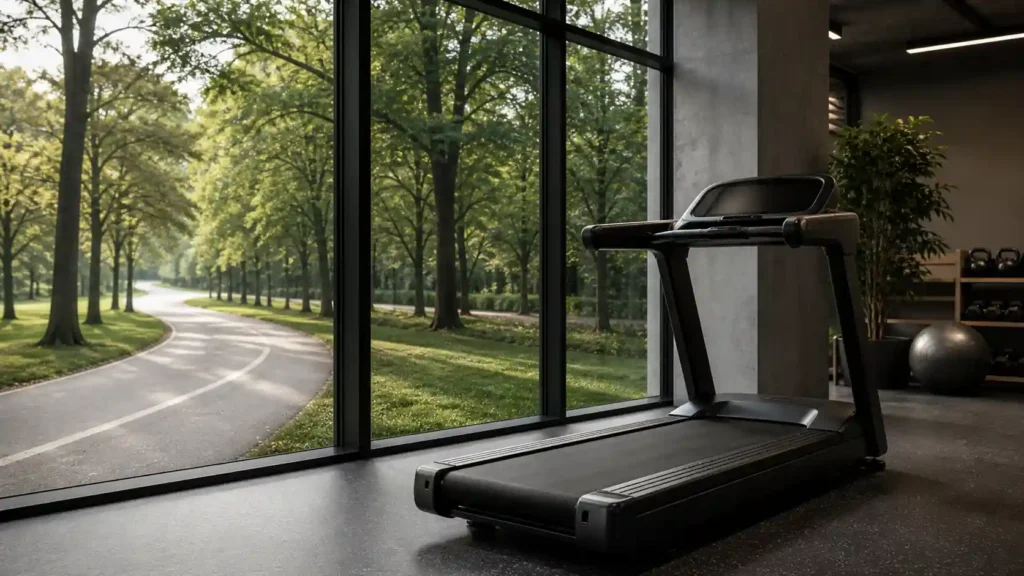
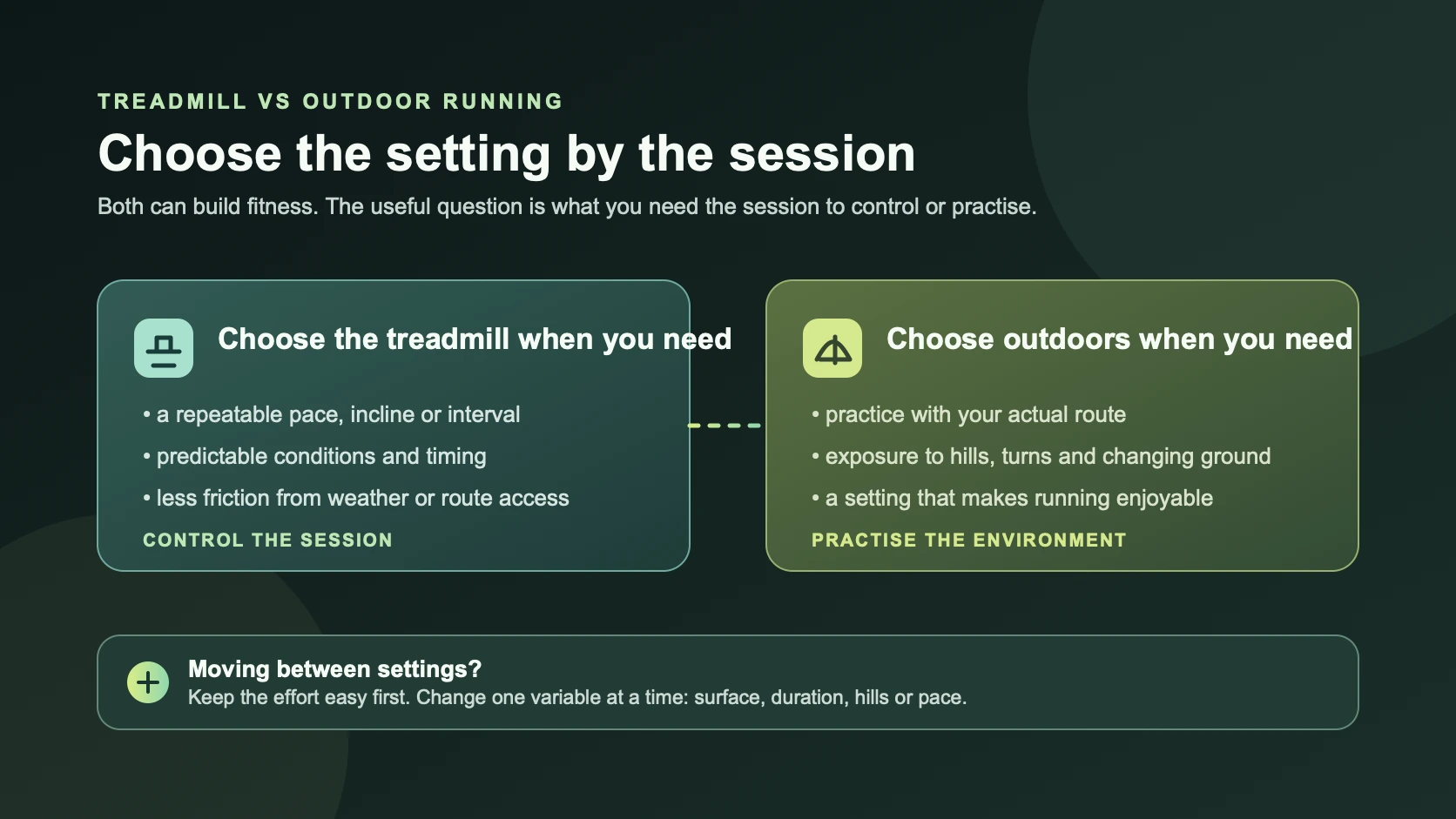
Both settings can build aerobic fitness. The important difference is not whether one counts. It is what each setting lets you control, what it asks you to adapt to, and whether it fits the session you actually planned. A treadmill makes speed, incline, temperature and timing easier to repeat. Outdoors adds changing ground, turns, wind, hills, traffic and route decisions. Those are different training environments, not rival identities.
- What stays similar and what changes
- When a treadmill is the better tool
- When outdoor running is the better tool
- How to move between the two
- How to make the choice fit your week
The work is similar, but the setting has a job
At a comparable effort, both a treadmill and an outdoor route ask you to run. The useful distinction is not that one secretly produces an entirely different form of fitness. A systematic review and meta-analysis of 33 crossover studies found that most biomechanical outcomes were broadly comparable between motorized treadmill and overground running, while also finding some small, condition-specific differences around foot strike, knee motion, contact time and propulsion. Read the systematic review of treadmill and overground running for the methods and limits.
That is a more useful conclusion than declaring a winner. A motorized belt moves beneath you; an outdoor route does not. A route may rise, fall, turn, change underfoot or become windy. A treadmill removes much of that variability and lets you repeat a pace or grade without checking a watch every few seconds. Neither environment is automatically closer to your goal. The right one depends on whether you need control or exposure to the conditions you will meet outside.
Do not turn a setting on the machine into a magic conversion formula. You may have heard that a fixed incline makes treadmill running equal to the outdoors. Research conditions, wind, surface, belt design, pacing and the individual runner all vary too much for a single number to settle that question. Use incline because you want to train an incline, make a session more demanding, or vary a familiar routine, not because it grants an exact outdoor-equivalence stamp.
A treadmill is useful when consistency is the goal
A treadmill is a strong tool when removing variables makes the session more likely to happen. Dark mornings, heavy rain, unfamiliar streets, a short window between commitments or the need to hold a gentle pace can all make an indoor run the sensible choice. There is nothing second-rate about using the option that lets you train instead of negotiating with the weather.
It is especially useful for a controlled session. You can hold an easy conversational pace, repeat short intervals with a known recovery, or learn what a modest incline feels like without guessing about hills. That control can be valuable when running is new, when you are returning after a break, or when the running work needs to coexist with strength sessions. The aim is not to make every run perfectly measurable. It is to make the dose clear enough that you can adjust it next time.
The treadmill can also make a small running habit less fragile. If you are fitting exercise around work, lifting and family, a predictable 25-minute run may be more valuable than waiting for an ideal outdoor route. That same principle anchors Fitness for People With Actual Lives: the plan should work in the week you actually have, not only in the week you imagine.
There are practical limits. Treadmill pace is not always comfortable on day one, and staring at the same wall can make a longer run feel mentally flat. Use music, a simple interval structure, a change in incline or a shorter session when those details make the habit easier. Do not force yourself to enjoy an environment simply because another runner says it is more efficient.
Outdoor running is useful when the route matters
Running outside gives you practice with the conditions that a route actually contains. You adjust to curves, gradients, irregular surfaces, wind, temperature and the small pace changes that happen around other people. That makes outdoor running the more specific choice if you want to enjoy local routes, participate in a road event, or simply prefer moving through a changing environment.
The variation is part of the appeal, but it also changes the planning. A pace that feels easy on a flat treadmill may feel different on a hot day, a long hill or a crowded path. Let effort, breathing and the ability to keep good form matter more than forcing a familiar number from the treadmill display. If the route is hillier or the weather is harder than expected, slowing down is an adjustment, not a failure.
Outdoor running also deserves ordinary safety planning. Pick a route and time that feel appropriate, follow local path or road rules, use lights or visible clothing when conditions call for them, and leave the headphones low enough to notice your surroundings. These are not performance hacks. They are the details that help the run remain a repeatable part of life.
If outdoor running is new to you, start with an easy route before adding distance, hills and pace at the same time. The goal of the first few outings is familiarity: learn how the surface feels, how long the route takes and how you feel later that day. There is no prize for making the first run outside a test.
Move between settings without making the switch dramatic
You do not have to choose one setting forever. Many people use a treadmill for a controlled weekday session and head outside when time, weather and daylight make it enjoyable. The transition becomes simpler when you change one variable at a time.
For example, a runner used to the treadmill can keep the first outdoor session easy and similar in duration rather than adding hills or intervals. A runner used to the road can use the treadmill for a short easy run first, then learn how the chosen pace feels before attempting a hard workout. This approach is less dramatic than jumping from one environment to the other at maximum effort, but it gives you feedback you can use.
The 2020 review does not say that every runner should expect the same response. Its findings describe averages across studies, different treadmills, surfaces and participants. Your useful feedback is more ordinary: did the planned effort feel sustainable, did the session fit the rest of the week, and do you want to do it again? That is enough information to guide the next choice.
Build the running choice around the rest of your training
Running does not sit outside the rest of a program. If you also lift, place harder running and demanding lower-body work where the combined week stays manageable. An easy treadmill run after an upper-body session may be fine for one person; a hilly outdoor run before a heavy leg day may not fit another. The answer is not a universal sequence. It is knowing which sessions you want to be fresh for. The CDC’s adult activity guidance treats aerobic and muscle-strengthening work as complementary weekly categories, which is a useful reminder to plan the whole week rather than judge one run in isolation.
How to Make Strength Training Part of Your Life offers the wider planning rule: build the schedule around the priorities and constraints that are real, then give the smaller habits a place they can survive. A run that repeatedly disrupts sleep, strength work or the rest of the week may need a shorter route, easier pace, different day or different environment.
For general fitness, begin with the setting that removes the most friction. If the treadmill gets you moving consistently, use it. If an outdoor route makes the run feel like time you look forward to, use that. Keep the other option available as a tool, not as a judgment about what kind of runner you are.
Stop exercise and seek appropriate professional guidance for chest pain, fainting, unusual shortness of breath, or pain and swelling that alter normal movement. This guide cannot assess your medical history, medication, injury or personal readiness for running.
Continue with a related guide
For a practical framework for fitting training around a normal schedule, read Fitness for People With Actual Lives. To place running beside a longer-term strength habit, continue with How to Make Strength Training Part of Your Life.