Velocity-based training, usually shortened to VBT, uses the speed of a lift as training data. A device records how quickly the bar moves, often during the concentric portion of a repetition. The appeal is obvious: instead of guessing whether a load is unusually heavy today, you have a number beside the set.
That number can be useful. It can also be a very expensive way to create noise. Bar speed is affected by the exercise, range of motion, device, setup, load, technique, intent and the metric the device reports. A fast-looking repetition is not automatically a good session, and a slow one does not diagnose fatigue, poor recovery or a problem that needs medical attention.
The practical question is smaller: can a repeated bar-speed measurement help you make a better decision in this session or the next one? If the answer is yes, VBT has a place. If the number only makes you chase a display, the logbook is probably enough.
- What bar speed is actually measuring
- What research says about VBT outcomes
- When a velocity number becomes comparable
- What VBT cannot tell you
- How to use it without replacing good programming
Bar speed is a measurement, not a verdict
Most VBT systems report a speed value for a repetition or set. Depending on the system and setting, that might be mean concentric velocity, peak velocity, or another device-specific measure. Those labels are not interchangeable. A number is only interpretable when you know exactly what was measured and how.
For a lifter, the most useful comparison is usually boring: the same movement, range of motion, equipment, device mode and lifting intent, repeated over time. Compare a high-bar squat to another high-bar squat with the same device. Do not treat it as directly comparable to a paused bench press, a machine press, or a reading from someone else’s sensor.
This is why VBT is best thought of as a measurement habit, not a universal language of strength. It can make a warm-up or work set more visible. It cannot turn unlike lifts into one clean leaderboard.
The research does not make VBT an automatic winner
The promise of VBT is not that it makes every program superior. It is that adjusting a load or stopping point from a live velocity measurement may make training more responsive than following a fixed percentage on paper.
A 2025 systematic review and meta-analysis comparing velocity-based and percentage-based resistance training included 17 studies and 348 participants. Across the included interventions, VBT showed small advantages for jump performance and change-of-direction performance. It did not show a statistically significant advantage for maximal strength or sprint performance. The pooled maximal-strength estimate was close to the threshold of significance, which is a useful reason to avoid claiming that a velocity device is the better way to get strong.
An earlier 2022 systematic review and meta-analysis had only four trials and 88 participants. Its certainty ratings were low or very low, and it did not find clear evidence that VBT produced different strength, power or sprint adaptations from traditional training. That smaller evidence base does not prove VBT fails. It means the confident marketing version of the claim is ahead of the evidence.
There are also more favorable findings. A 2022 meta-analysis of nine controlled studies in 253 trained male participants reported positive effects for several lower-limb strength and power outcomes. The sample and intervention details matter: trained males are not every lifter, and the studies did not all use the same device, exercise, adjustment rule or program. The practical reading is cautious: VBT may be a useful tool in a well-run strength plan, not a guaranteed upgrade purchased by itself.
Give the number one job
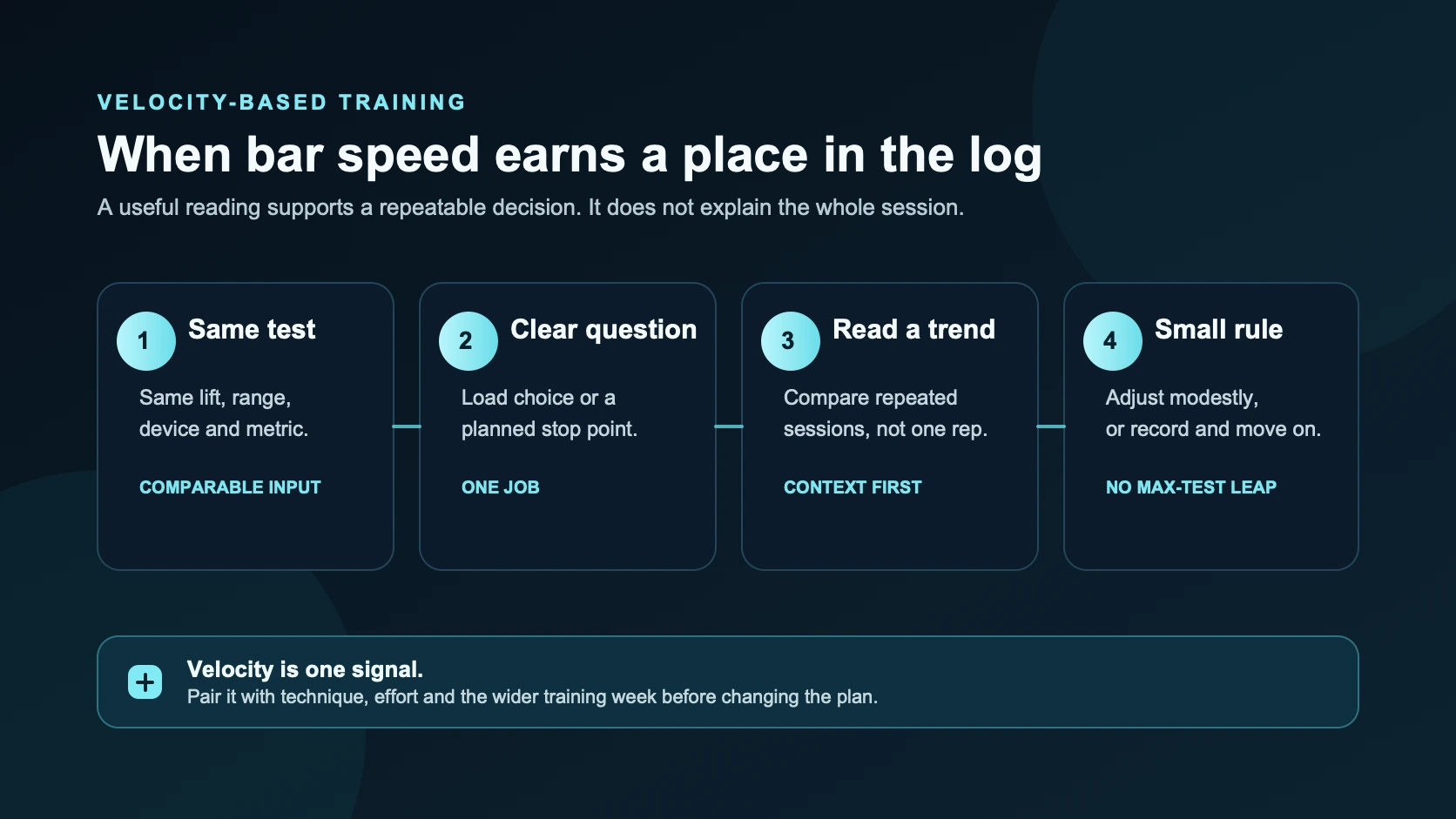
VBT becomes practical when it answers a prewritten question. For example: does a familiar warm-up load move unusually differently from the recent pattern under the same setup? Or: is the planned work load landing in the range this training block has repeatedly produced? Those are narrow questions with a useful next action.
The next action should be modest. You might keep the planned load, make a small adjustment, add a note to the session, or choose not to chase an extra set. The device is not telling you that you are ready for a max attempt. It is giving one more piece of context for a decision that still includes technique, effort, soreness, sleep, the rest of the week and the actual objective of the lift.
This fits the same logic as RPE and RIR Are Measuring the Same Problem From Different Angles. A set-level effort rating is imperfect but can be useful when you use the same language consistently. Bar speed can add another signal, but it does not make the effort rating obsolete. A slow rep with a messy setup can be bad data; a clean RIR note may explain more.
Trends matter more than a single reading
One velocity value is a snapshot, not a readiness diagnosis. A lower value may reflect a changed warm-up, a different pause, a different depth, a device position, a less aggressive intent, or ordinary day-to-day variation. The more conditions you change, the less the number can tell you.
The useful pattern is repeated comparable work. Log the exercise, load, repetitions, velocity metric, device setting and a short effort or technique note. After several sessions, you may see that a particular load is moving differently while the rest of the setup stays stable. That can prompt a question worth answering in the next week of training.
The same restraint applies to within-set speed loss. A drop in speed can describe what happened during that set, but it is not a universal fatigue meter. It cannot tell you how recovered you are as a person or decide the ideal number of sets for every exercise. The training-volume dose guide explains why additional work needs to be judged by its purpose and cost, not by one attractive metric.
VBT does not replace a program
The strongest use of VBT is inside a plan that already has a clear goal, exercises, rep ranges and progression rule. A lifter trying to improve a bench press still needs enough technical practice, appropriate loading and time. A velocity display cannot repair an unclear program or turn every session into a test.
For example, the Bench Press Blueprint starts with movement practice and a manageable progression. A VBT device could help an experienced lifter compare a repeated work set within that plan. It cannot choose grip, solve a technique issue, or tell the lifter to ignore an uncomfortable shoulder.
This is also where fixed percentages remain useful. Percentages create a simple shared prescription and are easy to plan. RIR, RPE and velocity can be ways to adjust that prescription when the rules are clear. The comparison in Percentages vs RPE shows why a paper target and a session-level adjustment can coexist. The goal is not to collect every metric; it is to use the smallest system that produces an honest decision.
A sensible first experiment
If you already have access to a reliable VBT device, pick one main lift and one stable point in the session. Use the same warm-up structure and record the same metric for a few weeks. Do not rewrite the whole program around the display. Decide in advance what would count as a meaningful observation and what small adjustment, if any, you would make.
If you do not own a device, you are not missing a requirement for productive strength training. A consistent log of load, repetitions, RIR or RPE, and technique notes can answer many of the same coaching questions at a lower cost. VBT becomes worth considering when it solves a real logging problem that those tools cannot solve well enough for you.
Conclusion
Bar speed becomes useful data when it is measured consistently and tied to a specific decision. Research leaves room for VBT to help some training outcomes, but it does not show that it automatically beats percentage-based programming for maximal strength. The studies are varied, and older evidence is small and uncertain.
Use the device to notice trends in comparable work. Pair it with technique and effort notes. Keep the adjustment small. That is enough for a velocity number to support training without pretending it can explain the entire session.
FAQ
Do I need a velocity device to get stronger?
No. A planned progression, sound technique, and a consistent log are sufficient for most lifters. A device is useful only if the extra measurement improves a real training decision.
Can bar speed tell me whether I am recovered?
No. It can be one observation from a comparable lift, but it cannot diagnose recovery, fatigue, injury or readiness. Consider the wider training context and seek appropriate support when symptoms affect health or movement.
Is velocity-based training better than percentage training?
Not automatically. Recent evidence found small advantages for some explosive outcomes but no statistically significant advantage for maximal strength. Either approach can work when it fits a clear program and is applied consistently.
Continue with a related guide
For a practical way to read effort alongside a training log, continue with RPE and RIR Are Measuring the Same Problem From Different Angles. To decide whether more work belongs in the program, read Training Volume Has a Dose — and More Isn’t Always Better.