A set of 20 controlled leg extensions can make a muscle work very hard. So can a set of 5 squats with a much heavier bar. The visible difference has led to a familiar gym argument: if both feel demanding, can lighter weights build as much muscle as heavy ones?
For muscle growth, the research points to a qualified yes. Lower-load and higher-load resistance training can produce similar average hypertrophy when the programs create enough demanding work. That does not mean the two styles are interchangeable in every way. Heavier loads are generally better practice for a one-repetition maximum, lighter sets often take longer and feel more uncomfortable, and an exercise still has to be stable enough to use well.
This article explains what the load-comparison reviews actually studied and how to make a sensible choice. It is for healthy adults, not a personal rehabilitation plan. Pain that changes your movement, a recent injury, unexplained weakness or dizziness deserves individual assessment instead of a new rep target.
- What the research is really comparing
- Why similar growth does not mean identical training
- Why strength still favors heavier loads
- How to choose a load for the job
- What the evidence cannot decide for you
What the research is really comparing
“Light” and “heavy” are research labels, not fixed dumbbells. A weight can be light relative to your one-repetition maximum and still make a long set difficult. In many studies, lower-load work is defined as at or below about 60% of one-repetition maximum, while higher-load work is above that threshold. The number of repetitions is another shorthand, but it is less exact because two people can reach fatigue at different repetition counts.
A 2021 systematic review and meta-analysis included 45 studies comparing higher-load and lower-load resistance training. The authors found similar hypertrophy outcomes across whole-body, whole-muscle and muscle-fibre measures. Higher-load programs produced greater average improvements in one-repetition maximum and isometric strength. Read the full review for the methods, effect estimates and variation among the included studies.
A separate 2022 systematic review and meta-analysis compared very low, low, moderate and high loads in volume-matched programs. Its pooled hypertrophy analysis also found no difference across load magnitudes, while the higher-load conditions favored dynamic maximal strength. The volume-matched review is useful because it asks a narrower question: what happens when the amount of work is made more comparable?
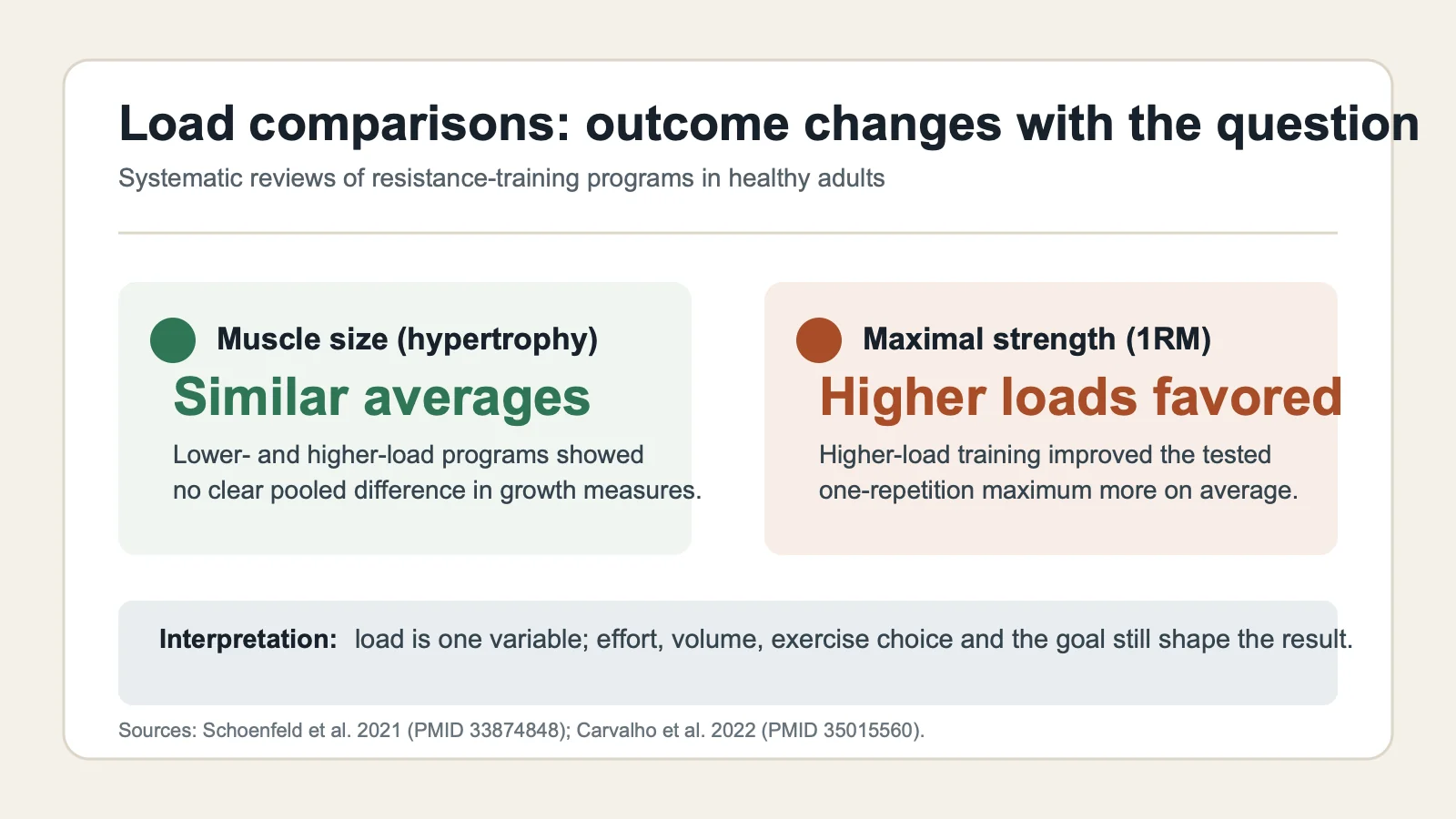
The result is not that any light weight works. It is that load sits inside a program. Studies differ in exercises, set numbers, proximity to fatigue, training experience, duration and how they measure muscle size. The findings support a range of workable loading choices; they do not produce a universal high-reps-equals-low-reps rule.
Similar growth does not mean identical training
The comparison becomes most useful when the set is demanding. In the 2017 review of low- and high-load protocols, the included comparisons required sets to reach momentary muscular failure. That is a specific condition: it does not show that casually stopping a very light set far from fatigue will create the same stimulus as a challenging heavier set.
It also does not require turning every set into a test. The 2026 American College of Sports Medicine position stand, which synthesized 137 systematic reviews of resistance training in healthy adults, found no consistent extra benefit from training to momentary fatigue for the outcomes it reviewed. The position stand supports progressive resistance training and identifies several variables that matter, including volume for hypertrophy. See the ACSM overview for its scope and limits.
In practice, a lighter set usually asks for more repetitions and more time under local fatigue. That can be a useful choice on a machine, cable or bodyweight movement where you can keep the path controlled. It can be a poor choice when the limiting factor becomes balance, grip, boredom or a position that breaks down before the target muscle has done useful work.
Heavier sets solve a different practical problem. They reach a demanding effort with fewer repetitions, but they need more setup, more rest and closer attention to technique. Neither experience automatically wins. The better option is the one that lets you repeat high-quality work in the movement you actually want to train.
Strength still favors heavier loads
Muscle size and maximal strength are related, but they are not the same outcome. A one-repetition maximum is a specific skill: it includes the ability to brace, coordinate and produce force against a heavy resistance in a particular movement. Training with heavier loads rehearses that task more closely.
That is why the same reviews can report similar average hypertrophy alongside an advantage for higher-load training in one-repetition maximum strength. If your priority is a heavier squat, bench press or deadlift, some well-managed practice with challenging loads belongs in the plan. Our guide to why heavy loads still rule when strength is the goal explains that specificity in more detail.
This does not make lighter work a distraction for a strength-focused lifter. It can add muscle-building volume, train a position with less absolute load and give a muscle more work after the main lift. The point is to give the set a job. A light leg curl can support a deadlift program; it is not a substitute for practicing the deadlift itself.
Choose the load that solves the next training problem
Start with the result you are trying to improve, then choose the exercise and load that make the work repeatable.
- For muscle growth with a familiar exercise: use a load that lets you control the full range of motion and accumulate challenging repetitions. A heavier 6–10 repetition set and a lighter 15–25 repetition set can both be reasonable if the exercise remains stable and the effort is real. You do not need to force either range because it looks more serious.
- For a maximal-strength goal: keep some heavier, technically sound work in the lift or a close variation. Add moderate or lighter work when it gives useful volume without making the following sessions worse. Heavy, Moderate or Light? shows how those jobs can coexist in one strength plan.
- For limited equipment: make the resistance harder through a stable variation, a longer controllable range of motion, additional repetitions or added load when it becomes available. Do not mistake “I can do lots of easy reps” for progressive training.
- For an accessory movement: favor the load that allows reliable setup and a controlled target area. A very heavy single on a small isolation exercise often adds less than a repeatable set with a clearer purpose.
Track the same exercise for several sessions before drawing a conclusion. If you can complete the planned work with consistent technique, a similar effort and recovery that allows you to train again, add a small amount of load or a repetition. If position quality deteriorates, reduce the demand rather than trying to prove that a particular rep range is superior.
What the evidence cannot decide for you
Meta-analyses estimate average effects from groups; they do not reveal the best dumbbell for your next set. The included studies also use different exercises, populations and measurements. Similar average hypertrophy does not guarantee identical results for every muscle, every trained lifter or every program length.
The reviews do not say that load is irrelevant. They say it is one variable among several. Exercise selection, total hard work, range of motion, progression, recovery and your goal change what a useful set looks like. A lower-load approach may be more comfortable for one person and intolerably fatiguing for another. A heavier approach may be motivating for one lifter and technically premature for someone still learning the movement.
Avoid turning this into a test of tolerance. You do not earn extra muscle for choosing the most miserable set possible. Choose a load that serves the target, keep the set controlled and build enough repeatable work across weeks to see whether it is helping.
The practical answer
Light weights can build muscle. Heavy weights can also build muscle. The best current summaries find similar average hypertrophy across a broad range of loads when training is sufficiently demanding, while heavier loads better improve the specific ability to lift heavy once.
Use that result to widen your options, not to abandon judgment. Train heavy enough to practice a heavy-lift goal, use lighter work where it helps you add controlled volume, and let the quality you can repeat determine the next adjustment.