If your goal is to get stronger, should every set be heavy? No. Challenging loads help you practice producing force in the lift you want to improve, but moderate and lighter sets can build muscle, add practice and let you do useful work without treating every set like a test. The mistake is assigning one rep range to every exercise and every training day.
This guide is for healthy adults building general barbell or gym strength. It explains how to give each set a purpose, choose a load you can control and adjust it over several sessions. It is not an individual program or a reason to lift through pain.
- What heavy, moderate and light actually describe
- Why heavy work matters for a heavy-lift goal
- Where moderate and lighter sets earn their place
- How to build and adjust a practical session
Start with the outcome, not a magic number
A repetition range is a way to organize work, not a biological switch. Five repetitions do not suddenly train “strength” while six train only “muscle.” The load, exercise, effort, range of motion, rest and total work all affect what a set asks you to do. So does the test you care about: improving a heavy squat is a more specific goal than becoming generally stronger at many tasks.
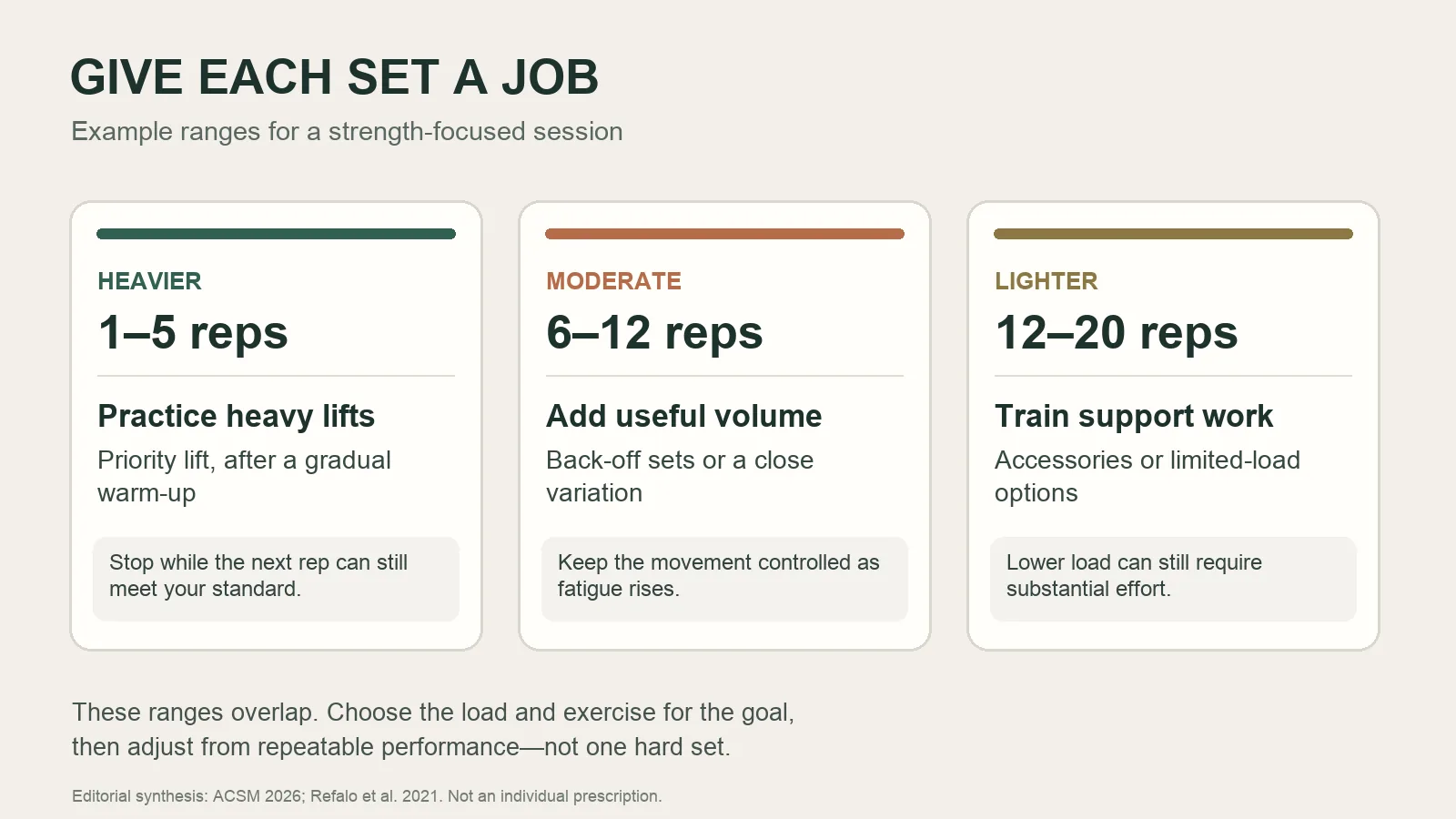
As a working shorthand, sets of about 1–5 repetitions are often heavier, 6–12 are often moderate, and 12–20 are often lighter. These bands overlap. Ten reps of a difficult split squat may feel more demanding than five reps on a machine; two people can also complete different numbers of reps at the same percentage of their one-rep maximum. Use the labels to describe the job of a set, not to certify its exact training effect.
The 2026 American College of Sports Medicine position stand synthesized 137 systematic reviews of resistance training in healthy adults. It found that many forms of resistance training improve strength. When the goal was to enhance voluntary strength, heavier loads of at least about 80% of one-repetition maximum were among the variables associated with better results. That is a useful direction, not an instruction to test a maximum before you may begin.
Use heavier sets to practice lifting heavy
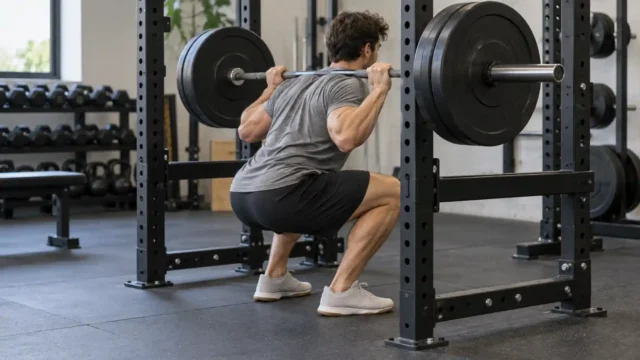
Strength has a skill component. A heavy squat asks you to brace, maintain position and coordinate force under a load that a light set does not fully reproduce. Regular exposure to challenging but controlled loads makes that task more familiar. It also gives you a clearer signal about whether your ability to lift heavy is improving.
A 2021 meta-analysis comparing higher and lower loads found similar average muscle growth across load conditions, while higher-load training produced a greater gain in one-repetition maximum strength. A separate review of volume-matched load comparisons also favored higher loads for dynamic maximal strength. Neither result means every repetition should be near maximal. It means that if the outcome is a heavy one-rep lift, you should practice lifting relatively heavy at least some of the time.
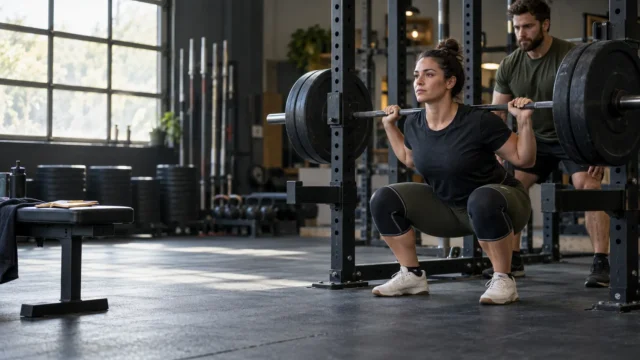
For an everyday lifter, a few clean sets of roughly 2–5 reps on a priority lift can fill that role. Choose a weight you can repeat with stable technique and enough effort to be challenging. Keep a rack’s safeties or a competent spotter where the lift calls for one. Stop the set when the next repetition is unlikely to meet your planned standard. A rep range is useful only if the repetitions remain comparable.
The point is especially relevant once basic technique is established. A beginner can get stronger with a wide range of loads while learning the movement. As the goal becomes more specific, training should include more practice that resembles the goal. Our guide to why heavy loads matter for strength explains that specificity in greater detail.
Give moderate sets the volume job
Moderate sets are often the most flexible part of a strength session. They let you rehearse the movement with less load than the heaviest work and accumulate repetitions that can support muscle growth. That added tissue can raise the longer-term potential for force, even though muscle size and a one-rep result are not the same measurement.
For example, after several heavier squat sets, you might perform 2–3 sets of 6–8 squats with a reduced load, or use a close variation such as a paused squat. The specific numbers are an illustration, not an evidence-based prescription for everyone. The purpose is to keep positions consistent while doing enough additional work to matter. If every moderate set turns into a grinding test, it is no longer serving that purpose well.
The ACSM review found that higher weekly set volume was linked to greater hypertrophy, while heavier loading favored maximal-strength outcomes. Those findings help explain why a program can use both. They do not imply that every lifter needs the same weekly number of sets or that more work always improves a lift. Our guide to useful training volume offers a way to judge whether extra work is helping or merely making the next session harder.
Use lighter work where it solves a problem
Lighter sets can train a muscle with less absolute load, introduce a movement, or let you practice a controlled range of motion. They are often a sensible choice for accessories, unfamiliar exercises and days when a heavy attempt would add little. The lower load is not automatically easy: a high-repetition set close to fatigue can be uncomfortable and demanding.
The research does not support dismissing lighter sets as useless for muscle growth. The load-comparison reviews found broadly similar average hypertrophy across higher and lower loads under the conditions studied. But a light set on a leg extension is not an interchangeable replacement for practicing a heavy squat if your test is a heavy squat. Choose it because it serves a supporting purpose, not because it is secretly the same task.
Effort needs context too. A 2024 exploratory meta-regression on proximity to failure found strength gains across a wide range of estimated repetitions in reserve. Its estimates of how close sets were to failure came from study descriptions, so they cannot identify a perfect stopping point. Combined with the 2026 ACSM review, the practical message is modest: you do not need to fail a lift on purpose to make progress. Leave enough room to preserve technique and keep the next set useful.
Build a session around one priority
Start by naming the lift or ability you want to improve. Put the most important movement early, when you can give it attention. Then assign the remaining work a supporting job. For a strength-focused squat session, one possible structure is:
- Warm up with gradually heavier, low-fatigue sets until the work weight feels familiar.
- Do 2–3 challenging sets of 2–5 controlled squats, with enough rest to maintain quality.
- Add 2 sets of 6–8 squats or a close variation at a reduced load if your technique and recovery support it.
- Finish with 1–2 lighter accessory sets for a specific muscle or position you want to train.
This is a planning example for a healthy adult, not a universal loading protocol. A new lifter may spend more time with moderate weights learning the movement. Someone returning after a break may do fewer total sets. A lifter with limited equipment can use a harder variation, a wider range of motion they can control, or more repetitions rather than chasing a load the equipment cannot provide. Your overall program matters more than a perfect-looking set of numbers on one day.
Write the purpose beside each exercise: heavy practice, additional volume or lower-load support. If two exercises do the same job while recovery is tight, one may be enough.
Progress by the quality you can repeat
Pick a rep range and hold the exercise steady long enough to compare sessions. When you complete the planned sets with consistent technique and a similar effort level across several exposures, add a small amount of load or a repetition. If your positions deteriorate or the next session suffers, repeat the load, reduce a set, or make the exercise easier. This is more informative than changing the entire program after one unusually good or bad day.
The choice also changes by exercise. A heavy single may be useful in a well-planned squat cycle, while a heavy single on a small isolation exercise usually offers little that a controlled moderate set could not. Use the lowest rep ranges where they match the goal and you can manage the setup. Use moderate and lighter ranges where they let you accumulate work safely and consistently.
If pain changes your movement, or you have unexplained weakness, dizziness or a recent injury, stop treating this as a rep-range problem and seek appropriate professional assessment. A general article cannot determine what loading is suitable for an individual medical situation.
Conclusion
There is no winning rep range for every set. Heavier work helps you practice a heavy-lift goal; moderate work adds useful volume; lighter work can support muscle, technique and exercise options with less absolute load. The best mix is the one that gives each set a clear job and lets you return for the next productive session.
Start with the movement you want to improve. Include some challenging, well-controlled practice in that movement, then add only the supporting work you can recover from and track. Let repeated performance guide the next adjustment.