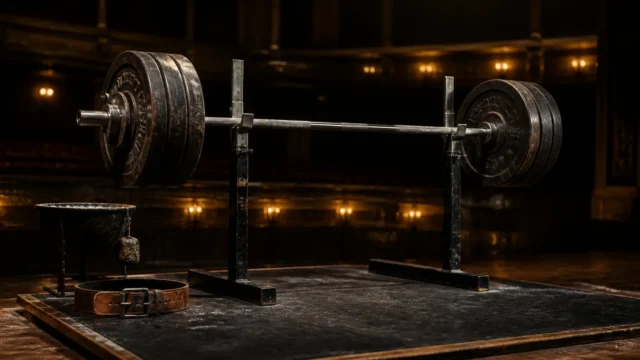

Doug Hepburn’s name can sound like a collection of old strength myths: a Canadian lifter with a club foot, a world title, huge presses and stories of public feats that seem designed for a comic book. The documented record is remarkable enough without adding to it.
In 1953, Hepburn won the heavyweight division at the World Weightlifting Championships in Stockholm. The following year, in his hometown of Vancouver, he won heavyweight gold at the British Empire Games and set four Games records. He was also a major public figure in an era when weightlifting, strongman exhibitions and the emerging culture of strength magazines were often part of the same story.
This profile uses hall-of-fame and Olympic material to keep the achievement in view. It does not present the editorial illustration as a photograph of Hepburn, and it does not turn his lifts into a template for another person’s training.
- A difficult beginning and a weightlifting path
- The 1953 world title
- Why Vancouver made the story national
- How to read a mid-century strength legend
A Canadian lifter with an unusual route to the platform
Hepburn grew up in Vancouver and began lifting as a teenager at a local YMCA. The Canada’s Sports Hall of Fame profile records that he was born with a club foot and underwent surgery that left one leg affected. Its biography also notes a Canadian press record of 300 pounds in 1948, when he was still largely unknown beyond his region.
That background is part of the biography, but it should not be reduced to a motivational slogan. A childhood disability does not automatically explain a sporting career, and Hepburn’s achievements came through years of competition, training and a particular mid-century lifting environment. The useful historical fact is that he entered a sport built around the press, snatch and clean and jerk, then made himself impossible for the rest of the weightlifting world to ignore.
The sport he entered is not identical to modern powerlifting. Olympic weightlifting at the time still used three competition lifts, including the press, while modern powerlifting is organized around the squat, bench press and deadlift. The big three explain the language of the latter sport; Hepburn’s results belong to a different competitive test and should be read that way.
Stockholm, 1953: a title with lasting weight
At the 1953 World Weightlifting Championships in Stockholm, Hepburn won the heavyweight title with a 1,030-pound total. The Canadian Olympic Hall of Fame describes him as the first and only Canadian to win the world heavyweight title, an achievement that brought a formerly regional athlete into national attention.
The score matters because it was a competition total. It was not one exhibition lift or a claimed gym best. Hepburn had to perform across the three judged lifts of the day, under the event’s rules, against the leading heavyweight field. The Conacher-Rosenfeld award archive notes that the victory handed John Davis his first competition defeat since 1938.
Hepburn was also known for bench pressing milestones. The Olympic Hall of Fame says he became the first man to bench press 400, 450 and 500 pounds during the 1950s. Those feats helped make him a public strongman as well as a competitive weightlifter. They should not be treated as interchangeable with his world-championship result: the bench press was not part of that weightlifting total.

A hometown Games and a national profile
Vancouver hosted the 1954 British Empire Games, and Hepburn won heavyweight gold there. The Canadian Olympic Hall of Fame records four heavyweight Games records: 370 pounds in the press, 300 in the snatch, 370 in the jerk and 1,040 for the total. The result was a home-city moment that turned a world champion into a larger Canadian sports figure.
Recognition followed. Hall-of-fame material lists the Lou Marsh Trophy in 1953 and British Columbia’s Man of the Year recognition in 1954. These awards do not add kilograms to a total, but they reveal how visible strength sport had become around Hepburn. His exhibitions and unusual feats gave newspapers and audiences a way to see strength outside a formal meet, while the medals gave that public image a competitive foundation.
The details also show why historical claims need sources. A total, a record or a first-man-to-lift claim may be quoted differently in pounds and kilograms, or attached to an exhibition rather than a sanctioned event. The BC Sports Hall of Fame’s account of his route to Stockholm notes that Hepburn had to raise funds to travel after Canadian authorities declined to send athletes to the 1953 worlds. That context makes the win more interesting than a bare number: the title was achieved after the trip itself became part of the challenge.
What his story can still teach
Hepburn’s legacy is not a program. The equipment, event rules, medical understanding and training culture of the 1950s were not today’s. A reader cannot learn a safe load, a technique standard or a personal bodyweight goal from copying an old record.
The more durable lesson is about context. Great performances become clearer when we know the event, the lifts, the total and the source. That is true for weightlifting history and for powerlifting history. The question of what an approved competition item actually means is a modern reminder that rules and specifications remain part of how a result is understood.
Hepburn also reminds us that strength sport has always had two connected audiences. One is the platform, where results are judged under rules. The other is the public, drawn to feats that make the sport legible and exciting. He excelled in both spaces, but the competition record is what lets the legend remain accountable.
Conclusion
Doug Hepburn helped shape the public image of modern strength because he paired extraordinary exhibition appeal with documented competitive results. His 1953 world heavyweight title and 1954 Vancouver gold made him a Canadian sporting icon, while his presses and bench feats made the story travel beyond a weightlifting hall.
Read the legend through its platform record: three lifts, a named event, a documented total and a specific sporting era. That does not make Hepburn’s career less dramatic. It makes the achievement easier to appreciate honestly.